Jaco van der Laan
Active filters:Data Modeling ×Clear all

Your Data Model Is the Semantic Layer: Why Clean Metadata Beats AI Wrappers

BIRD Bench research reveals that well-structured data models achieve 95% SQL generation accuracy — without semantic layer tools BIRD Bench research reveals that well-structured data models achieve 95% SQL generation accuracy — without semantic layer tools MotherDuck’s analysis of the BIRD Benchmark — a rigorous SQL generation test — reveals a counterintuitive truth: “AI-ready data simply means a clean data model. Well-named tables, straightforward joins, and clear column names are enough for frontier LLMs to...
Read more

SCD2 Is Not Enough (Part 1) — The Bi-Temporal Foundation — From Snapshots to Deterministic…

Engineering Time in Data Platforms — A 3-Part Series From Snapshots to Deterministic Timelines: Engineering Time in Data Platforms Most data platforms believe they are historized. They are not. They store history — but they do not engineer time. In this three-part MDDE deep dive, we will move from: Basic SCD2 storage to bi-temporal standardization (this article) Timeline compression and deterministic integration (Part 2) Valuation reconstruction with impact-driven refresh (Part 3) This first article lays...
Read more

SCD2 Is Not Enough (Part 2) — Timeline Compression and Deterministic Integration

Series Context Merging Multiple SCD2 Timelines Without Explosion: ASOF Sampling, Gaps-and-Islands, and PIT Tables In Part 1, we standardized heterogeneous sources into controlled bi-temporal SCD2. Now comes the hard part. Once everything is SCD2… Joining them becomes dangerous. Each SCD2 table has its own change points. Consider a simple 360-degree customer view requiring three SCD2 sources: Combined timeline: 9 change points from just 3 sources with 3 changes each. Each change fragments the timeline. Add...
Read more

Import Enterprise Models to Modern Metadata Workspaces

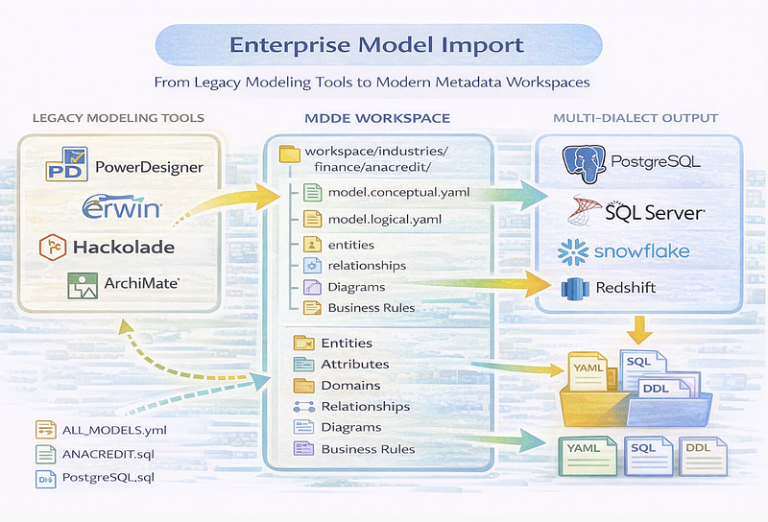
From PowerDesigner, erwin, Hackolade and ArchiMate to Modern Metadata Workspaces Most enterprise data platforms do not start with dbt. They start with: PowerDesigner erwin Data Modeler ArchiMate repositories SSDT database projects Industry-specific capability models These tools represent years — sometimes decades — of modeling investment. But they often suffer from the same problem: The model lives in one place. The implementation lives somewhere else. And over time, they drift apart. MDDE addresses this gap by...
Read more

🧩 Designing Layered Data Models with Inbound, Intermediate, and Outbound Entities

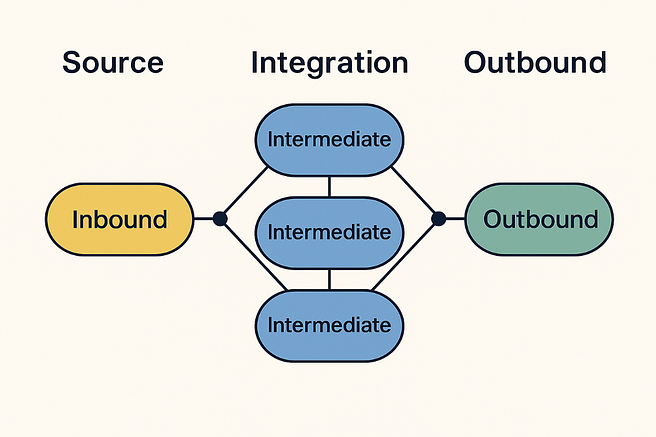
A Core Design Rule in Model-Driven Data Engineering In Model-Driven Data Engineering (MDDE), data models aren’t static diagrams — they are semantic building blocks that can be connected, versioned, validated, and automated. Every model has its own role within the data platform, but what’s often forgotten is that models also need internal structure to remain maintainable as they evolve. That’s where the Inbound → Intermediate → Outbound principle comes in. It’s a simple but powerful design rule that isolates change, simplifies mappings,...
Read more

💍 The Marriage of Modeling Structure and Movement

Where Data Modelers and Data Engineers Finally Say “I Do” “Data modeling describes what data is_. Data movement modeling describes how data_ becomes what it is.” For decades, these two worlds lived side by side — data modelers defining the form, and data engineers shaping the flow. Each spoke a different dialect of metadata. And somewhere between the ERDs and the DAGs, the truth of the data got lost. But times are changing. The modern data world is witnessing a marriage — between modelers and engineers,...
Read more

From Drawing to Generation — How Mermaid, Draw.io, PlantUML, GraphViz, and yEd Redefine Data Modeling Visualization

💡 Why modern metadata-driven teams no longer draw diagrams — they generate them. In classic data modeling, diagrams were the main artifact — we used tools like PowerDesigner or ERwin to draw boxes and lines, define relationships, and label attributes. The visuals were the models. Today, that relationship has flipped. In metadata-driven environments, the model comes first, and the diagram is a view — automatically generated from the underlying metadata. This shift — from drawing to generating — may...
Read more

Fact-Based Modeling Meets Metadata-as-Code — Can FCO-IM Be the Semantic Backbone of Modern Data Architecture?

💡 How the principles of Fact-Based Modeling could strengthen the next generation of metadata-driven and AI-assisted data platforms. Over the past months, much of the discussion around data modeling has focused on tools — how legacy suites compare to Git-native environments, and how AI is reshaping the way we create and maintain models. But a comment from Marco Wobben (author and long-time advocate of Fact-Based Modeling and FCO-IM) reminded me that, before any tool or automation, there must be semantic...
Read more

The Missing Piece in Metadata-Driven Data Modeling: Integration

💡 We have open formats, automation, and AI — but not yet one coherent ecosystem. In the last few years, the data modeling world has made incredible progress. We’ve moved from proprietary repositories to open metadata, from ==static diagrams== ==to== ==version-controlled YAM==L, and from manual governance to automated validation. But as one reader recently pointed out in response to my article Do We Still Need Traditional Data Modeling Tools?: “There’s no integrated tool to gather these open data formats into a coherent single experience.” And...
Read more

Are Legacy Data Modeling Tools Catching Up to Metadata-as-Code?

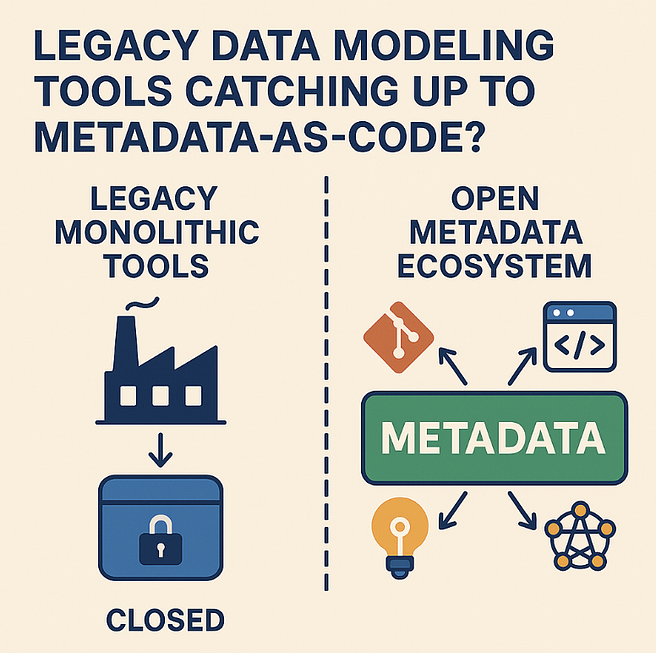
💡 [[Legacy modeling tools]] are modernizing fast — but can they really compete with open, Git-native, AI-assisted metadata ecosystems? When I asked whether we still need traditional data modeling tools, I expected mostly practitioner reactions. What surprised me was how strongly tool vendors themselves joined the conversation. Executives from [[SqlDBM]], [[Hackolade]], Ellie.ai, and even erwin Data Modeler (erwin DM) responded — each confirming that the industry is moving toward metadata-driven, Git-integrated, and AI-assisted modeling. That’s a positive sign. It shows that the discussion is...
Read more
1 2 3 … 14