Work & proof
Proof, not slides.
Two kinds of evidence: a career building reliable data systems for regulated institutions, and a personal AI system I run on the same architecture every day.
Work & proof
Two kinds of evidence: a career building reliable data systems for regulated institutions, and a personal AI system I run on the same architecture every day.
Flagship project
As Lead Modeller, I led the design of a new, model-driven data warehouse for de Volksbank’s brands (ASN Bank, SNS, RegioBank, BLG Wonen). It became one of the most influential MDDE implementations in the Dutch data community — and the proving ground for the method I now bring to other teams.
Separate what the data means (functional modeling — business semantics, relationships) from how it runs (technical engineering). Merge structure (the model) and movement (the transformations) into one unified metadata framework.
Rules and models are defined as structured metadata (entity-first), not hand-coded pipelines. The platform reads those models and generates database-agnostic transformations, data-quality tests and documentation — consistently, across the bank.
Business stakeholders could understand and trust the data because physical designs are regenerated from logical models. Lineage and historization are built in. Manual pipeline work became architecture-as-code.
Agility and independence from any single database technology, far fewer hand-coding errors, and governance that’s inherent rather than bolted on. Delivered with continuous user involvement and short cycles — not waterfall.
I invited CrossBreeze (Harmen Wessels & Willem Otten), whom I’d met on the Rabobank project, to help build the framework — and brought the wider community along through the MDDE meetup and Roelant Vos’s training. The trade press covered it (see below). This is the work the rest of my approach is built on.
The live case study
Before I bring an approach to a client, I prove it on my own work and life. This isn’t a diagram drawn for a pitch — it’s the instrument I use daily.
Mail, calendar, reading, finance, travel — wired in through typed, governed access, landing in a central store.
A rules layer derives structure; plausibility checks validate it. On a mismatch, it flags — it never guesses.
A publishing layer pushes out — tasks, summaries, exports — one direction, source of truth intact.
The strongest demonstration of an approach is someone who has applied it to their own life. When I help a team build their foundation, I’m transferring something that already works.
Signature engagement
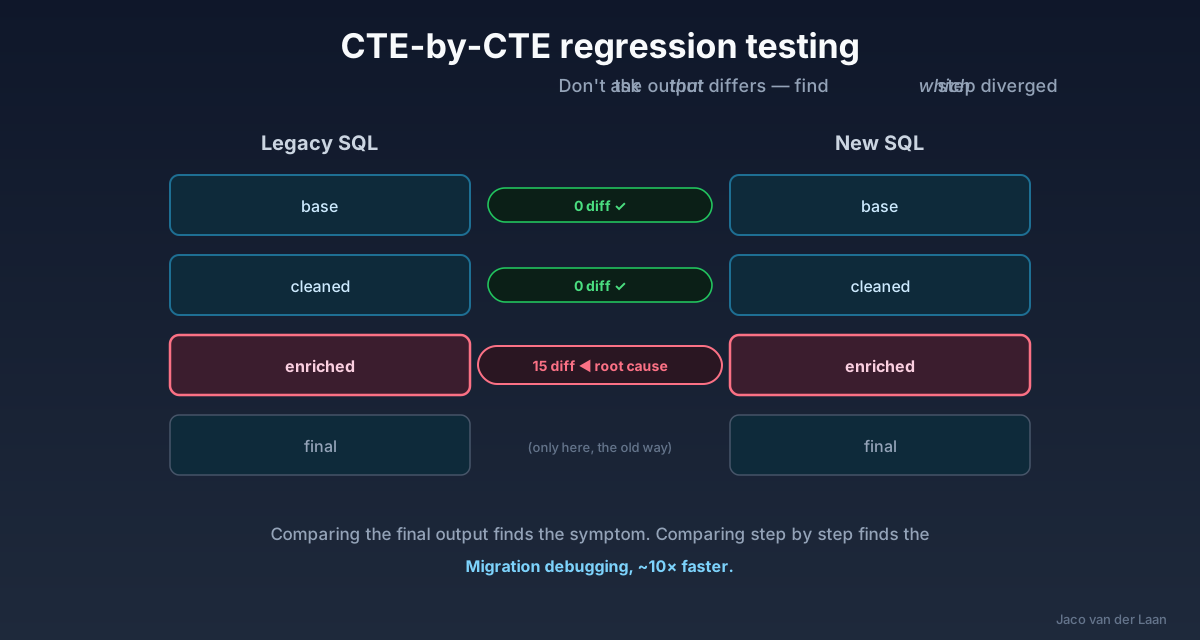
My largest recent delivery: migrating complex legacy SQL to a governed, bi-temporal integration layer for a bank’s Risk & Finance data platform. The hard part isn’t rewriting the SQL — it’s proving the new pipeline produces exactly the same data as the old one. So I built the tooling to prove it.
Comparing only the final output tells you that something differs across 50,000 rows. Comparing query step by step tells you which transformation introduced it — root cause found, not just symptom. Migration debugging, ~10× faster.
Explode a SQL file into an interactive notebook where each step is profiled and checked — PII detection, SCD2/temporal patterns, lineage, data contracts — before a single query runs. SQL becomes self-documenting and self-validating, then exports back to deployable SQL.
Parse legacy SQL into metadata, deterministically rebuild clean SQL that fits the target architecture, prove equivalence with automated regression — then let AI safely optimize the rest. Non-deterministic SQL caught before it corrupts the validation.
This is where the method earned its stripes: systematic validation and large-scale SQL analysis turned migration from a risky rewrite into something verifiable. The same discipline now underpins how I make AI output reliable. More in the writing →
Track record
Model-driven data engineering, business-friendly data modeling, and data governance — delivered where reliability is not optional.
Data-platform and governance work at regulated institutions, where “in control” is a requirement, not a slogan. This is where the discipline behind the method comes from.
A career built on the premise that structure and method beat ad-hoc cleverness — in data modeling first, now applied to the AI layer.
Long-form thinking on data architecture, quality, and the structure-beats-magic approach. See the writing →
Community
Beyond delivery and writing, I bring the community together. I organise the Model-Driven Data Engineering (MDDE) meetup — rated 4.6★ across 52 reviews — to share best practices, lessons learned and live demos with fellow modeling and automation enthusiasts.
At de Volksbank, Utrecht · Dec 2019 · 90+ attendees. A live demo of generating physical mappings from logical models — and parsing SQL back into the model for full lineage.
With Roelant Vos · Utrecht · Nov 2019. Bringing a leading voice in data-engine thinking to the community.

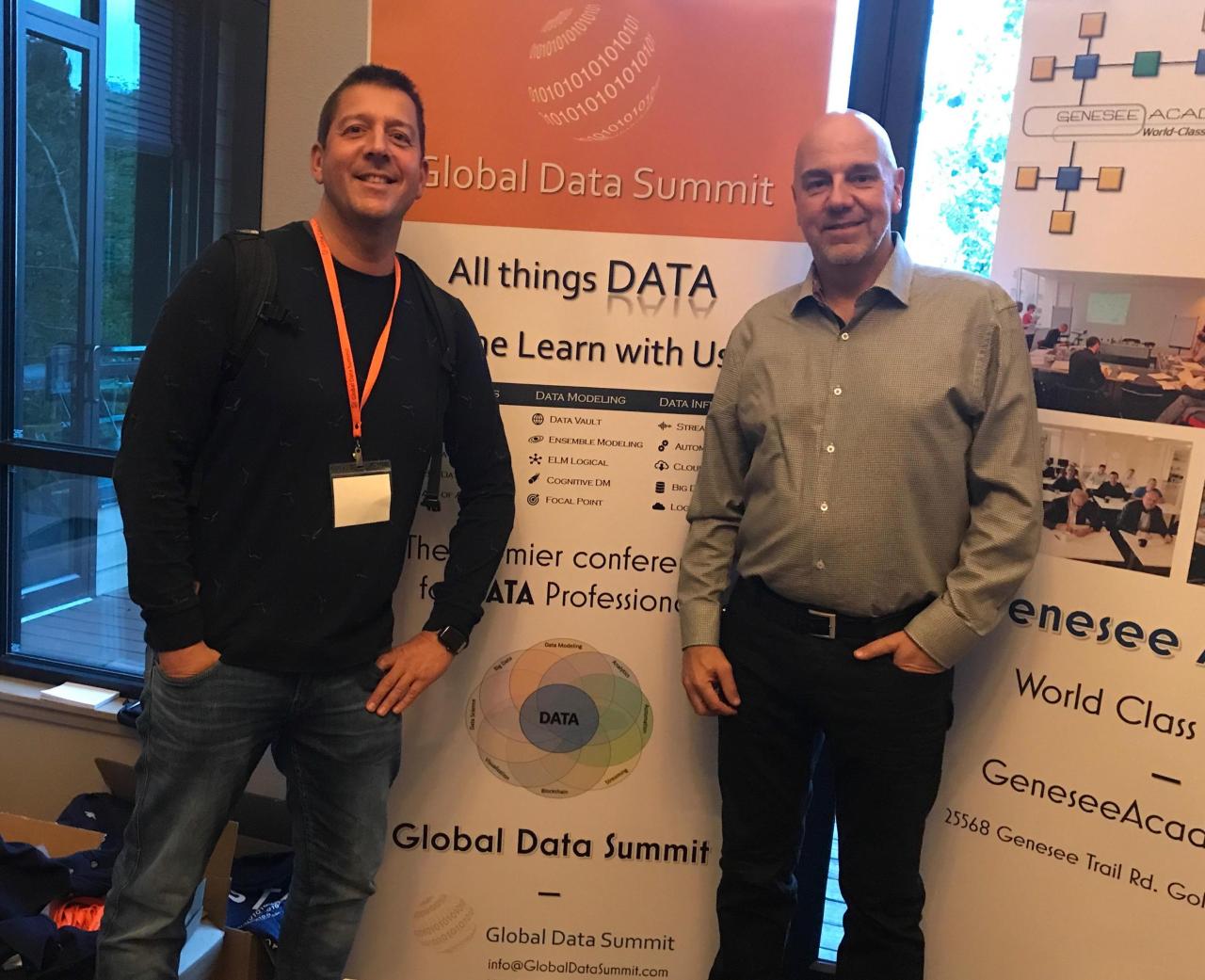
I’m an active member of the Dutch Data ZZP Netwerk, where I was invited to share my success story applying AI in practice — and I’ve spoken at the Global Data Summit (Denver) presenting a customer case.
Staying sharp is part of the job. I keep learning at the source — Genesee Academy’s Advanced Data Vault, Alec Sharp’s modeling masterclass, the Anthropic AI courses — and bring what’s genuinely new back into how I work. Curiosity over credentials.
And I’m just getting started — more MDDE meetups are on the way. Want to host or speak? Let’s talk →
In the press
When de Volksbank built its new model-driven data warehouse for Finance & Risk, the trade press covered it — and named me Lead Modeller.
banken.nl, December 2019 — on the bank’s model-driven approach: “With our model-driven approach, we can quickly implement adjustments. Data flows are created and maintained simply and clearly.” Jurriaan Groot (Architect Finance Innovation) & Jaco van der Laan (Lead Modeller).
Let’s talk about what you’re building and whether I’m the right person to help.
Start a conversation