Jaco van der Laan
Active filters:Data Architecture ×Clear all

Why Data Architects Should Pursue the Claude Certified Architect Credential

How AI certification maps to data modeling challenges — and why the timing is perfect How AI certification maps to data modeling challenges — and why the timing is perfect When Anthropic launched the Claude Certified Architect (CCA) Foundations credential in March 2026, I didn’t expect it to feel so familiar. After 15 years in data architecture — designing Data Vaults, building dimensional models, and wrestling with metadata management — the exam domains read like...
Read more

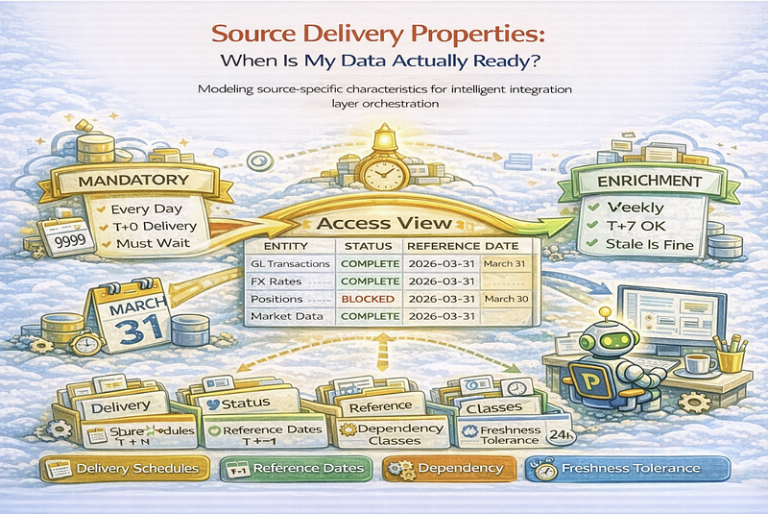
Source Delivery Properties: When Is My Data Actually Ready?

Modeling source-specific characteristics for intelligent integration layer orchestration Modeling source-specific characteristics for intelligent integration layer orchestration It’s the last working day of the month. Your finance team needs the end-of-month snapshot processed by 6 AM. But here’s the challenge: GL Transactions delivers daily, including weekends FX Rates only delivers on working days Positions delivers weekdays, but Friday’s file contains Thursday’s data Market Data is optional enrichment — nice to have, but don’t wait for it...
Read more

Where Should Data Documentation Live? A Modern Architecture for AI-Enabled Teams

Moving beyond Confluence sprawl to a unified, AI-consumable documentation strategy Moving beyond Confluence sprawl to a unified, AI-consumable documentation strategy Every data team I’ve worked with has the same problem: documentation is everywhere and nowhere. Confluence : Data dictionaries, architecture decisions, meeting notes SharePoint : Business glossaries, compliance documents, data contracts Local drives : ERDs, design documents, “that one Excel with all the mapping rules” Wiki : Runbooks, troubleshooting guides, onboarding docs Code repos :...
Read more

Your Data Model Is the Semantic Layer: Why Clean Metadata Beats AI Wrappers

BIRD Bench research reveals that well-structured data models achieve 95% SQL generation accuracy — without semantic layer tools BIRD Bench research reveals that well-structured data models achieve 95% SQL generation accuracy — without semantic layer tools MotherDuck’s analysis of the BIRD Benchmark — a rigorous SQL generation test — reveals a counterintuitive truth: “AI-ready data simply means a clean data model. Well-named tables, straightforward joins, and clear column names are enough for frontier LLMs to...
Read more

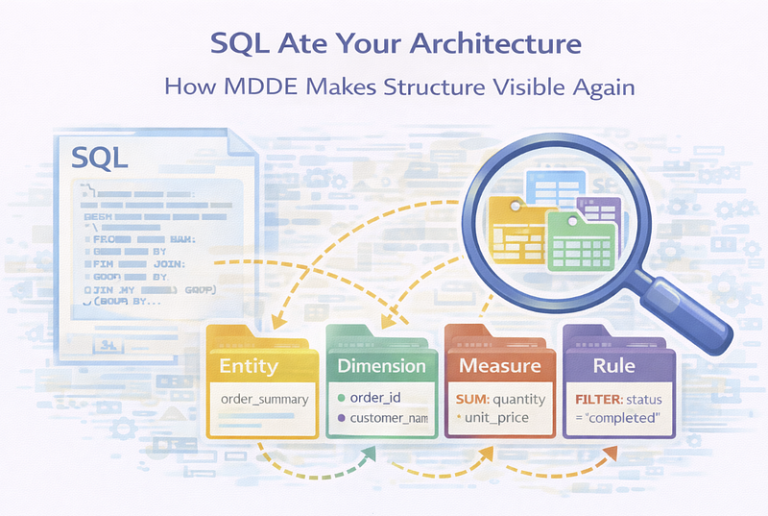
SQL Ate Your Architecture — How MDDE Makes Structure Visible Again

The Architecture Absorption Problem Your data platform works. Queries run. Dashboards refresh. Pipelines complete. But ask a simple question: What does this table represent conceptually? Why is this calculation defined this way? What breaks if I change this join? And the answer is often: “Read the SQL.” That’s not architecture. That’s archaeology. Early in a project, architecture is visible. You have: Source systems Transformations Clear data flows Documented intent It looks something like this: Source...
Read more

Making Data Architecture Part of CI — How MDDE turns architectural intent into continuous…

Architecture usually fades after delivery Most data architectures are strongest at the start of a project. Decisions are discussed. Diagrams are drawn. Guidelines are agreed upon. Then delivery accelerates — and architecture slowly fades into the background. New queries appear. Exceptions accumulate. Rules become optional. The problem is not intent. It’s the lack of continuous enforcement. MDDE addresses this by treating architecture as something that runs — not something that is reviewed once. This article...
Read more

From Discussion to Decision — How RFCs and ADRs Work Together in Practice

Good architecture needs two things that often pull in opposite directions: space to think and stability to build. Good architecture needs two things that often pull in opposite directions: space to think and stability to build. When there is only space, architecture never settles. When there is only stability, architecture hardens too early. Over the past weeks, while writing about Architectural Decision Records (ADRs), several thoughtful responses highlighted the complementary role of Requests for Comments...
Read more

Architectural Decision Records for Data Platforms

A practical way to make architectural intent explicit, reviewable, and durable. A practical way to make architectural intent explicit, reviewable, and durable. Data architectures accumulate decisions. Some are explicit. Most are not. Over time, this leads to familiar questions: Why is this modeled this way? Why do we parse SQL instead of treating it as text? Why is this rule enforced here but not elsewhere? Why is this query generated rather than handwritten? Without a...
Read more

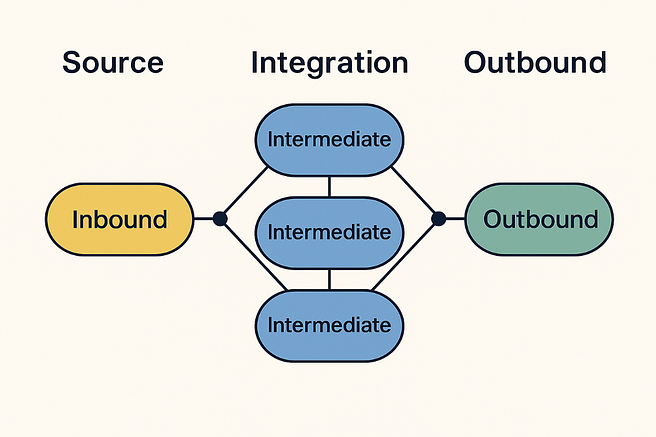
🧩 Designing Layered Data Models with Inbound, Intermediate, and Outbound Entities

A Core Design Rule in Model-Driven Data Engineering In Model-Driven Data Engineering (MDDE), data models aren’t static diagrams — they are semantic building blocks that can be connected, versioned, validated, and automated. Every model has its own role within the data platform, but what’s often forgotten is that models also need internal structure to remain maintainable as they evolve. That’s where the Inbound → Intermediate → Outbound principle comes in. It’s a simple but powerful design rule that isolates change, simplifies mappings,...
Read more

🧱 The Metadata-Driven Anti-Corruption Layer

Translating Legacy Semantics into the Common Integration Layer Modernization isn’t about rewriting code — it’s about restoring meaning. Over time, legacy systems drift away from the business concepts they were meant to represent. The data still flows, but the semantics erode. What once described your business now merely encodes your past. In his talk Legacy Architecture Migration Patterns, Nick Tune captured this perfectly: “Modernization is a chance for semantic convergence.” That’s where the Anti-Corruption Layer (ACL) comes in — not...
Read more
1 2 3 … 13