Translating Legacy Semantics into the Common Integration Layer
Summary
Modernization isn’t about rewriting code — it’s about restoring meaning.
Over time, legacy systems drift away from the business concepts they were meant to represent. The data still flows, but the semantics erode. What once described your business now merely encodes your past.
In his talk Legacy Architecture Migration Patterns, Nick Tune captured this perfectly: “Modernization is a chance for semantic convergence.”
That’s where the Anti-Corruption Layer (ACL) comes in — not as an integration pattern buried in code, but as a metadata-driven translation layer that keeps your Common Integration Layer clean while legacy continues to run in parallel.
🧩 1. From Crystallized Drift to Semantic Alignment
Legacy systems accumulate assumptions. They’re hard to change, so their internal model becomes crystallized semantic drift — the gap between how the system structures data and how the business actually thinks.
When teams modernize, the temptation is to replicate the legacy schema in new technology. But that’s not modernization — that’s migration without transformation.
A metadata-driven architecture approaches this differently:
- Define your Common Integration Layer (CIL) — a harmonized model that reflects current business concepts.
- Use metadata mappings to translate from legacy schemas into this layer.
- Let automation generate code, lineage, and documentation directly from those mappings.
The ACL is the semantic firewall between how legacy was built and how your modern data platform should mean.
🔄 2. The Anti-Corruption Layer Reimagined
In Domain-Driven Design (DDD), the ACL protects a clean domain model from external ones. It’s the translation boundary that allows internal semantics to remain pure while external models change freely.
In a metadata-driven architecture, this boundary becomes declarative rather than imperative:
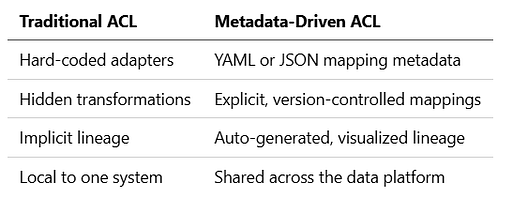
By externalizing these definitions, the ACL stops being a technical detail and becomes a governed artifact — version-controlled, testable, and explainable.
🧠 3. Bubbles, Boundaries, and Controlled Translation
Nick Tune’s Bubble Context pattern illustrates how modernization can evolve safely without a “big bang.”
There are two key variations:
- The Bubble: uses the legacy database directly (no sync risk).
- The Autonomous Bubble: owns its data and synchronizes via domain events.
In both cases, the Anti-Corruption Layer is the translator that makes coexistence possible. It maps old concepts to new ones, filters inconsistent data, and enforces modern validation rules.
In a metadata-driven implementation:
- Mappings are stored as metadata, not embedded in ETL logic.
- Each mapping defines a semantic bridge between legacy and the Common Integration Layer.
- This bridge is visible in lineage graphs — not buried in SQL or pipeline scripts.
⚙️ 4. Metadata as the Translation Contract
Metadata turns the ACL into a semantic contract between systems. Each mapping, validation rule, and event transformation becomes:
- Machine-readable, so it can generate SQL, dbt models, or Spark code.
- Human-readable, so business users can trace and verify meaning.
- Governed, so changes are reviewed like source code.
This contract prevents what Nick Tune calls “legacy leakage” — when old identifiers, codes, or assumptions silently infect your new platform.
When mappings are explicit:
- Data lineage becomes transparent.
- Impact analysis becomes automated.
- Validation becomes enforceable.
The ACL ensures your CIL remains a clean, stable foundation.
🌱 5. Modernization as a Knowledge-Adaptive Process
Once the ACL is metadata-driven, it becomes the foundation for knowledge-adaptive architecture. By combining metadata relationships with AI and automation, your platform can:
- Detect semantic drift automatically.
- Suggest mappings between legacy and CIL attributes.
- Validate alignment across conceptual, logical, and physical layers.
The ACL evolves from a static integration layer into a learning translation system — continuously refining the organization’s shared understanding of its data.
🧾 6. Conclusion: Clean Layers, Aligned Meaning
Every modernization project faces the same challenge:
How do we evolve without inheriting yesterday’s confusion?
The answer lies in the Anti-Corruption Layer — reimagined for the metadata age.
🔹Instead of hiding translation logic in scripts, we make it visible, testable, and reusable.
🔹Instead of chasing semantic drift, we create convergence by design.
The ACL ensures your Common Integration Layer remains clean, governed, and adaptable — the single source of shared semantics between legacy and modern systems.
It’s how modernization becomes a process of semantic alignment, not endless migration.
A metadata-driven Anti-Corruption Layer turns modernization into a living knowledge system — where every mapping is not just code, but a statement of shared meaning.
🔧 Coming Next — Implementing the Anti-Corruption Layer in Practice
In the next article, we’ll move from concept to code.
You’ll see how to actually build a metadata-driven Anti-Corruption Layer —
defining mappings, generating transformations automatically, validating data, and visualizing lineage.
If this article defined the why, the next one will show the how.
🧩 Metadata-Driven Architecture Series
1️⃣ Scaling Metadata-Driven Data Modeling — From Conceptual to Physical with Git and YAML
2️⃣ Generating Logical Models Automatically from Conceptual Metadata
3️⃣ The Common Integration Layer: Building a Harmonized Semantic Backbone (coming soon)
4️⃣ The Metadata-Driven Anti-Corruption Layer 👈
5️⃣ Implementing the Anti-Corruption Layer in Practice (coming soon)