How metadata, draw.io, and VSCode turn data models into living, executable assets
Summary
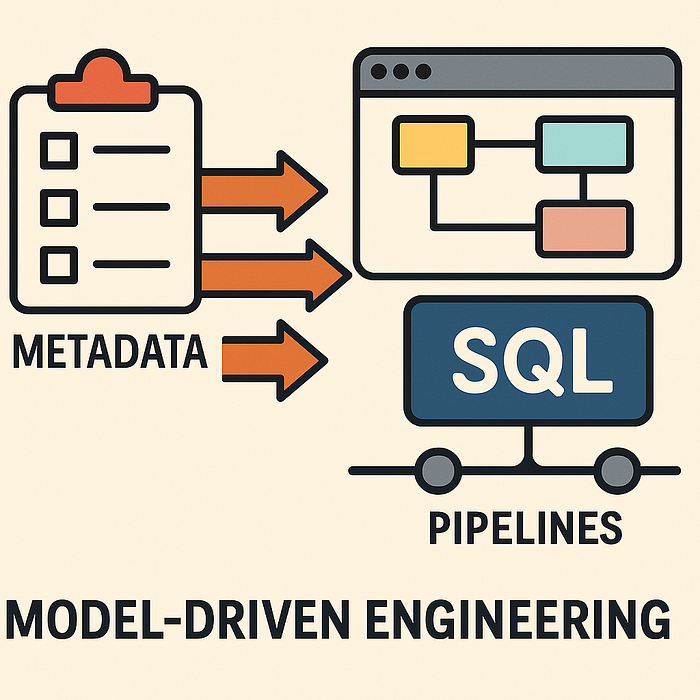
Model-Driven Engineering (MDE) is about shifting from coding to modeling — making the model the system.
Instead of handcrafting every SQL transformation, we treat metadata and diagrams as sources of truth that drive automation.
In this article, I show how we apply MDE in practice using draw.io, VSCode, and metadata-driven pipelines, and how this connects directly to the other pillars of our methodology.
From Coding to Modeling
The move from coding to modeling reflects a broader industry trend: stop reinventing transformations, and let models guide execution.
👉 I explored this shift in From Coding to Modeling: The Rise of Model-Driven Data Engineering.
👉 And described how we built this approach at de Volksbank in From Whiteboards to Working Models: How We Built a Model-Driven Data Warehouse at de Volksbank with CrossBreeze.
Metadata as the Engine
At the heart of MDE is metadata — business definitions, mappings, and lineage stored in a structured, queryable form.
- Logical and physical models can be expressed in YAML, JSON, or database tables.
- Mappings capture how business concepts translate into SQL.
- This metadata becomes the blueprint for automation.
👉 I wrote about this in Metadata as Data — Controlling and Governing Data Models.
Diagrams as Interfaces
Metadata can feel abstract — which is why visualization matters. We use draw.io diagrams as both:
- Generated views of metadata (ERDs, mapping diagrams).
- Editable artifacts that can be parsed back into metadata.
👉 I explained this workflow in Parsing draw.io Diagrams Back into Metadata and Automating draw.io Diagram Generation from Metadata.
This creates a two-way bridge: business-friendly visuals on the front end, metadata-driven engineering under the hood.
VSCode as the Workbench
For engineers, VSCode becomes the cockpit:
- Organizing diagrams and metadata (Organizing Diagrams and Metadata in VSCode).
- Validating and versioning metadata.
- Integrating with GitHub and automation pipelines.
This makes modeling a team sport — collaborative, version-controlled, and automated.
Execution: From Models to SQL
The final step is generation:
- Mapping metadata → SQL transformations.
- Logical LDMs → physical models.
- Exposure views → consumer-ready schemas.
👉 A practical example is in Business-Friendly Mapping Meets dbt: Virtualizing Logical Building Blocks into SQL.
By automating generation, we shift human effort from writing code to designing meaning.
MDE in the Four Pillars Framework
- Business-Oriented LDM (Pillar 1) provides the meaning.
- Model-Driven Engineering (Pillar 2) turns meaning into executable pipelines.
- Business-Friendly Mapping (Pillar 3) ensures transparency of transformations.
- UDMs (Pillar 4) accelerate delivery with reusable patterns.
Together, these make MDE not just a toolset but a way of working.
Where We’re Headed
Next, we’ll explore Business-Friendly Mapping in detail — showing how mapping becomes a collaboration tool between business and IT, rather than a hidden technical artifact.
Key Takeaways
- Model-Driven Engineering shifts the focus from coding to modeling.
- Metadata is the blueprint; diagrams and VSCode are the interfaces.
- Generation turns models into executable SQL and pipelines.
- MDE anchors the four pillars by making them practical and automated.
✍️ This article is Part 5 of the series “Why Elephants Matter in Data Modeling”, where I explore how John Giles’ ideas, Len Silverston’s Universal Data Models, and my own methodology come together in a business-first, model-driven approach.
Series overview
- Part 1: Why Elephants Matter in Data Modeling
- Part 2: Patterns + Universals: The Foundations of Reuse
- Part 3: From Ontology to Enterprise View
- Part 4: Borrowing from Data Vault Without Building One
- Part 5: Model-Driven Engineering in Practice
- Part 6: Business-Friendly Mapping as a Collaboration Tool
- Part 7: The Four Pillars of Business-Centered Data Architecture