How John Giles’ enterprise ontology connects to business-oriented logical data models
Summary
John Giles emphasized that enterprise modeling must begin with an enterprise ontology — a high-level view of essential business concepts and their relationships. This aligns perfectly with the idea of a Business-Oriented Logical Data Model (LDM): a model that reflects the business’s language and structures before any technical implementation. In this article, I explore how Giles’ ontology concept fits into modern data practices and why it remains a cornerstone of my four-pillar methodology.
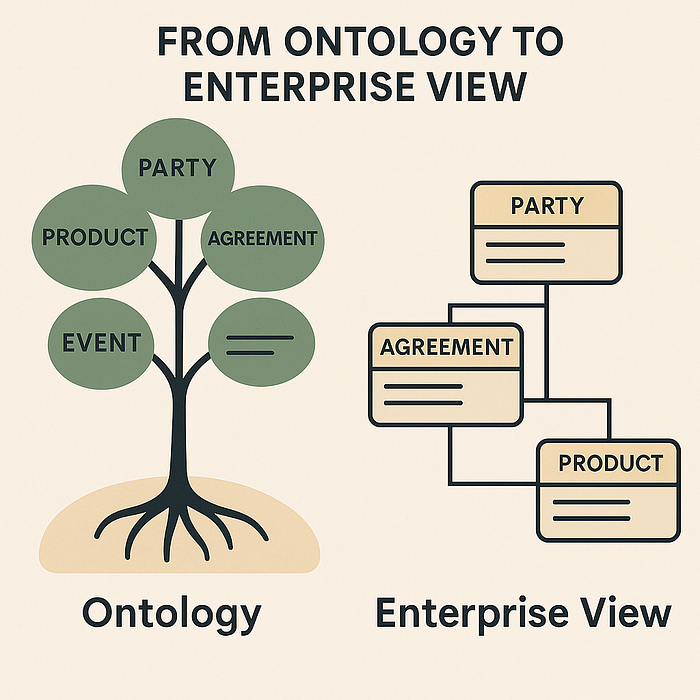
Ontology as the Starting Point
In The Elephant in the Fridge, Giles argued that success in data architecture depends on starting with an enterprise ontology:
- A shared vocabulary of business concepts (e.g., Party, Product, Agreement, Event).
- A model that is business-facing, not technology-facing.
- A foundation that makes later design decisions easier and more consistent.
This ontology is not about technical storage or performance. It is about shared meaning across the enterprise.
The Business-Oriented LDM
For me, Giles’ enterprise ontology maps directly to the Business-Oriented Logical Data Model (LDM) — the first pillar of my methodology. The LDM provides:
- A business-shaped integration layer that captures enterprise-wide meaning.
- A structure flexible enough to support historization, change, and multiple implementations.
- The anchor for all other pillars: mappings, metadata automation, and reuse.
👉 I explained this idea in Unlock Your Business’s True Potential: The Power of Business-Oriented Data Modeling.
👉 And I showed how Universal Data Models strengthen this foundation in How Universal Data Models Support Business-Oriented Data Modeling.
Universal Models as Seeds
Giles acknowledged that building an enterprise ontology from scratch can feel daunting. This is where Len Silverston’s Universal Data Models (UDMs) provide real value.
By using UDMs as seeds, we can:
- Accelerate delivery of the ontology.
- Rely on proven, generic structures for core business domains.
- Focus modeling discussions on adaptation instead of invention.
This is why UDMs earned their own place as the fourth pillar in my methodology.
Ontology and Bi-Temporal Integration
In my work, the enterprise LDM doesn’t stop at structure — it also incorporates historization. Specifically, I use a bi-temporal SCD2 approach (recording both technical history and business-effective history).
👉 I explained this more deeply in Bill Inmon’s Lasting Impact: Why 3NF and Universal Data Models Still Matter in Modern Integration Layers.
👉 And expanded on historization design in From Historization to Exposure: Building a Usable Data Platform with Dual SCD2.
This ensures that the ontology not only reflects today’s business but also preserves how meaning evolves over time.
From Ontology to Enterprise View
The transition Giles described — from ontology to enterprise view — is essentially the move from a conceptual business ontology into a business-shaped LDM that can guide integration and implementation.
This is where ontology moves from being a theoretical artifact to a living foundation for data architecture.
Where We’re Headed
In the next article, we’ll explore how we can borrow from Data Vault without building one — applying the useful ideas (like hubs, links, and satellites) while keeping the enterprise LDM and 3NF bi-temporal model at the center.
Key Takeaways
- John Giles’ enterprise ontology is about meaning, not storage.
- The ontology maps directly to a business-oriented LDM, the first pillar of my methodology.
- Universal Data Models can accelerate ontology design and provide tested seeds.
- Adding bi-temporality ensures the ontology reflects business reality over time.
- The enterprise ontology is the anchor for reuse, automation, and mapping.
✍️ This article is Part 3 of the series “Why Elephants Matter in Data Modeling”, where I explore how John Giles’ ideas, Len Silverston’s Universal Data Models, and my own methodology come together in a business-first, model-driven approach.
Series overview
- Part 1: Why Elephants Matter in Data Modeling
- Part 2: Patterns + Universals: The Foundations of Reuse
- Part 3: From Ontology to Enterprise View
- Part 4: Borrowing from Data Vault Without Building One
- Part 5: Model-Driven Engineering in Practice
- Part 6: Business-Friendly Mapping as a Collaboration Tool
- Part 7: The Four Pillars of Business-Centered Data Architecture