Jaco van der Laan
Active filters:Metadata ×Clear all

The Missing Piece in Metadata-Driven Data Modeling: Integration

💡 We have open formats, automation, and AI — but not yet one coherent ecosystem. In the last few years, the data modeling world has made incredible progress. We’ve moved from proprietary repositories to open metadata, from ==static diagrams== ==to== ==version-controlled YAM==L, and from manual governance to automated validation. But as one reader recently pointed out in response to my article Do We Still Need Traditional Data Modeling Tools?: “There’s no integrated tool to gather these open data formats into a coherent single experience.” And...
Read more
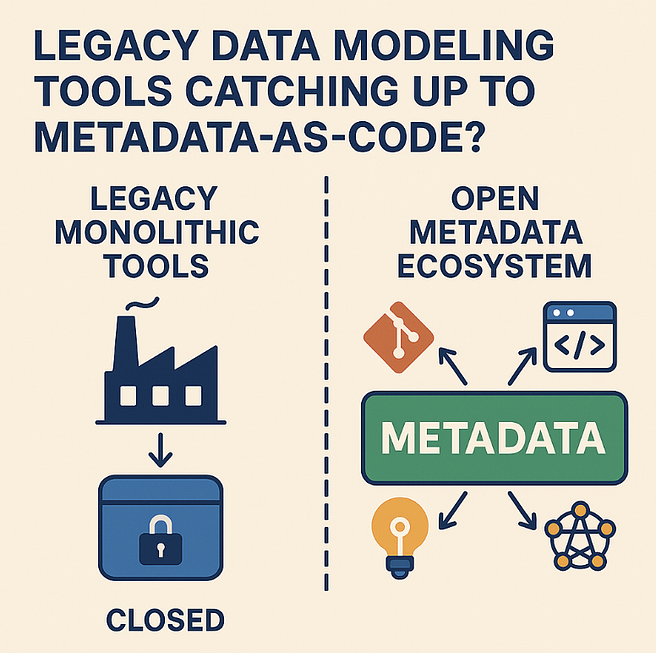
Are Legacy Data Modeling Tools Catching Up to Metadata-as-Code?

💡 [[Legacy modeling tools]] are modernizing fast — but can they really compete with open, Git-native, AI-assisted metadata ecosystems? When I asked whether we still need traditional data modeling tools, I expected mostly practitioner reactions. What surprised me was how strongly tool vendors themselves joined the conversation. Executives from [[SqlDBM]], [[Hackolade]], Ellie.ai, and even erwin Data Modeler (erwin DM) responded — each confirming that the industry is moving toward metadata-driven, Git-integrated, and AI-assisted modeling. That’s a positive sign. It shows that the discussion is...
Read more

Beyond Tools: Metadata-Driven Modeling as a Shared Language Between Business, Engineers, and AI

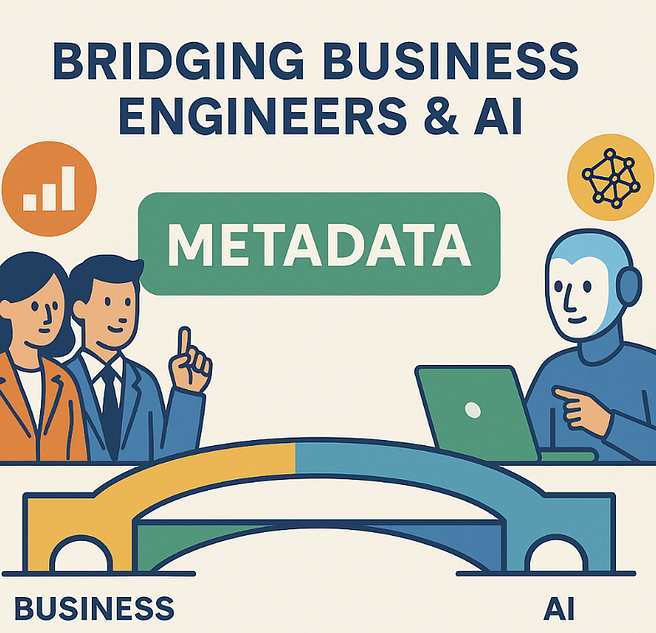
💡 From debate to convergence — how the data community is redefining modeling for the metadata and AI era. When I asked whether we still need traditional data modeling tools, I expected opinions. What followed was something richer — a thoughtful, cross-disciplinary conversation between data modelers, architects, tool builders, and AI enthusiasts. The responses revealed a shared realization: Modeling is not dying — it’s evolving. Traditional tools like [[PowerDesigner]], [[ERwin]], and [[ER/Studio]] gave us structure and...
Read more

Metadata Mesh: The Federated Architecture for Enterprise-Wide Data Modeling

How to scale metadata governance and collaboration using domain nodes and shared APIs As organizations adopt [[metadata-driven data modeling]], a new challenge emerges: How do we connect multiple autonomous domains — each modeling its own business — into a coherent, enterprise-wide view without creating a central bottleneck? The answer is [[Metadata Mesh]] — a [[distributed metadata architecture]] inspired by the same principles as [[Data Mesh]]: [[domain ownership]], [[interoperability]], and [[product thinking]]. A metadata catalog collects models and lineage into one searchable...
Read more

The Road Ahead: Towards a Self-Adapting Metadata Ecosystem

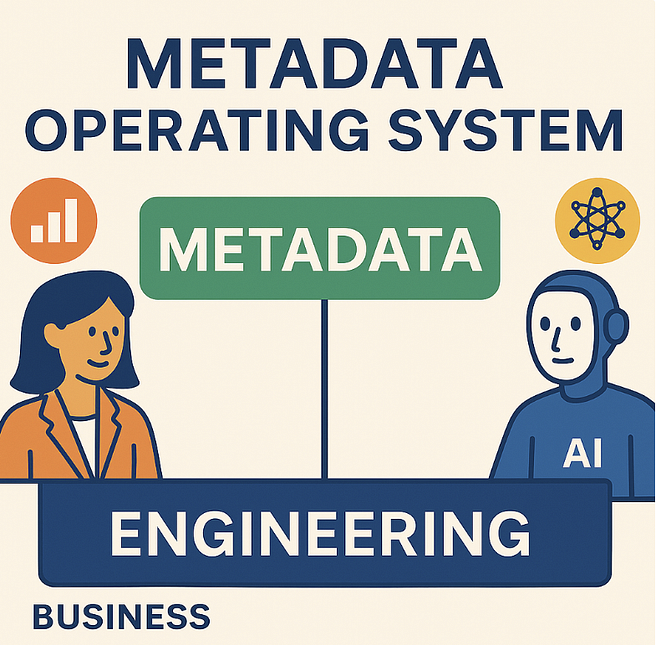
How feedback loops between metadata, AI, and data quality enable continuous improvement Throughout this series, we’ve built an entire metadata-driven foundation: From conceptual and logical modeling in YAML To metadata catalogs in DuckDB To lineage, quality, and observability To semantic enrichment and AI assistance Now we take the next evolutionary step — where the metadata ecosystem becomes self-adapting. In this vision, metadata doesn’t just describe or automate your data architecture; it actively learns, evolves, and optimizes it....
Read more

The Semantic Layer of Metadata

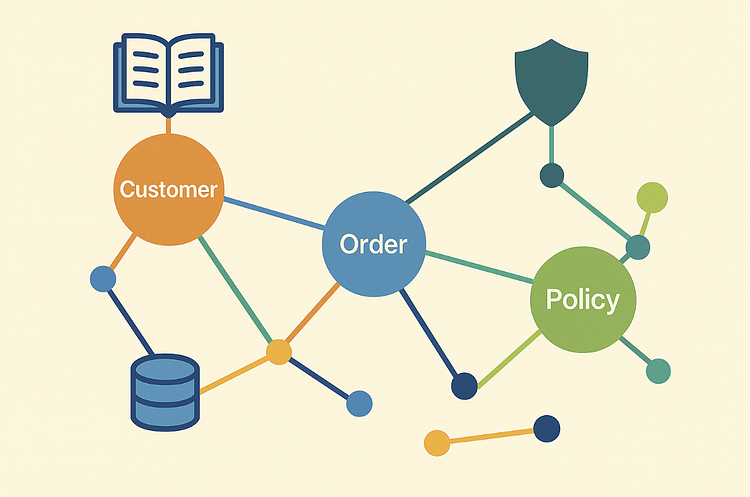
How to connect concepts, rules, and business meaning across your metadata mesh As we scale metadata-driven modeling across teams, we eventually hit a new challenge: We know how data flows — but do we know what it means? We can trace lineage and structure across thousands of tables, yet still struggle to answer basic business questions like: What exactly is a “Customer”? How does “Revenue” differ between domains? Which policies govern “Personal Data”? To solve this, we...
Read more

Semantic Model, Ontology, and Knowledge Graph — Three Layers of Meaning in the Modern Data Landscape

Inspired by “Semantic Model vs Ontology vs Knowledge Graph: Untangling the Latest Data Modeling Terminology” by Cassi Hunt In recent years, the language of data modeling has grown richer — and more confusing. Terms like semantic model, ontology, and knowledge graph appear across architecture diagrams, vendor slides, and LinkedIn think pieces, often used interchangeably. Yet these concepts describe distinct — and complementary — layers of meaning in the modern data ecosystem. Understanding how they relate helps bridge business semantics with machine-readable...
Read more

Querying the Metadata Itself: Building a Metadata Catalog with DuckDB

How to turn your YAML-based data models into a searchable, queryable, and visual metadata repository In the previous article, we published conceptual, logical, and physical data models to Notion and Confluence — making them accessible to the wider organization.  Now we’ll take the next leap: treating metadata as data. By loading your YAML files into DuckDB, you can query, analyze, and visualize your entire modeling landscape — from conceptual entities to SQL tables — using standard SQL. When metadata is just...
Read more

Publishing Metadata Models to Notion and Confluence

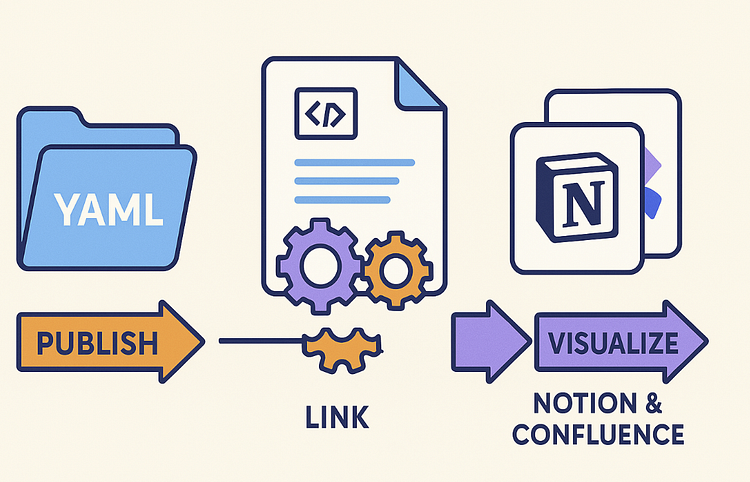
How to make conceptual, logical, and physical data models discoverable and navigable for everyone Over the past four articles, we’ve built a fully automated metadata-driven framework — from conceptual modeling to physical SQL generation.  Now it’s time to share it with the wider organization. This article focuses on how to publish your YAML-based models to documentation platforms such as Notion or Confluence, combining lineage, diagrams, and model definitions into dynamic knowledge assets. Even the best-designed models lose...
Read more

Metadata Observability Measuring Quality, Completeness, and Change in Your Data Models

How to detect inconsistencies and model drift using DuckDB and metadata-as-code In the previous article, we loaded our YAML-based conceptual, logical, and physical models into DuckDB, turning them into a queryable metadata catalog. Now we’ll take it one step further: making that catalog observable. Metadata observability means continuously monitoring the health, completeness, and evolution of your data models — much like data observability tools monitor pipelines and datasets. When your data models are managed as code, they...
Read more
1 2 3 4 5 6