How transparent mappings bridge the gap between business meaning and technical implementation
Summary
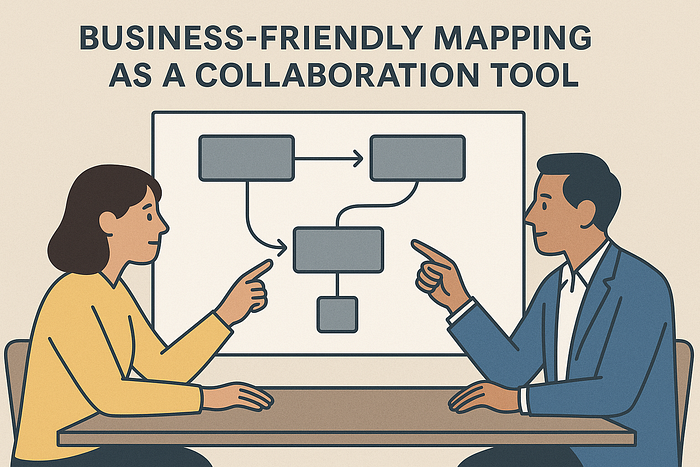
Mappings often live in hidden ETL scripts or transformation logic, invisible to the business. But when mappings are made business-friendly and transparent, they become powerful collaboration tools.
In this article, I explain how Business-Friendly Mapping (BFM) connects business concepts to technical systems, why this improves both agility and trust, and how it fits into the four pillars framework.
The Problem with Hidden Mappings
In many organizations, mappings are:
- Buried inside SQL scripts or ETL jobs.
- Documented in Excel sheets that quickly fall out of sync.
- Understood only by a handful of engineers.
This creates a black box where business users can’t verify how data is transformed — leading to mistrust, rework, and longer delivery cycles.
Making Mappings Business-Friendly
Business-Friendly Mapping turns mappings into living documentation that everyone can understand:
- Expressed in business terms first, then linked to technical details.
- Represented visually (e.g., diagrams) and textually.
- Stored in metadata so mappings are executable, not just descriptive.
👉 I illustrated this approach in Cooking with Data: How Business-Friendly Mapping Brings Clarity to ETL.
👉 And showed it in practice in Business-Friendly Mapping in Action — From Sources to Integration.
Mapping as a Collaboration Tool
When mappings are transparent:
- Business users can validate meaning: “Yes, this is how Customer maps to Agreement.”
- Engineers can trust that transformations reflect agreed business definitions.
- Auditors can trace lineage from source to integration.
👉 This idea builds on The Foundation of Business-Friendly Mapping — High-Quality Data Models.
Mappings stop being hidden glue and become a shared contract.
Metadata + Mapping
When mappings are stored in metadata:
- They can be versioned, validated, and reused.
- They can drive automation (e.g., generating SQL in dbt, as I showed in Business-Friendly Mapping Meets dbt).
- They remain transparent to both business and IT.
This is what makes them truly business-friendly: they are not just documentation but part of the system.
BFM in the Four Pillars Framework
- Business-Oriented LDM (Pillar 1) defines the business concepts.
- Model-Driven Engineering (Pillar 2) makes mappings executable.
- Business-Friendly Mapping (Pillar 3) provides the collaboration layer.
- UDMs (Pillar 4) accelerate mappings with proven universal patterns.
This ensures that mappings strengthen the entire methodology rather than becoming isolated artifacts.
Where We’re Headed
In the final article of this series, we’ll bring the threads together and show how the four pillars form a cohesive methodology for business-centered data architecture.
Key Takeaways
- Hidden mappings create mistrust and inefficiency.
- Business-Friendly Mapping makes mappings transparent and collaborative.
- When stored in metadata, mappings become both executable and auditable.
- BFM is the bridge that connects business meaning with technical reality.
✍️ This article is Part 6 of the series “Why Elephants Matter in Data Modeling”, where I explore how John Giles’ ideas, Len Silverston’s Universal Data Models, and my own methodology come together in a business-first, model-driven approach.
Series overview
- Part 1: Why Elephants Matter in Data Modeling
- Part 2: Patterns + Universals: The Foundations of Reuse
- Part 3: From Ontology to Enterprise View
- Part 4: Borrowing from Data Vault Without Building One
- Part 5: Model-Driven Engineering in Practice
- Part 6: Business-Friendly Mapping as a Collaboration Tool
- Part 7: The Four Pillars of Business-Centered Data Architecture