How OpenMetadata can unify lineage, governance, and business-friendly mapping in an architecture powered by DuckDB, Python, and Notion.
Summary
OpenMetadata is an open-source metadata and governance platform that connects to databases, warehouses, pipelines, dashboards, and models.
It provides cataloging, lineage, governance, quality, and collaboration features out of the box.
In the proposed architecture, OpenMetadata can complement DuckDB (execution metadata), Python (SQL generation), and Notion (business-facing reviews) by:
Acting as the central metadata hub across sources, transformations, and consumption layers.
Managing lineage, governance, and quality policies at scale.
Linking technical metadata to business glossaries and stakeholders.
Limitations: setup complexity, additional infrastructure, overlap with some Notion/business annotation functions.
Best fit: Use OpenMetadata for system-wide metadata management and governance, while DuckDB/Python remain the lightweight execution engine and Notion the business-facing collaboration layer.
Introduction
In metadata-driven data engineering, metadata is not just documentation — it drives design, execution, governance, and collaboration.
You’ve already designed an architecture where:
- DuckDB stores metadata as data.
- Python generates SQL pipelines from that metadata.
- Notion serves as a business-friendly front-end for mapping and annotations.
OpenMetadata can enhance this ecosystem by adding governance, lineage, and enterprise-scale metadata integration.
What OpenMetadata Offers
- Central metadata catalog: ingestion from databases, data lakes, warehouses, BI tools, ML models, pipelines.
- Data lineage visualization: source → transformation → consumption.
- Business glossary: definitions, tags, and business ownership.
- Data quality & governance: policies, tests, and workflows.
- Collaboration features: annotations, discussions, ownership.
- Open APIs: metadata can be queried and updated programmatically.
How OpenMetadata Fits into the Proposed Architecture
1. Metadata-as-Data, at Scale
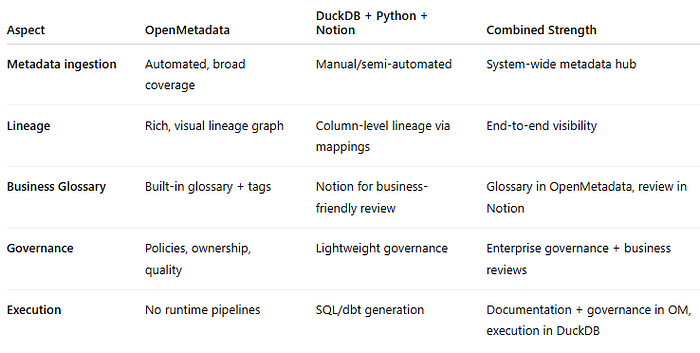
You already treat metadata as queryable data in DuckDB. OpenMetadata expands this by automatically ingesting metadata from your entire ecosystem (Databricks, Airflow, BI dashboards, ML platforms). This makes it your central metadata catalog.
2. Business-Friendly Mapping
Mappings stored in DuckDB and annotated in Notion can be linked into OpenMetadata through its APIs, making them part of a broader catalog. OpenMetadata also provides glossaries and tags, making it easier to connect mappings with business terminology.
3. Governance & Policies
Your metadata generator enforces historization and SCD2 logic. OpenMetadata adds policy-level governance — e.g., PII tagging, data quality tests, or ownership assignments — which can be integrated with your metadata pipeline.
4. Lineage Integration
DuckDB stores source → target mappings. OpenMetadata can visualize lineage across sources, pipelines, and dashboards, showing stakeholders the end-to-end flow. It provides a graph-based view complementary to your SQL generation.
5. Historization & Temporal Context
Historization (Dual SCD2) remains better handled in DuckDB and your SQL generation scripts. But OpenMetadata can track versions of models and schemas, so you can align temporal changes with lineage and governance.
6. Collaboration
While Notion remains your lightweight, business-friendly collaboration platform, OpenMetadata enables technical collaboration for data engineers, governance teams, and architects, with discussions, ownership, and approval workflows.
Benefits vs. Gaps
Example Flow: OpenMetadata in Action
- Ingest metadata from Oracle, Databricks, Airflow, BI dashboards into OpenMetadata.
- Model business-friendly mappings in Notion, synced into DuckDB metadata tables.
- Generate SQL in Python for historization (Dual SCD2), PIT tables, and exposure views.
- Push mapping metadata into OpenMetadata, linking to lineage and business glossaries.
- Govern and collaborate: assign owners, tag PII, define quality policies.
- Visualize lineage across the full platform: sources → transformations → exposure views → BI dashboards.
When to Use OpenMetadata
- To integrate metadata across multiple systems without manual effort.
- To provide end-to-end lineage and visibility to both engineers and business stakeholders.
- To enforce governance and quality policies centrally.
- To maintain a business glossary and ownership model at scale.