Why documenting your Power BI datasets is just the first step — and how a model-first, metadata-driven approach unlocks true scalability, governance, and automation.
🌟 Summary
Microsoft’s step-by-step guide to creating a data dictionary in Power BI shows an important truth: metadata matters.
But most teams stop there — producing a static catalog or dictionary that helps with understanding, but doesn’t drive the platform itself.
In Model-Driven Data Engineering (MDDE), metadata isn’t just documentation; it’s the engine.
Your models define how data flows, how it’s historized, and even how cost and governance are enforced by design.
This article explores how a simple data dictionary can evolve into a model-first, metadata-driven architecture that powers automation, cost control, and governed delivery layers.
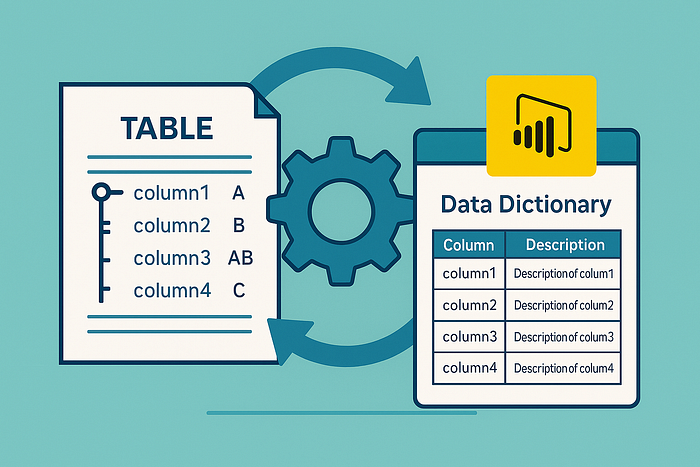
Data Dictionaries: A Good Start
The Power BI article walks through:
- Extracting table and column information.
- Adding descriptions, data types, and business context.
- Publishing a readable, searchable dictionary for analysts.
This step is valuable:
- It creates a shared vocabulary.
- It reduces onboarding friction.
- It improves trust in reports.
But if the dictionary lives only in Excel or a wiki, it’s static. When schema changes, the docs drift. When governance rules evolve, they’re not enforced.
Model-First, Metadata-Driven Data Engineering
Over the past years I’ve written extensively about moving from hand-crafted ETL to model-driven automation:
- From Coding to Modeling: The Rise of Model-Driven Data Engineering
- Metadata as Data — Controlling and Governing Data Models
- Publish Your Metadata Story to Confluence
- Universal Metadata Models: From a Blueprint in 2014 to Modern Metadata Architectures in 2025
- Business-Friendly Mapping Meets dbt
Core principle:
The model is not documentation — it is the single source of truth that drives the platform.
Key capabilities:
- Metadata as Code
Store table definitions, lineage, and mappings in a structured repository (YAML, JSON, or a metadata database). - Automatic Pipeline Generation
Frameworks turn those models into SQL/ELT pipelines — SCD2 historization, PIT tables, business-friendly mappings. - Governance by Design
Data contracts, column-level lineage, and access policies are generated and enforced automatically. - Cost Awareness at Design Time
(see Designing for Cloud Cost Control with Model-Driven Data Engineering): predict storage & compute cost for every new dataset before deployment. - Continuous Documentation
Your metadata drives live dictionaries in Confluence, OpenMetadata, or Power BI — always in sync with what’s actually running.
How Power BI Fits In
- Power BI is the last mile.
Even in a model-driven platform, analysts still need clear, trusted datasets. - Generate, don’t manually curate.
Instead of building the dictionary by hand, publish it from your metadata store to Power BI (via the REST API or tools like OpenMetadata). - Close the loop.
Analysts’ feedback (renamed fields, better descriptions) can flow back into the model repository, keeping everything aligned.
Practical Integration Pattern
- Model your semantic layer and transformations (SCD2, business mappings) in a metadata repository.
- Generate data pipelines (dbt, Delta Live Tables, Lakeflow) automatically from the model.
- Publish dictionary content into Power BI’s data model documentation or a Confluence portal.
- Synchronize — if the model changes, both pipelines and documentation stay up to date.
This is the same mindset that powers Rethinking EA Mapping with DuckDB & Python and Metadata-Driven Data Architecture: Leveraging draw.io and VSCode for Scalable Design.
Why It Matters
- Consistency: one model feeds both engineering and analytics.
- Speed: no manual re-work when schemas evolve.
- Governance: lineage, contracts, and access policies stay accurate.
- Cost control: designs are evaluated before they hit the cloud bill.
- Empowered analysts: Power BI remains the business-friendly face, but backed by a governed, automated core.
Related Reading
- How to Create a Data Dictionary in Power BI — Microsoft
- From Coding to Modeling: The Rise of Model-Driven Data Engineering
- Metadata as Data — Controlling and Governing Data Models
- OpenMetadata in a Metadata-Driven Data Architecture
- Data Contracts: Anchoring Reliability in Model-Driven Data Engineering
- Designing for Cloud Cost Control with Model-Driven Data Engineering
Key Takeaways
- A Power BI data dictionary is a valuable first step but shouldn’t be static.
- Model-Driven Data Engineering turns metadata into an engine — driving pipelines, governance, cost control, and live documentation.
- Power BI fits beautifully as the consumer layer when fed by a metadata-driven backbone.
- Move from “document after” to design first, generate everything — including your dictionaries.