Data Contracts- Anchoring Reliability in Model-Driven Data Engineering
Defining promises between producers & consumers so our pipelines, historization, and models become trustworthy, evolvable, and business-friendly
Summary
Data contracts are formal, enforced agreements between data producers and consumers that specify schema, semantics, quality, and change expectations.
In our architecture with dual/bi-temporal SCD2 and business-aligned 3NF models, contracts help ensure consistency, prevent downstream breakage, and make exposure views reliable.
Implementation involves embedding contracts in metadata, enforcing them via tests or CI/CD, setting ownership, and monitoring violations.
What Are Data Contracts?
A data contract refers to a specification (or agreement) that defines what a data product promises to deliver. Think of it like an API contract in software: it says this table or view will always include certain columns, with specific types and constraints; it sets rules around freshness, backward compatibility, and acceptable change.
Some of the key components often include:
- Required columns & their data types (schema shape)
- Not-null, uniqueness, value/range constraints
- Semantic guarantees: what the columns mean (business keys, dates, logical delete flags, valid_from / valid_to, etc.)
- SLAs or freshness/latency/update frequency expectations
- Ownership: who’s responsible for maintaining the contract
- Versioning: how changes are proposed, accepted, and rolled out over time
In tools like dbt (see “dbt and Data Contracts: Enabling Reliable, API-Driven Analytics” by Abhishek Kumar Gupta), contracts are codified in YAML or schema files, and tests are applied so breaking changes cause failures or alerts.
Why Data Contracts Matter in Our Architecture
Given our architectural principles — dual/bi-temporal (or bi-temporal) SCD2 historization, insert-only records, logical deletes, business-aligned 3NF models, and exposure views — data contracts bring several benefits:
- Stable Interfaces for Consumers
Exposure views (or any data product delivered out of the platform) become stable. Analysts, dashboards, and business users can rely on schema, naming, and semantics. If we rename or introduce a required field, the contract makes sure such changes are governed, deliberate, and transparent. - Consistency Across Historization Layers
Our dual SCD2 approach (with valid vs. recorded timestamps, version inserts, logical deletes) relies on preservation of shape and semantics across versions. Contracts ensure that every version — past, present, or future — adheres to the defined schema and intended semantics. - Preventing Surprise Breakages
Without contracts, upstream changes (schema drift, source changes, structural adjustments) often break downstream logic, mapping flows, and BI artifacts silently. Contracts force tests and validations so violations are detected early (build time, CI/CD) rather than discovered by business stakeholders later. - Governance, Ownership & Clarity
Contracts clarify responsibilities. When many teams produce and consume data, confusion over who owns business definitions, or what “active” means, causes misalignment. Ownership of contracts ensures accountability, and clarity helps both engineering and business align expectations. - Aligning with Business and Functional Semantics
A strong data contract captures both:
- Business Semantics: how business stakeholders think about data. What constitutes a “customer”? How is “revenue” calculated? What does it mean for a record to be “active” vs. “historical” from the business’s point of view?
- Functional Semantics: the technical rules that ensure data behaves correctly: how logical deletes are modeled, how dual SCD2 inserts new versions rather than updates, valid_from vs. valid_to semantics, and how flags like “active” are derived in views.
- By combining the two, we create a bridge: business users can understand what data means; engineering ensures it behaves consistently over time.
How Data Contracts Can Be Implemented in Our Framework
Here are ways to embed contracts in our model-driven architecture with dual SCD2 and 3NF models, while preserving agility and clarity:
A. Define Contracts in Metadata
- Extend the logical data model (LDM) and mapping definitions so every entity/view includes contract metadata: required columns, data types, constraints (not-null, uniqueness), semantics (business key, valid_from, valid_to, logical delete).
- Represent ownership and responsibilities.
- Maintain version control (git or equivalent) for the metadata/contract definitions, so every change is traceable.
B. Enforce Contracts During Build / Tests
- Use tests in your transformation framework: check for schema shape, existence of fields, data types, not-null, allowed values (domains).
- At build or CI/CD time, ensure any contract violation (in exposure views, historized tables, or mapping) causes alerts or build failures.
- Include historical checks: sample older versions or partitions to ensure schema hasn’t changed in undesirable ways.
C. Ownership & Change Process
- Assign each contract to a team or domain owner who is responsible for updates and communicating changes.
- Define a change process: proposals for schema changes (adding/removing/renaming fields), impact assessment (who uses the data), versioning of contract, backwards compatibility or deprecation paths.
- Use dual SCD2 and versioned metadata so changes can be additive and non-breaking where possible.
D. Monitoring & Alerting
- Create dashboards that track contract compliance: schema drift, type mismatches, freshness, missing values.
- Alerts when exposure views or historized outputs violate the contract (e.g., missing fields, wrong types, stale data).
- Periodic audits across versions/partitions to ensure consistency.
E. Prioritize Contracts for Critical Data Products
- Not every dataset demands the same rigor. Identify high-impact exposure views or tables (used in reporting, dashboards, decision support) and apply strict contract rules there.
- Use lighter or evolving contracts for exploratory or early-stage datasets; gradually expand coverage as maturity grows.
Possible Challenges & Trade-offs
- Upfront Overhead: Defining contracts, writing metadata, creating tests take effort.
- Change Management: Schema changes must be managed carefully, especially when consumers depend on existing views.
- Performance/Cost: Contract tests, historical audits, or version comparisons can add cost.
- Ownership Clarity: Ensuring teams take responsibility for contracts, and ensuring contracts evolve rather than being neglected.
We mitigate these in our methodology by starting small (piloting with critical products), versioning, using non-destructive change patterns (additive changes, deprecation rather than removal), and aligning contract evolution with business mapping updates.
Example: Applying Data Contracts in Our Dual SCD2 + 3NF Model-Driven Stack
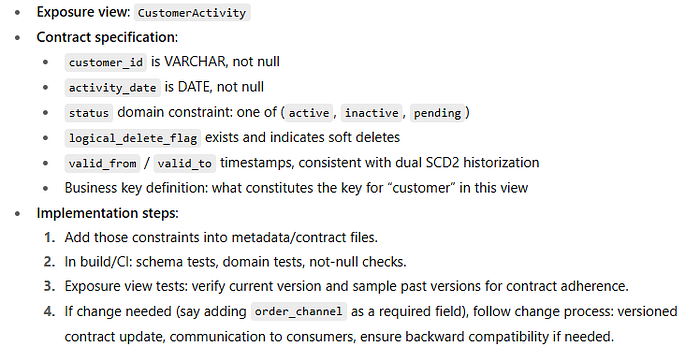
Here’s how a contract might look in practice for one of our exposure views:
Press enter or click to view image in full size
Conclusion
Data contracts are more than governance checkbox items — they are foundational to building reliable, trustable, and maintainable data platforms. In our architecture — business-aligned 3NF models, dual/bi-temporal SCD2 historization, exposure-first delivery — data contracts help avoid surprises, anchor meaning, and make schemas predictable.
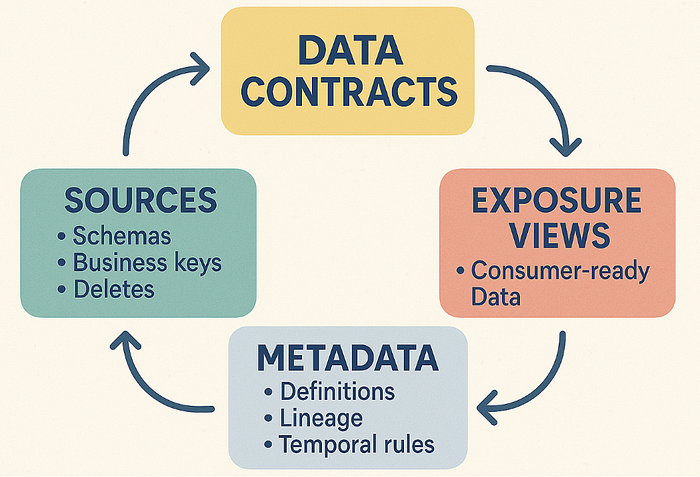
By embedding business semantics + functional rules, enforcing contracts in build/test pipelines, assigning ownership, and monitoring compliance, we reinforce the integrity of every layer: from sources through historization to exposure.
References & Further Reading
- dbt and Data Contracts: Enabling Reliable, API-Driven Analytics — Abhishek Kumar Gupta (Medium)
- Data Contracts & Schema Enforcement with dbt (Xebia)
- Implementing Data Contracts in the Data Warehouse (Monte Carlo / Chad Sanderson)