Cloud Tools vs. Code-Based Modeling — What We Can Learn from SqlDBM
How the rise of collaborative cloud modeling tools complements the metadata-as-code movement
🧩 Metadata-Driven Modeling Series
A continuing exploration of how modern data platforms connect business meaning and technical implementation through metadata-as-code.
1️⃣ From Business Concepts to Database Blueprint
2️⃣ Linking Conceptual and Logical Data Models in Metadata
3️⃣ Scaling Metadata-Driven Data Modeling — From Conceptual to Physical with Git and YAML — coming soon
4️⃣ Cloud Tools vs. Code-Based Modeling — What We Can Learn from SqlDBM (this article)
5️⃣ Generating Logical Models Automatically from Conceptual Metadata — coming soon
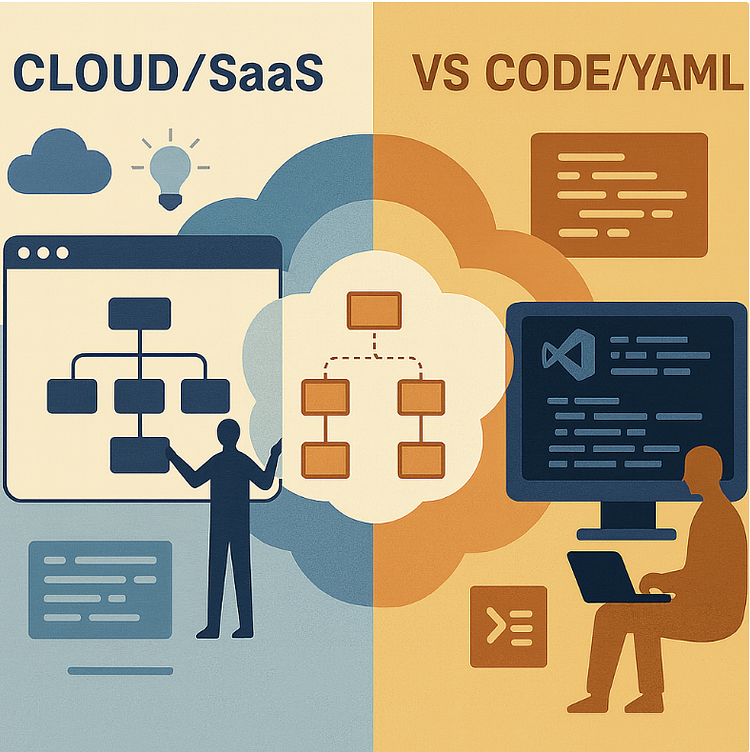
1. Why This Comparison Matters
In a recent discussion about whether traditional modeling tools like Erwin and PowerDesigner are being replaced by dbt-centric workflows, one platform kept coming up: SqlDBM.
SqlDBM has positioned itself as a modern, cloud-native modeling environment — collaborative, AI-assisted, and deeply integrated with Snowflake, dbt, and governance platforms.
At first glance, it looks very different from a metadata-as-code approach built around YAML files, VS Code, and Git. But beneath the surface, both approaches share a vision:
Modeling should be living, collaborative, and connected — not a static diagram hidden in a desktop tool.
The difference lies in where that collaboration happens:
- SqlDBM: in the browser.
- Metadata-as-code: in the repository.
2. SqlDBM at a Glance
According to SqlDBM’s recent article, “Modern Data Modeling: The Quiet Revolution Powering the AI-Driven Enterprise,” modern data modeling is:
“Shared, collaborative, and deeply connected to every part of the data stack — from Snowflake and dbt to governance systems and AI copilots.”
SqlDBM provides:
- Cloud-based modeling — no installation, real-time collaboration.
- Integrated environments — logical and physical models side-by-side.
- Versioning and branching — “Google Docs for data modeling.”
- Governance and standards — naming rules, templates, and metadata tagging.
- AI Copilot — auto-suggests entities, documentation, and schema improvements.
- dbt integration — imports manifests, generates YAML, and synchronizes lineage.
In short, SqlDBM merges visual modeling, governance, and code-integration into a single SaaS experience.
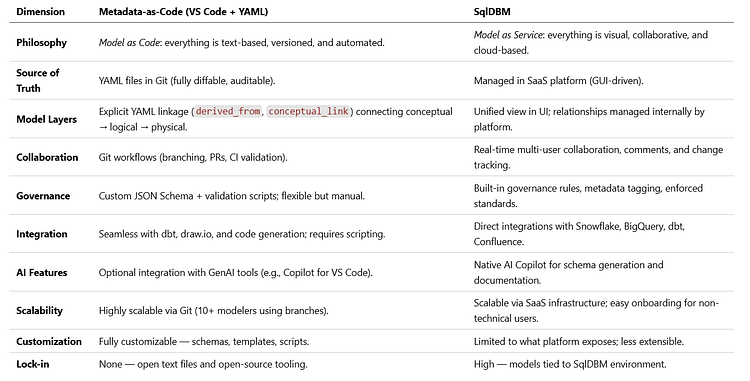
3. Comparing Paradigms: Cloud vs. Code
Here’s a structured comparison between SqlDBM and our YAML + VS Code metadata-driven workflow.
4. What SqlDBM Gets Right
There’s a lot we can admire in SqlDBM’s design — especially how it re-imagines modeling as a collaborative experience rather than a technical step.
Key strengths worth studying:
- Instant collaboration.
Real-time editing and commenting make modeling feel dynamic and team-oriented. - Governance baked in.
Standards, naming conventions, and classification rules are part of the creation process — not an afterthought. - AI-assisted modeling.
The AI Copilot bridges the gap between natural language intent and technical structure. - Visual-semantic integration.
Logical and physical models co-exist, with automatic lineage and dbt synchronization. - Frictionless onboarding.
Browser-based, no setup required — ideal for mixed teams of modelers, engineers, and analysts.
5. What the Code-Based Approach Adds
While SaaS modeling platforms streamline collaboration, metadata-as-code excels in control, transparency, and automation.
- Version control is native.
Every change is a commit; every commit is traceable. - Tool-agnostic.
YAML and JSON are universal — easy to parse, transform, and integrate with any stack. - Executable metadata.
Models generate SQL, dbt files, diagrams, and documentation — not just pictures. - Continuous Metadata Integration (CMI).
Validation, lineage checks, and publishing run automatically in CI/CD pipelines. - Governance as code.
JSON Schema and validation scripts enforce naming conventions, data types, and lineage links. - Custom automation.
You control how conceptual models become logical models, including normalization and business-rule translation.
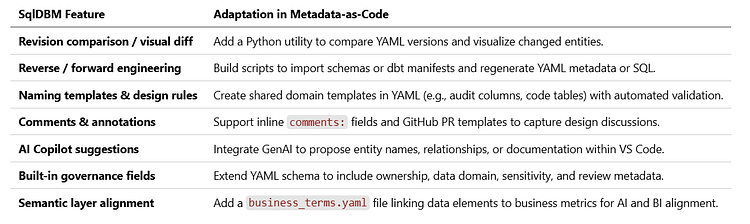
6. What We Can Learn (and Borrow) from SqlDBM
The beauty of open metadata is that we can borrow good ideas freely.
Here are practical enhancements inspired by SqlDBM’s capabilities:
7. The Road Ahead
In essence, SqlDBM and metadata-as-code represent two sides of the same evolution:
- SqlDBM makes data modeling more human and collaborative.
- Metadata-as-code makes it more structured and automatable.
The future likely lies in hybrid models — where visual interfaces and code repositories coexist.
Imagine editing YAML metadata directly from a browser UI that syncs to Git — or running validation pipelines inside a collaborative modeling session.
That’s where the next generation of model-driven engineering tools will emerge: combining the usability of SqlDBM with the automation and openness of code.
8. In Summary
Modern data modeling is no longer about static diagrams — it’s about living metadata ecosystems.
- SqlDBM shows how modeling can become collaborative, intelligent, and cloud-native.
- Metadata-as-code shows how it can become automated, validated, and version-controlled.
The best future will merge both philosophies — a model as code that’s also a shared workspace of understanding.