Do We Still Need Traditional Data Modeling Tools
Why VS Code, Python, AI, and Git-based metadata workflows might replace PowerDesigner, ERwin, and ER/Studio.
💡 Summary
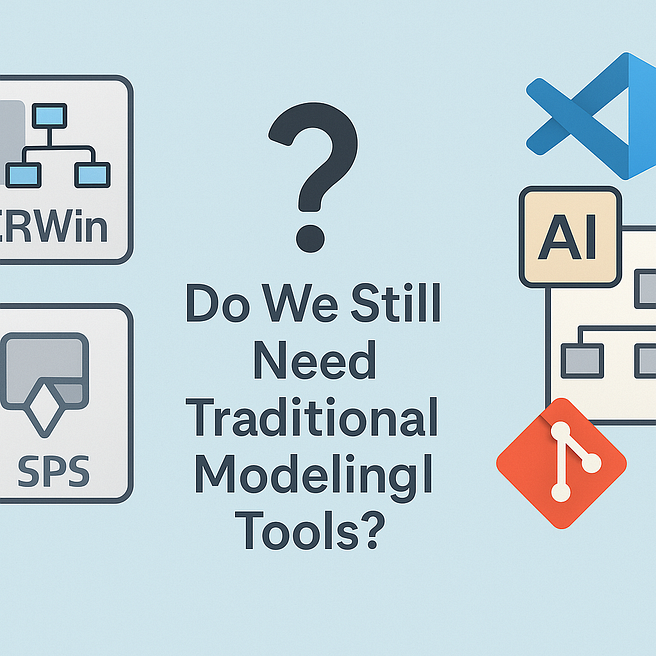
For decades, enterprise data modeling relied on heavyweight tools like PowerDesigner, ERwin, and ER/Studio — specialized environments with rich diagramming and repository features.
But as metadata, automation, and AI evolve, we’re seeing a quiet shift: modeling is becoming code.In this article, I explore whether we still need these classic tools — and how a modern, open workflow using VS Code, Python, Draw.io, Git, and AI can fulfill (and often surpass) their role.
Press enter or click to view image in full size
The Old World: Specialized, Centralized, and License-Limited
Most large organizations still maintain one or more “official” modeling tools. They’re mature, feature-rich, and packed with capabilities: domain hierarchies, validation rules, naming conventions, lineage reporting, and diagram generation.
But they also come with a cost:
- Proprietary repositories separate from the codebase
- Long learning curves and steep licensing fees
- Limited collaboration (often only a few trained users)
- Complex versioning and poor integration with CI/CD pipelines
In practice, these tools often end up being islands — disconnected from where the real development happens: the data platform, code repositories, and transformation logic.
The New Reality: Metadata as Code
When we treat data models as metadata, not as “files” inside a modeling tool, something powerful happens.
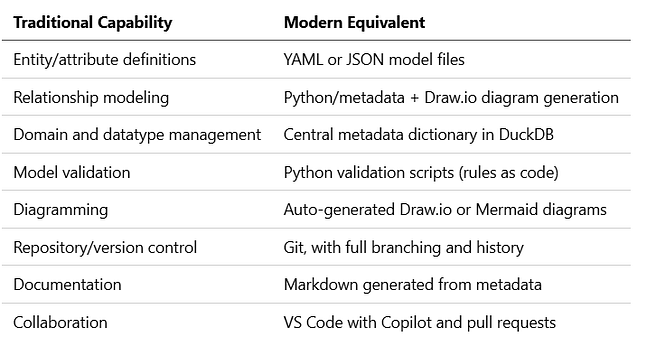
We can represent the same core concepts — entities, attributes, relationships, domains, subject areas, and diagrams — using open, versioned formats such as:
- YAML or JSON for structure and relationships
- Draw.io (XML) for diagrams (rendered in VS Code or web tools)
- Markdown for documentation
- DuckDB or SQLite for validation metadata
- Git for version control and branching
Now, the “model” is part of the same repository as the code, following the same DevOps principles: branch, commit, review, merge, release.
No licenses. No closed repositories.
Just metadata in files, readable by both humans and machines.
Reimagining the Modeling Toolchain
We’ve reached a point where the traditional features of modeling tools can be replicated — and improved — using open technologies.
Press enter or click to view image in full size
Add to that the power of AI, and we can:
- Generate models directly from existing metadata or SQL structures
- Suggest keys, relationships, and domain alignments
- Auto-document attributes and relationships in natural language
- Validate conformance to enterprise standards
It’s not just modeling — it’s living metadata engineering.
Why VS Code Is Becoming the New Modeling Environment
VS Code offers exactly what legacy modeling tools lack:
- A shared, extensible environment for both business developers and engineers
- Integration with AI copilots for contextual guidance
- A consistent experience across YAML, SQL, Python, and documentation
- Rich visualization via Draw.io and Mermaid plugins
- Seamless Git integration for collaboration and version control
Most importantly, it’s where the work already happens.
Instead of switching between modeling tools, notebooks, and wikis, we can unify everything — metadata, logic, documentation — in one governed workspace.
The Missing Piece: Validation and Standards
One valid argument for keeping specialized tools is their built-in model validation — they check for missing keys, broken references, inconsistent domains, etc.
But even that gap is closing.
Using our Python rule engine, we can now perform the same checks programmatically:
- Missing primary or foreign keys
- Duplicate column names or undefined datatypes
- Relationship integrity between entities
- Violations of naming conventions or domain rules
Validation becomes part of the pipeline — not a manual review step.
Why This Shift Matters
This isn’t just about technology preference.
It’s about accessibility, collaboration, and sustainability.
- Everyone can model, not just licensed specialists.
- Every model lives in the same repository as the transformations and code.
- Versioning and branching become natural parts of model governance.
- AI accelerates learning and ensures consistency across teams.
When modeling becomes part of the normal development workflow, it stops being an isolated discipline and becomes a shared language for the organization.
A Cultural Shift, Not a Tool Debate
This evolution doesn’t mean PowerDesigner or ERwin suddenly become obsolete — they’ve earned their place in history.
But it does mean we should rethink where modeling belongs in a modern, metadata-driven organization.
Instead of asking, “Which tool should we buy?”
We can ask, “How can we make modeling open, collaborative, and integrated with our data platform?”
That’s the future we’re building — one YAML, one diagram, one AI-assisted model at a time.
💬 Invitation for Input
We are currently exploring this shift— moving from traditional modeling tools toward an open, AI-assisted, VS Code-based workflow.
If you’ve worked with PowerDesigner, ERwin, or ER/Studio, I’d love to hear your thoughts:
- What features from those tools do you think are truly irreplaceable?
- What challenges or opportunities do you see in code-based modeling?
- How do you imagine AI supporting this process going forward?
You can respond in the comments or reach out directly — this conversation is just beginning.
Key Takeaways
- Modeling is evolving from specialized tools to open, code-based environments.
- Metadata, AI, and Git enable collaboration, automation, and governance at once.
- VS Code can serve as the new modeling hub — visual, extensible, and rule-aware.
- Validation, documentation, and diagrams can all be generated automatically.
- The future of data modeling is not about tools — it’s about metadata and collaboration.
🧭 Related articles
This article relates to the series “AI-Assisted SQL Migration” — an exploration of how we can combine metadata, Python, and Generative AI to transform the way we design, migrate, and govern data platforms.
Series Overview:
1️⃣ Why AI-Assisted SQL Migration Matters
2️⃣ Extracting the Hidden Metadata Inside SQL
3️⃣ From Raw SQL to Logical Building Blocks
4️⃣ Teaching AI to Apply Rules: Prompts, Validation, and Feedback Loops
5️⃣ Governance by Design: Making SQL Transparent, Modular, and Auditable
6️⃣ The Power of YAML Rules: Deduplication, Unions, and Optimization Patterns
7️⃣ The Python Rule Engine: Automating Transformation, Validation, and Documentation
8️⃣ Beyond Migration: Copilot-Assisted Data Modeling in VS Code
9️⃣ AI and Metadata-Driven Collaboration: The Future of Data Development
🤝 Join the Conversation
I’m exploring how AI, metadata, and model-driven thinking can make data platforms more transparent, explainable, and collaborative.
If you’ve experimented with similar ideas — or have thoughts on applying AI to data modeling, migration, or governance — I’d love to hear from you in the comments or connect on LinkedIn.