Bringing business-friendly data models to life inside the Snowflake platform.
Summary
Data teams have long struggled to make data both technically consistent and business-friendly.
We design models and mappings that capture the business, but in practice they often dissolve into raw SQL views and table names that mean little to non-engineers.With Snowflake’s Semantic Views — announced in 2024 and now steadily rolling out — we finally have a way to connect model-driven design with a query-ready, governed semantic layer inside Snowflake itself.
For teams investing in metadata-driven data engineering, business-oriented modeling, and universal data models, Semantic Views can become the natural delivery layer.
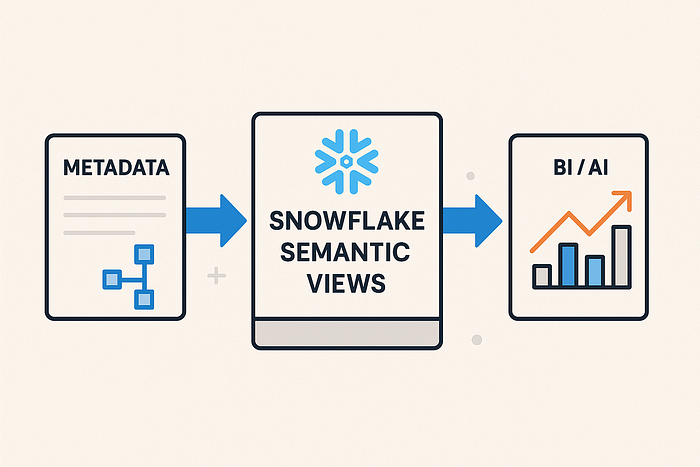
What Are Snowflake Semantic Views?
Snowflake’s new Semantic Views are a metadata-driven abstraction on top of your Snowflake tables and views. They allow you to:
- Define business entities and measures (e.g., Customer, Order, Revenue)
- Express relationships and semantic joins
- Add business-friendly names and descriptions
- Control aggregation logic and security centrally
- Expose a clean, governed semantic layer to BI and analytics tools
Unlike just building a chain of SQL views, Semantic Views are model-aware: they capture the meaning behind the tables and give downstream tools (Tableau, Power BI, Looker, Sigma) a richer structure to query.
Why This Matters for Our Approach
Our methodology — Model-Driven Data Engineering + Business-Friendly Mapping + Universal Data Models — is about making metadata the single source of truth and generating everything else from it.
Semantic Views slot perfectly at the delivery boundary of this architecture:
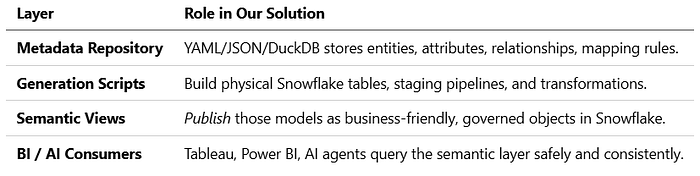
Instead of stopping at “generate SQL and tables,” we can automatically generate Semantic View definitions from the same metadata. That means:
- One model file drives the warehouse and the analytics layer.
- Business terms stay consistent from design → storage → consumption.
- AI tools can read the semantic layer to generate better queries (LLM SQL generation becomes easier and safer).
Practical Integration: How We’d Do It
Model First
Define entities (Customer, Order, Product), attributes, keys, relationships in metadata (YAML/DuckDB).
Mapping & Transformation
Our scripts generate staging/transform tables (Data Vault hubs/links/sats or dimensional tables).
Semantic View Generator
A code generator turns each model entity into a Snowflake Semantic View:
- Business name & description
- Logical joins to related entities
- Calculated fields & measures
- Row-level security if defined in metadata
Publish & Version
Push Semantic Views to Snowflake as part of CI/CD.
Version the YAML so changes to the model propagate safely.
Consume Everywhere
BI tools connect to the Semantic Layer.
LLMs use metadata + semantic definitions for accurate SQL generation.
Example
Metadata (YAML)
entity: Customer
description: "A person or company purchasing products."
keys:
  - customer_id
attributes:
  - name
  - email
relationships:
  - to: Order
    type: 1:n
Generated Snowflake Semantic View
CREATE OR REPLACE SEMANTIC VIEW customer_sv
  ENTITY 'Customer'
  DESCRIPTION 'A person or company purchasing products.'
AS
SELECT
  c.customer_id,
  c.name,
  c.email
FROM raw.customer c;
Now BI users see Customer as a semantic object with documented meaning — not just RAW.CUST_TBL.
Why This Is a Big Deal
- Consistent Language — Business and engineers finally share the same vocabulary.
- Governed Self-Service — Analysts query safely without breaking joins or duplicating logic.
- Better AI SQL Generation — LLMs generate correct, governed queries when they see semantic metadata.
- Single Source of Truth — One model file drives ETL, documentation, and the semantic layer.
- Future-Proof — As AI gets better, having a semantic layer is key to trustworthy natural language querying.
Key Takeaways
- Snowflake’s Semantic Views create a native semantic layer directly in the platform.
- They align perfectly with a metadata-driven, model-first workflow.
- We can auto-generate Semantic Views from our universal models, ensuring consistency from source to consumption.
- They prepare your data platform for AI-powered analytics by making schemas self-describing and business-friendly.
Related Reading
- Snowflake Docs — Semantic Views (official documentation)