How SQL parsing, AI-assisted prompts, and structured validations enable safe migration from complex Data Vault implementations to simpler, governed 3NF platforms.
Summary
Migrating from Data Vault to a simplified bi-temporal SCD2 platform requires a controlled, metadata-driven process.
By parsing legacy SQL, extracting mappings, and using Python + GenAI for query translation, organizations can re-historize their data into a business-shaped 3NF model with SCD2 tables.
The approach reuses helpful DV concepts (like PIT/bridge tables) but avoids its complexity, delivering a cleaner, auditable, and faster data platform.
Introduction
Once a Data Vault implementation has become overly complex, many organizations face a daunting question: How do we get out without breaking everything?
Rebuilding from scratch is rarely an option. But continuing to operate on an over-engineered Raw Vault + Business Vault stack leads to rising costs, slower delivery, and dependency on scarce experts.
In this article, I propose a structured, metadata-driven migration methodology: one that leverages SQL parsing, AI-assisted rewriting, and dual SCD2 target structures to move safely from Data Vault toward a simplified bi-temporal 3NF integration layer.
Why Migration Is Hard
Data Vault queries fall broadly into two categories:
- Raw Vault loading: Mostly metadata-driven, often straightforward 1:1 mappings from sources into Hubs, Links, and Satellites.
- Business Vault transformations: Highly customized SQL, applying business rules, derived logic, and workarounds.
Raw Vault queries are repetitive, but Business Vault queries are where the complexity lives. Over the years, these scripts accumulate layers of patterns, anti-patterns, and inconsistencies — often tied closely to a specific interpretation of Data Vault standards. Migrating them requires intelligence, not just automation.
Treating the Legacy Vault as a “Source Model”
The first step in migration is reframing the Data Vault. Instead of treating it as the “truth,” we consider the entire DV model — hubs, links, satellites, and business vault layers — as a legacy source model.
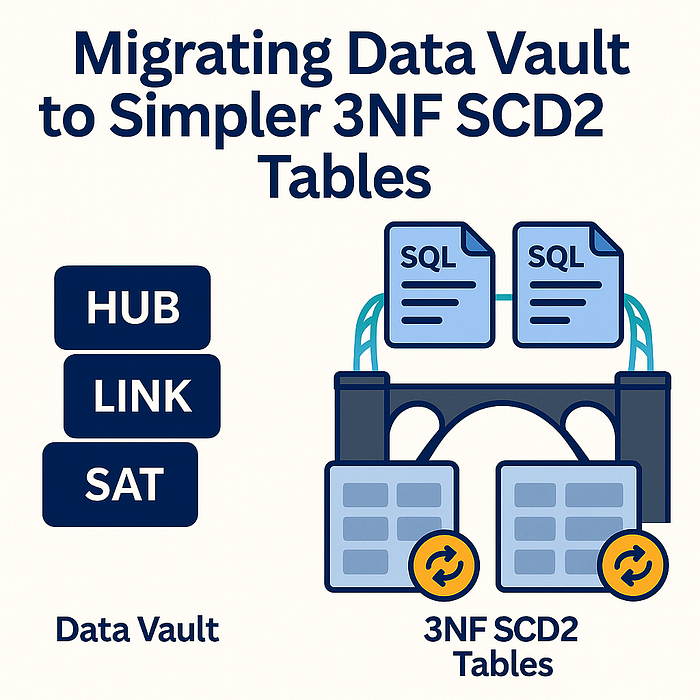
From there, we define mappings from the DV constructs to a new business-shaped logical data model (LDM) implemented in 3NF bi-temporal SCD2 tables:
- Hubs → Core entities
- Satellites → Attribute entities (bitemporal) with valid-from/valid-to
- Links → Associative entities
- Helper constructs (link satellites, multi-active satellites, keyed instance hubs, etc.) → Simplified into governed 3NF patterns
This allows us to create a migration layer: a special staging zone with queries designed to extract data from the DV world into the new LDM-shaped target.
Parsing and Metadata Extraction
Since most of the business vault logic is hidden inside SQL scripts, the methodology begins with SQL parsing:
- Step 1: Parse SQL queries to extract structural metadata (tables, joins, keys, derived columns).
- Step 2: Normalize the extracted metadata into a structured form (e.g., DuckDB, JSON, or a metadata repository).
- Step 3: Map constructs against the new LDM-based integration model.
This metadata then feeds into two types of AI-generated prompts:
- Migration prompts: Translate existing queries to equivalent transformations against the new 3NF SCD2 structure.
- Optimization prompts: Improve queries for performance, consistency, and readability.
AI-Assisted Migration
Using ChatGPT/GenAI in the process is not a “black box.” Instead, it is controlled:
- Prompts are generated per table/query based on metadata and migration rules.
- AI output is validated with automated Python scripts and validation checklists.
- Human review remains critical for edge cases and business rule interpretations.
The result is a semi-automated pipeline: fast enough to accelerate migration, but disciplined enough to ensure auditability and trust.
Re-Historizing Data
Migrating logic is only half the story — we must also replay history stored in the legacy DV tables.
- Hubs, Links, Satellites are unwound and reloaded into the corresponding 3NF SCD2 entities.
- Validity ranges (valid_from, valid_to) are reconstructed.
- Special care is taken with constructs like link satellites and multi-active satellites, which require re-interpretation under simpler 3NF rules.
This ensures the new platform carries forward the historical lineage — without carrying forward the complexity.
Validation and Risk Management
Migration is only successful if it is provably correct. That’s why validation happens on multiple levels:
- Python validations: Automated tests that compare row counts, key distributions, historization timelines, and aggregates between source (DV) and target (3NF).
- GenAI checklists: Structured prompts to confirm that query rewrites follow agreed migration patterns and do not introduce anti-patterns.
- Iterative testing: Running both layers in parallel for a period, ensuring business reporting aligns.
This layered validation builds confidence while ensuring governance remains intact.
Why This Approach Works
- Controlled: Everything starts from metadata, not guesswork.
- Semi-automated: AI accelerates query rewriting but is kept within strict guardrails.
- Business-aligned: The target model reflects the logical business model (LDM), not abstract DV constructs.
- Governed: Every step is validated, ensuring auditability and trust.
Conclusion
Migrating from Data Vault to bi-temporal 3NF is not a “rip and replace” exercise. It is a disciplined, multi-step process that reframes the legacy Vault as a source, systematically translates its logic, and replays history into a governed, business-shaped model.
By combining SQL parsing, AI-assisted rewriting, and rigorous validation, organizations can move from the weight of complexity to the clarity of 3NF — keeping the valuable concepts of Data Vault, while leaving its dogmas behind.
✍️ This article is Part 7 of the Data Vault Reconsidered series.
- Part 1: Still Relevant in the Cloud Era?
- Part 2: The Complexity of a Data Vault Implementation
- Part 3: The Data Vault Practitioner’s Glossary
- Part 4: Dan Linstedt and the Origins of Data Vault
- Part 5: What We Should Keep — DV Techniques Worth Carrying Forward
- Part 6: From Data Vault to Bi-Temporal 3NF: A Simpler Path to Governed Data Platforms
Disclaimer
This article describes an experimental, semi-automated methodology that combines SQL parsing, metadata extraction, and AI-assisted rewriting. These techniques are intended as accelerators for migration projects, not replacements for expert design, testing, and governance.
Results will vary depending on data sources, existing Vault implementations, and the target architecture. Always run extensive validations and involve domain experts before applying these approaches in production.