How to Build a Metadata-Driven Translation Layer Between Legacy and Modern Systems
Summary
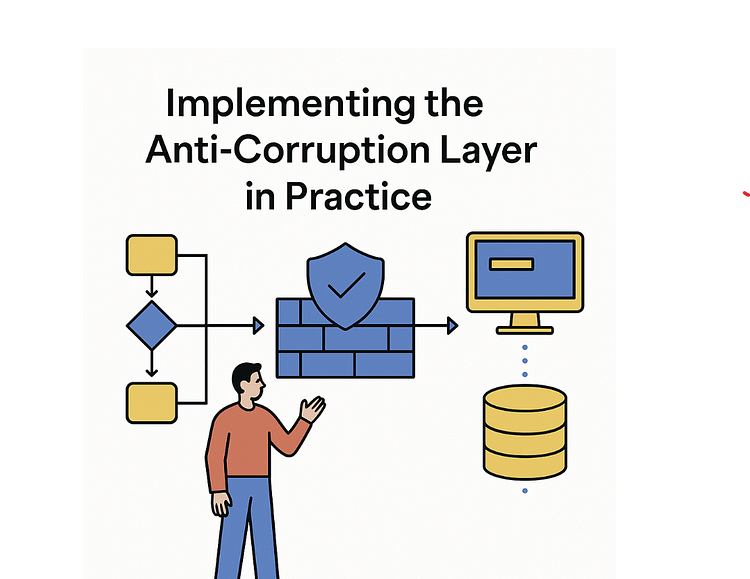
The Anti-Corruption Layer (ACL) isn’t just a theory from Domain-Driven Design — it’s a practical architectural component.
It’s the firewall of meaning between legacy systems and your modern data platform.If the Common Integration Layer (CIL) defines your organization’s shared vocabulary, then the ACL is the translator that keeps that language uncorrupted during every integration, migration, and synchronization.
This article walks through what an ACL looks like in practice: how to define it, automate it, and make it observable — step by step.
💡 1. Recap — The Purpose of the ACL
In The Metadata-Driven Anti-Corruption Layer, we defined the ACL as a semantic firewall between old and new. Its goal: prevent legacy semantics from leaking into your modern models.
In practice, it does three things:
- Translates legacy field names, codes, and data types to harmonized equivalents.
- Validates incoming data against shared business rules and constraints.
- Decouples your new model so it can evolve independently of legacy systems.
Think of it as a declarative ETL — one that translates meaning, not just data.
title:
aliases: []
status: published
tags:
– output/post
categories:
created: 2025-10-11
medium:
substack: false
paywall:
topic: Data Quality
migrated_from_calendar: 2025\Q4\11 – Nov\2025-W45 (03 Nov – 09 Nov)\2025-11-09 Sun\⚙️ Implementing the Anti-Corruption Layer in Practice
migrated_on: 2026-05-14
🧩 3. Step-by-Step Implementation
Let’s walk through a practical example: migrating an HR system into a harmonized Employee domain.
title:
aliases: []
status: published
tags:
– output/post
categories:
created: 2025-10-11
medium:
substack: false
paywall:
topic: Data Quality
migrated_from_calendar: 2025\Q4\11 – Nov\2025-W45 (03 Nov – 09 Nov)\2025-11-09 Sun\⚙️ Implementing the Anti-Corruption Layer in Practice
migrated_on: 2026-05-14
Step 2 — Map Legacy to the Common Integration Layer
Next, define mappings for each legacy source. Each mapping file acts as a translation contract.
source_system: HR_Legacy
target_entity: Employee
mappings:
EMP_ID: EmployeeID
FNAME: FirstName
LNAME: LastName
JOB_TYPE:
transform:
FullTime: “FullTime”
PartTime: “PartTime”
“C”: “Contractor”
START_DT: StartDate
These mappings describe how to translate legacy semantics into the Common Integration Layer — declaratively, not procedurally.
title:
aliases: []
status: published
tags:
– output/post
categories:
created: 2025-10-11
medium:
substack: false
paywall:
topic: Data Quality
migrated_from_calendar: 2025\Q4\11 – Nov\2025-W45 (03 Nov – 09 Nov)\2025-11-09 Sun\⚙️ Implementing the Anti-Corruption Layer in Practice
migrated_on: 2026-05-14
Step 4 — Add Validation Rules
Extend your metadata with validation constraints.
validation:
EmployeeID: not_null
StartDate: greater_than(“1900-01-01”)
EmploymentType: in_list[“FullTime”, “PartTime”, “Contractor”]
Validation rules can be translated into dbt tests or Great Expectations checks. Your ACL becomes not just a translator — but a semantic gatekeeper.
title:
aliases: []
status: published
tags:
– output/post
categories:
created: 2025-10-11
medium:
substack: false
paywall:
topic: Data Quality
migrated_from_calendar: 2025\Q4\11 – Nov\2025-W45 (03 Nov – 09 Nov)\2025-11-09 Sun\⚙️ Implementing the Anti-Corruption Layer in Practice
migrated_on: 2026-05-14
🧠 4. Implementation Patterns
There’s no single way to implement an ACL — it’s a pattern, not a product.
But the core principle remains: declarative translation and validation through metadata..
title:
aliases: []
status: published
tags:
– output/post
categories:
created: 2025-10-11
medium:
substack: false
paywall:
topic: Data Quality
migrated_from_calendar: 2025\Q4\11 – Nov\2025-W45 (03 Nov – 09 Nov)\2025-11-09 Sun\⚙️ Implementing the Anti-Corruption Layer in Practice
migrated_on: 2026-05-14
🔍 5. Observability and Testing
Every ACL should be observable and testable.
- Data quality checks — record counts, constraints, and field coverage.
- Change impact analysis — detect which mappings depend on changing attributes.
- Error tracking — log translation and validation errors clearly.
These capabilities turn your ACL into a self-auditing component — able to detect drift automatically and support root-cause analysis.
title:
aliases: []
status: published
tags:
– output/post
categories:
created: 2025-10-11
medium:
substack: false
paywall:
topic: Data Quality
migrated_from_calendar: 2025\Q4\11 – Nov\2025-W45 (03 Nov – 09 Nov)\2025-11-09 Sun\⚙️ Implementing the Anti-Corruption Layer in Practice
migrated_on: 2026-05-14
🧱 7. The Role of Interface Models in Continuous Evolution
The Anti-Corruption Layer is actually a specialized interface model — part of a broader architectural strategy to manage continuous change.
🔗 Interface Models as Semantic Buffers
Interface models exist between architectural layers to isolate them from each other’s changes:
[ Source Models ]
↓
[ Interface Models – Inbound ]
↓
[ Common Integration Layer ]
↓
[ Interface Models – Outbound ]
↓
[ Consuming / Logical Models ]
- Inbound interface models translate and align source semantics into the Common Integration Layer.
- Outbound interface models present harmonized data to consuming systems or domains.
The Anti-Corruption Layer is a specific kind of inbound interface model — one that handles translation from legacy semantics to harmonized meaning.
title:
aliases: []
status: published
tags:
– output/post
categories:
created: 2025-10-11
medium:
substack: false
paywall:
topic: Data Quality
migrated_from_calendar: 2025\Q4\11 – Nov\2025-W45 (03 Nov – 09 Nov)\2025-11-09 Sun\⚙️ Implementing the Anti-Corruption Layer in Practice
migrated_on: 2026-05-14
🧪 Regression Verification and Testing
Interface models are ideal for regression verification.
When a new model version is released, automatically generated regression queries can check:
- Do aggregates or metrics still reconcile with the previous version?
- Can new attributes still be mapped back to older semantics?
- Are all consumer interfaces still valid?
Because these definitions live in metadata, regression tests can be generated automatically — turning interface verification into a repeatable process.
title:
aliases: []
status: published
tags:
– output/post
categories:
created: 2025-10-11
medium:
substack: false
paywall:
topic: Data Quality
migrated_from_calendar: 2025\Q4\11 – Nov\2025-W45 (03 Nov – 09 Nov)\2025-11-09 Sun\⚙️ Implementing the Anti-Corruption Layer in Practice
migrated_on: 2026-05-14
🧾 8. Conclusion — Translating Meaning, Not Just Data
The Anti-Corruption Layer is not another ETL step — it’s a semantic interface pattern. It turns metadata into meaning, mappings into governance, and modernization into alignment.
🔹In a metadata-driven platform, your ACL isn’t a pile of scripts — it’s a library of semantics.
🔹Each mapping is a statement of truth, protecting your Common Integration Layer from legacy complexity.
By implementing the ACL as part of your interface model strategy, your platform becomes a living, evolvable architecture — one that can adapt continuously without losing coherence.
🧩 Metadata-Driven Architecture Series
1️⃣ Scaling Metadata-Driven Data Modeling — From Conceptual to Physical with Git and YAML
2️⃣ Generating Logical Models Automatically from Conceptual Metadata
3️⃣ The Common Integration Layer: Building a Harmonized Semantic Backbone(coming soon)
4️⃣ The Metadata-Driven Anti-Corruption Layer
5️⃣ Implementing the Anti-Corruption Layer in Practice 👈