How AI certification maps to data modeling challenges — and why the timing is perfect
Why Data Architects Should Pursue the Claude Certified Architect Credential
How AI certification maps to data modeling challenges — and why the timing is perfect
The Certification That Speaks Our Language
When Anthropic launched the Claude Certified Architect (CCA) Foundations credential in March 2026, I didn’t expect it to feel so familiar.
After 15 years in data architecture — designing Data Vaults, building dimensional models, and wrestling with metadata management — the exam domains read like a data engineer’s daily struggle translated into AI terms.
This isn’t a prompting fundamentals test. It’s a systems design exam. And that’s exactly why data architects should pay attention.

The Five Domains (Through a Data Architect’s Lens)
The CCA exam covers five competency areas. Let me map each to data architecture challenges:
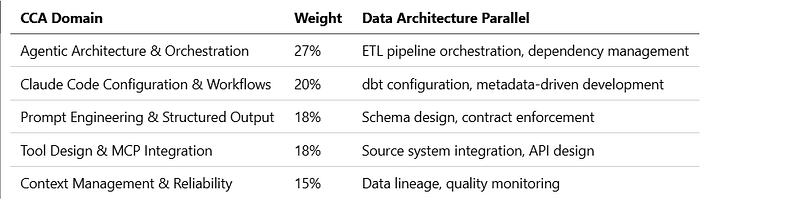
Notice anything? Over 45% of the exam focuses on architecture and configuration — not prompt tricks.
This is systems thinking, the same skill that separates a SQL script writer from a data architect.
Why Now? The Metadata-First Moment
I’ve spent the past three years building MDDE (Metadata-Driven Data Engineering), a framework that generates SQL transformations, DDL, and documentation from YAML metadata. The thesis is simple: define once, generate everywhere.
Here’s what’s changed: Claude Code now understands this approach natively.
The Old Way: Prompt Engineering Roulette
User: Generate a Data Vault hub for customer

Claude: [Generates SQL with wrong naming conventions,
         missing hash keys, incorrect temporal columns]

User: No, use SHA-256 for hash keys, add _loaded_at...

[Repeat 5 times]\
The New Way: Skills + Rules + Agents
# .claude/skills/modeling/data-vault/SKILL.md
# Loaded automatically when Data Vault patterns detected

## Hash Key Generation
- SHA-256 from normalized, pipe-delimited business keys
- Column: _hash_bk (BINARY(32))

## Temporal Columns (Required)
| Column      | Type       | Purpose             |
|-------------|------------|---------------------|
| _valid_from | TIMESTAMP  | Business time start |
| _loaded_at  | TIMESTAMP  | System time start   |
| _row_hash   | BINARY(32) | Change detection    |
With skills loaded, Claude generates correct Data Vault structures on the first attempt.
This is what the CCA exam calls “agentic architecture” — designing systems where AI agents have the context they need to succeed.
What the Exam Actually Tests
From the exam domain breakdown:
1. Agentic Architecture & Orchestration (27%)
Data Architecture Translation : How do you design multi-step pipelines where AI agents handle subtasks?
In MDDE, we spawn specialized agents:
┌─────────────────────────────────────────────────────┐
│  Lead Agent (Orchestrator)                          │
│  - Analyzes user request                            │
│  - Delegates to specialists                         │
│  - Merges results                                   │
└───────────┬───────────────────────┬─────────────────┘
            │                       │
    ┌───────▼───────┐       ┌───────▼───────┐
    │ Data Modeler  │       │ SQL Generator │
    │ Agent         │       │ Agent         │
    │               │       │               │
    │ Skills:       │       │ Skills:       │
    │ - data-vault  │       │ - sql-patterns│
    │ - dimensional │       │ - dialect     │
    └───────────────┘       └───────────────┘
This maps directly to how we think about ETL orchestration — except now the “transformations” are AI agents with specialized knowledge.
2. Claude Code Configuration & Workflows (20%)
Data Architecture Translation : How do you encode standards so they’re always applied?
The CCA exam tests your understanding of:
- CLAUDE.md : Project-level instructions (like dbt’s
dbt_project.yml) - Rules : Split configuration files (like modular profiles)
- Hooks : Automated actions on events (like pre-commit checks)
- Permissions : What agents can and cannot do (like database roles)
For data architects, this is familiar territory.
We’ve always encoded conventions — now we encode them for AI.
3. Tool Design & MCP Integration (18%)
Data Architecture Translation : How do you connect AI to external systems?
The Model Context Protocol (MCP) is described as “USB-C for AI.” It standardizes how Claude connects to:
- Databases (read schemas, execute queries)
- APIs (fetch metadata, sync changes)
- File systems (access documentation, code)
For metadata-driven development, this is transformative. My MCP servers let Claude:
- Query entity definitions from DuckDB
- Generate SQL using actual table schemas
- Validate against data contracts in real-time
The Skills Ecosystem: Progressive Disclosure for AI
One concept that clicked immediately: progressive disclosure.
From Claude’s documentation:
“Skills use progressive disclosure to keep Claude efficient — Claude first scans Skill metadata to identify relevant matches, if a Skill matches, Claude loads the full instructions.”
This is exactly how good data models work:
- High-level view : Business entities and relationships
- Medium detail : Attributes, keys, constraints
- Full detail : DDL, indexes, partitioning
Skills mirror this pattern:
- Metadata scan : “Is this about Data Vault?”
- Load instructions : “Here are the patterns”
- Load resources : “Here’s reference SQL”
We now have 21 skills covering Data Vault, Dimensional Modeling, Temporal Patterns, DAX, Fabric Direct Lake, and more.
Each encodes years of hard-won knowledge.
The $99 Bet on Your Career
The CCA Foundations exam costs $99 per attempt. For context:
- AWS Solutions Architect: $300
- Databricks Data Engineer: $200
- Snowflake SnowPro: $175
At $99, Anthropic is clearly prioritizing adoption over revenue. They want an ecosystem of certified architects who can:
- Design production Claude implementations
- Build enterprise-grade agentic systems
- Lead AI transformation projects
For data architects, this is an opportunity to translate existing expertise into AI architecture. The mental models transfer.
What I’m Studying
Based on the domain breakdown and best practices, here’s my prep focus:
High-Priority (47% of exam)
Agentic Architecture
- Subagent design patterns
- Context isolation strategies
- Error handling and fallback loops
Claude Code Configuration
- CLAUDE.md structure (keep under 150 lines)
- Rules directory organization
- Hooks for automation
- Permission wildcards
Medium-Priority (38% of exam)
Prompt Engineering & Structured Output
- JSON schema enforcement
- Preventing hallucinations
- Output parsing patterns
Tool Design & MCP
- When to use MCP vs. skills
- Tool permission boundaries
- Integration patterns
Foundation (15% of exam)
Context Management
- Manual compaction strategies
- Session management
- Long-running task patterns
The Data Architect’s Advantage
Here’s what I’ve realized: data architects are already systems thinkers.
We design:
- Pipelines with dependencies → Agentic orchestration
- Metadata contracts → Structured output schemas
- Integration patterns → MCP tool design
- Quality frameworks → Reliability engineering
The CCA exam tests these exact skills, translated to AI systems. If you’ve ever:
- Designed a medallion architecture
- Built a Data Vault with proper temporal handling
- Created dbt models with contracts and tests
- Integrated multiple source systems
You already think like a Claude Architect.
Getting Started
- Join the Claude Partner Network (free) for early exam access
- Study theClaude Code Best Practices from Anthropic
- Build a skills library for your domain (Data Vault, Dimensional, etc.)
- Configure a real project with rules, agents, and MCP servers
- Take the exam when the first 5,000 partner slots open
The certification explicitly tests production experience.
Book knowledge won’t cut it — but hands-on data architecture experience will.
The Bottom Line
The Claude Certified Architect credential isn’t about proving you can prompt. It’s about proving you can design systems where AI agents work reliably at scale.
For data architects, this is our moment.
We’ve spent years building metadata-driven frameworks, encoding conventions in configuration, and orchestrating complex pipelines.
The skills transfer directly.
The question isn’t whether AI will transform data engineering — it already has. The question is whether you’ll be designing those transformations or watching from the sidelines.
I know which side I’m choosing.
References
- Inside Anthropic’s Claude Certified Architect Program
- Anthropic Launches Claude Architect Certification
- Claude Code Best Practices
- Skills Explained: How Skills Compare to Prompts, Projects, MCP, and Subagents
- Claude Agents, Subagents, Agent Teams, Skills & MCP: A Developer’s Field Guide
- Understanding Skills, Agents, Subagents, and MCP in Claude Code
- Claude Code Best Practice Repository