When should your pipelines run? Not on a schedule — when there’s new data to process.
State-Aware Orchestration in Metadata-Driven Pipelines
When should your pipelines run? Not on a schedule — when there’s new data to process.
The Problem with Scheduled Pipelines
Hugo Lu’s article on State-Aware Orchestration identifies a fundamental issue: scheduled pipelines waste resources when:
- Data doesn’t land on time
- No new data has arrived since last run
- Models are forgotten but keep running
- Full refreshes happen when incremental would suffice
His framing of “5 assumptions that break at scale” is useful:
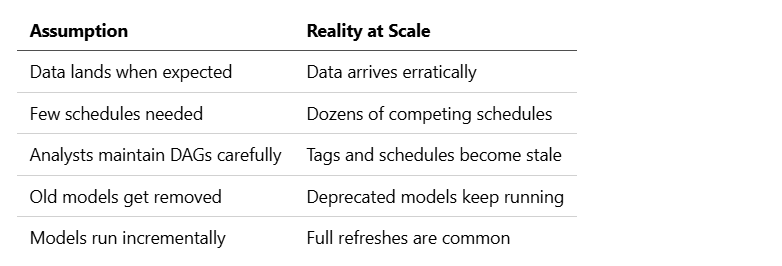
State-aware orchestration addresses this by tracking what was processed and only running when there’s work to do.
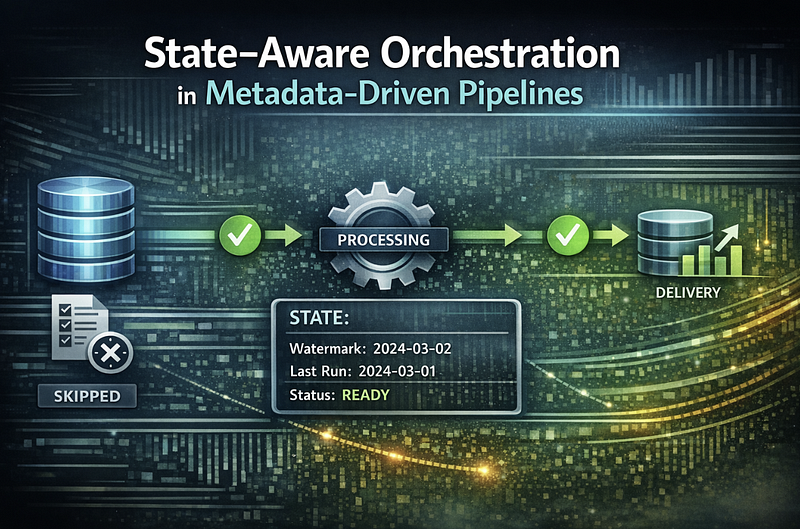
What Is State?
State in this context is metadata about what has been processed:
┌──────────────────────────────────────────────────────────────┐
│                        STATE EXAMPLES                        │
├──────────────────────────────────────────────────────────────┤
│                                                              │
│  HIGH WATERMARK                                              │
│  {"customer_table": {"last_id": 45678, "last_ts": "..."}}    │
│                                                              │
│  CHECKPOINT                                                  │
│  {"pipeline": "customer_etl", "position": "offset:12345"}    │
│                                                              │
│  MANIFEST                                                    │
│  {"model": "customer", "hash": "abc123", "modified": false}  │
│                                                              │
│  PARTITION STATE                                             │
│  {"table": "events", "partitions_loaded": ["2024-01", ...]}  │
│                                                              │
└──────────────────────────────────────────────────────────────┘
The insight: state has always existed. Kafka offsets, Spark checkpoints, Iceberg snapshots, Delta transaction logs — all are forms of state. dbt’s “state:modified” is just making this explicit for transformations.
State-Aware vs Schedule-Aware
Traditional scheduling:
# Run at 2am regardless of whether data exists
schedule:
  cron: "0 2 * * *"
tasks:
  - dbt run --select customer_model
State-aware:
# Run when source data has changed
model:
  name: customer_model
  sla: hourly
  depends_on:
    - source: crm.customers
      state: watermark
The orchestrator:
- Checks if
crm.customershas new data (watermark > last processed) - If yes → run the model
- If no → skip (no wasted compute)
How This Relates to MDDE
MDDE already tracks much of the metadata needed for state-aware orchestration:
1. Entity Lineage = Dependency Graph
entity:
  id: customer_360
  sources:
    - entity: crm_customer
    - entity: erp_customer
    - entity: web_analytics_customer
This defines what depends on what.
The orchestrator can use this to determine run order.
2. Delivery Properties = SLA Definition
entity:
  id: customer_360
  delivery_properties:
    refresh_frequency: hourly
    sla: "by 08:00 daily"
    criticality: business_critical
This is the when it needs to be ready , not when to run it.
3. Source Freshness = State Tracking
source:
  id: crm_customer
  freshness:
    loaded_at_field: _load_timestamp
    warn_after: 12 hours
    error_after: 24 hours
This is input state — has new data arrived?
4. Historization Metadata = Output State
The bi-temporal SCD2 pattern already tracks state:
-- What was last processed?
SELECT MAX(load_dts) FROM customer_scd2;

-- What's the current watermark?
SELECT MAX(valid_from) FROM customer_scd2 WHERE is_current = TRUE;
Adding State-Aware Orchestration to MDDE
New: Pipeline State Entity
entity:
  id: pipeline_state
  stereotype: operational_metadata
  description: Tracks processing state for each entity
  attributes:
    - name: entity_id
      type: string
      description: The entity being tracked
    - name: last_source_watermark
      type: timestamp
      description: Highest watermark seen in source
    - name: last_processed_watermark
      type: timestamp
      description: Highest watermark actually processed
    - name: last_run_timestamp
      type: timestamp
      description: When the pipeline last ran
    - name: last_run_status
      type: string
      description: SUCCESS, FAILED, SKIPPED
    - name: rows_processed
      type: bigint
      description: Number of rows in last run
    - name: model_hash
      type: string
      description: Hash of model definition (detect schema changes)
New: SLA-Based Scheduling
# Instead of cron schedules, define SLAs
entity:
  id: customer_360
  orchestration:
    sla:
      - name: hourly_refresh
        deadline: "+1 hour"  # Ready within 1 hour of source data
  triggers:
      - type: source_change
        sources: [crm_customer, erp_customer]
      - type: schedule
        cron: "0 * * * *"  # Check hourly, but skip if no new data
    skip_conditions:
      - no_source_changes
      - within_sla  # Already met SLA, don't re-run
New: Watermark Configuration
source:
  id: crm_customer
  watermark:
    type: timestamp
    column: updated_at

    # Or for systems without timestamps
    # type: hash
    # columns: [customer_id, customer_name, email]
The State Check Pattern
Before running any pipeline:
-- 1. Get current source watermark
WITH source_state AS (
    SELECT MAX(updated_at) AS current_watermark
    FROM source.crm_customers
),
-- 2. Get last processed watermark
processed_state AS (
    SELECT last_processed_watermark
    FROM pipeline_state
    WHERE entity_id = 'customer_360'
),
-- 3. Determine if run is needed
run_decision AS (
    SELECT
        CASE
            WHEN source_state.current_watermark > processed_state.last_processed_watermark
            THEN TRUE
            ELSE FALSE
        END AS should_run,
        source_state.current_watermark AS new_watermark
    FROM source_state, processed_state
)
SELECT * FROM run_decision;
If should_run = FALSE, skip the pipeline entirely.
Integration with Bi-Temporal SCD2
The SCD2 pattern naturally supports state tracking:
SOURCE DATA                    STATE                      TARGET SCD2
┌─────────────────┐     ┌─────────────────┐      ┌─────────────────────┐
│ id: 1           │     │ watermark:      │      │ id: 1               │
│ name: "Acme"    │     │   2024-03-01    │      │ name: "Acme"        │
│ updated_at:     │     │                 │      │ valid_from: 2024-01 │
│   2024-03-01    │     │ last_run:       │      │ valid_to: 9999-12   │
│                 │     │   2024-03-01    │      │ load_dts: 2024-03   │
└─────────────────┘     │   06:00:00      │      └─────────────────────┘
                        └─────────────────┘
No new data scenario:
 Source watermark: 2024-03-01
Last processed:   2024-03-01
Decision:         SKIP (no new data)
New data scenario:
 Source watermark: 2024-03-02
Last processed:   2024-03-01
Decision:         RUN (process 2024-03-02 data)
State-Aware vs End-to-End Orchestration
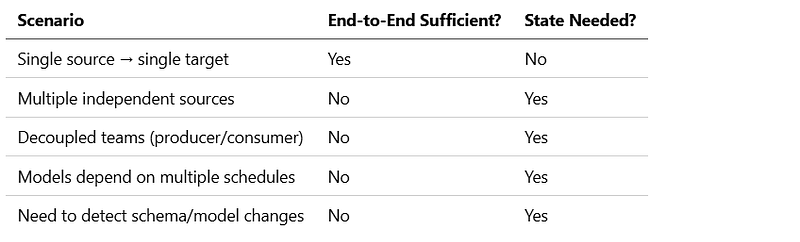
Hugo makes an important point: end-to-end orchestration often eliminates the need for state tracking.
WITH END-TO-END ORCHESTRATION:

Source System ──► Ingestion ──► Transformation ──► Delivery
      │              │               │               │
      └──────────────┴───────────────┴───────────────┘
                    Single Pipeline
If ingestion finds no data → entire pipeline stops

No need for state checks downstream
This is the pattern MDDE already supports with unified pipeline definitions:
pipeline:
  id: customer_etl

stages:
    - id: ingest
      source: crm_api
      target: raw.crm_customers
      on_no_data: stop  # Pipeline ends here if no data

    - id: historize
      source: raw.crm_customers
      target: source_hist.crm_customers
      depends_on: [ingest]

    - id: integrate
      source: source_hist.crm_customers
      target: integration.customer
      depends_on: [historize]
When to add state-aware orchestration on top:
The IDS Pattern and State
The IDS (Integrated Data Sets) pattern from our previous article has natural state boundaries:
DELIVERY ENTITY A (IDS)         DELIVERY ENTITY B (IDS)
     │                               │
     │ State: watermark_a            │ State: watermark_b
     ▼                               ▼
┌─────────────────────────────────────────────────────────────┐
│                 UNIFIED TABLE                               │
│                                                             │
│  PARTITION: entity_a, SOURCE_IDS                            │
│    └─ Last processed: 2024-03-01 06:00                      │
│                                                             │
│  PARTITION: entity_b, SOURCE_IDS                            │
│    └─ Last processed: 2024-03-01 08:00                      │
│                                                             │
│  PARTITION: entity_a, ENRICHMENT                            │
│    └─ Last processed: 2024-03-01 07:00                      │
│                                                             │
└─────────────────────────────────────────────────────────────┘
Each partition can have independent state , enabling:
- Entity A updates without affecting Entity B
- Enrichment runs only when base IDS changes
- Fine-grained watermark tracking per source
Configuration: State-Aware Pipeline
# orchestration/customer_pipeline.yaml
pipeline:
  id: customer_pipeline

  state_tracking:
    enabled: true
    storage: pipeline_state_table  # Or redis, file, etc.

  sources:
    - id: crm_customer
      watermark:
        column: updated_at
        type: timestamp
    - id: erp_customer
      watermark:
        column: modification_timestamp
        type: timestamp

  targets:
    - id: customer_360
      partition_by: [delivery_entity_id, source_type]

  orchestration:
    mode: state_aware  # vs 'scheduled' or 'triggered'
    check_interval: "*/15 * * * *"  # Check every 15 min
    run_conditions:
      - any_source_has_new_data
      - model_definition_changed
      - manual_trigger
    skip_conditions:
      - all_sources_unchanged
      - target_fresher_than_sla

  sla:
    deadline: "08:00 daily"
    alert_on_miss: true
State Storage Options
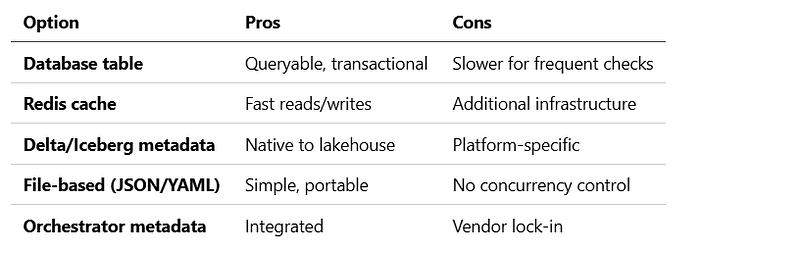
MDDE approach: store state as a regular entity with the same patterns as business data:
entity:
  id: pipeline_state
  stereotype: operational_metadata
  storage:
    type: delta_table
    location: metadata.pipeline_state
This means state is:
- Versioned (SCD2 if needed)
- Queryable
- Part of the same governance framework
- Backed up with other metadata
Impact-Driven Refresh Integration
State-aware orchestration connects to MDDE’s impact-driven refresh pattern:
# From ADR-275: Impact Analysis
impact_refresh:
  entity_id: customer_360

# Only refresh if impacted sources have new data
  impact_sources:
    - crm_customer
    - erp_customer
  # Check watermarks before running
  state_check:
    - source: crm_customer
      watermark: updated_at
    - source: erp_customer
      watermark: modification_timestamp

  # Skip refresh if no impact
  skip_if_no_impact: true
Key Takeaways
- State-aware orchestration tracks what was processed to avoid redundant runs
- MDDE already has the metadata needed (lineage, delivery properties, freshness)
- Bi-temporal SCD2 naturally supports watermark tracking via
load_dts - End-to-end orchestration often eliminates state needs for simple pipelines
- State as an entity makes it part of the governed metadata framework
- IDS + unified tables enable per-partition state tracking
- SLA-based scheduling is more declarative than cron expressions
The goal: pipelines that run when needed, not when scheduled.
This article is part of the Model-Driven Data Engineering series. Inspired by Hugo Lu’s State-Aware Orchestration article.