The Architecture Itself Becomes Queryable
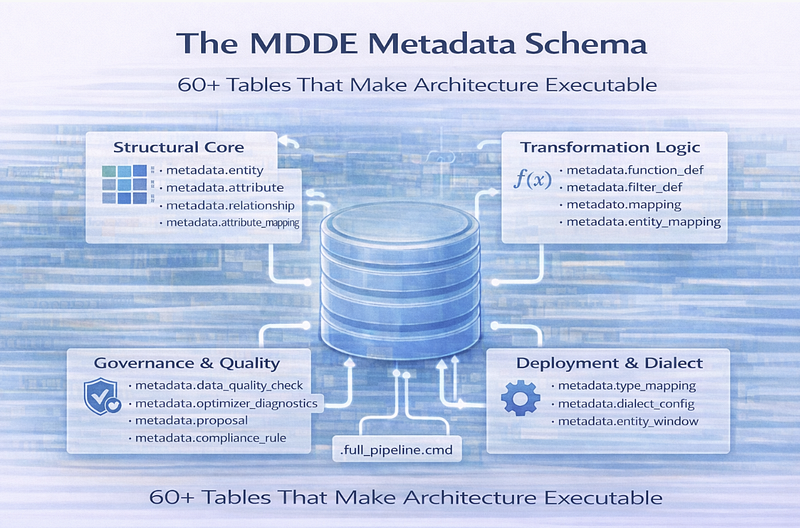
The MDDE Metadata Schema — 60+ Tables That Make Architecture Executable
The Architecture Itself Becomes Queryable
Most data platforms are built on SQL.
MDDE is built on metadata.
Not documentation metadata.
Not optional annotations.
Structured, relational metadata that describes:
- Entities
- Attributes
- Relationships
- Transformations
- Lineage
- Quality rules
- Optimizer findings
- Deployment behavior
In other words:
The architecture itself becomes queryable.
This article explains the schema that makes that possible.
Why a Metadata Schema at All?
When SQL is parsed into MDDE, it is not stored as text blobs.
It is decomposed into:
- Entities
- Attributes
- Relationships
- Expression trees
- Mappings
- Dependencies
- Window definitions
- Filters
- Functions
Each of these becomes a first-class object.
That requires structure.
The MDDE metadata schema currently consists of 60+ normalized tables, organized into four conceptual layers:
- Structural Core
- Transformation Layer
- Governance & Quality
- Deployment & Dialect
Let’s walk through them.
1️⃣ Structural Core
At the heart of the schema:
metadata.entity
metadata.attribute
metadata.relationship
metadata.attribute_mapping
These tables describe structure and lineage.
metadata.entity
Represents:
- Tables
- Views
- CTEs
- Subqueries
- Derived entities
Key columns (simplified):
entity_id
model_id
entity_name
entity_type
inheritance_kind
parent_query_id
This allows MDDE to distinguish:
- Physical tables
- Logical entities
- Derived CTE entities
- Inline UNION entities
Structure is no longer inferred from SQL text.
It is represented explicitly.
metadata.attribute
Represents columns.
attribute_id
entity_id
attribute_name
data_type
is_nullable
ordinal_position
Attributes are attached to entities.
They carry structural and semantic metadata.
metadata.relationship
Represents joins and foreign key relationships.
relationship_id
parent_entity_id
child_entity_id
cardinality
join_condition
Relationships can be:
- Explicit foreign keys
- Detected joins
- Logical relationships
- Imported model relationships
metadata.attribute_mapping
This is where lineage lives.
mapping_id
source_attribute_id
target_attribute_id
transformation_expression
Every transformation becomes a row.
This enables column-level lineage queries.
Architecture becomes relational data.
2️⃣ Transformation Layer
Where structural representation meets logic.
metadata.function_def
metadata.filter_def
metadata.mapping
metadata.entity_mapping
metadata.function_def
Reusable logic extracted from SQL.
function_id
name
expression
deterministic
Repeated expressions such as:
quantity * unit_price
Become reusable metadata objects.
This enables:
- Canonical SQL generation
- Deterministic substitution
- Pattern detection
- Optimization proposals
metadata.filter_def
Reusable conditions.
filter_id
name
expression
Filters can be normalized and reused across mappings.
metadata.mapping
Represents source-to-target transformation definitions.
mapping_id
target_entity_id
source_entity_id
mapping_type
This abstracts the idea of:
“Data flows from A to B.”
metadata.entity_mapping
Represents entity-level lineage.
Critical for:
- CTE resolution
- UNION handling
- Subquery modeling
- Dependency graph construction
This table allows the SQL generator to:
- Build correct WITH clauses
- Avoid duplicate CTE emission
- Construct dependency graphs safely
3️⃣ Governance & Quality
Where MDDE becomes operational.
metadata.data_quality_check
metadata.optimizer_diagnostics
metadata.proposal
metadata.compliance_rule
metadata.data_quality_check
Generated quality rules.
check_id
entity_id
check_type
generated_sql
severity
Examples:
- Null checks
- Duplicate detection
- Range validation
- Referential integrity
Quality is derived from structure.
Not manually scripted.
metadata.optimizer_diagnostics
Every optimizer pass emits structured output.
diagnostic_id
pass_name
scanned_count
extracted_count
severity
message
This creates:
- Observability
- CI integration points
- Measurable architecture health
metadata.proposal
Improvement lifecycle tracking.
proposal_id
observation_id
status
created_at
Proposals move through:
Draft → Proposed → Accepted → Applied → Rejected
Architecture evolves intentionally.
metadata.compliance_rule
Represents enforceable policies.
Examples:
- No
SELECT * - Mandatory primary keys
- Naming conventions
- Type consistency
Compliance can be scored.
And gated.
4️⃣ Deployment & Dialect
Where metadata becomes executable.
metadata.type_mapping
metadata.dialect_config
metadata.entity_window
metadata.type_mapping
Logical → dialect translation.
logical_type
snowflake_type
databricks_type
duckdb_type
bigquery_type
DDL generation becomes deterministic.
metadata.dialect_config
Dialect-specific rules:
- Quoting strategy
- Identifier casing
- Comment syntax
- Constraint handling
metadata.entity_window
Metadata for window functions.
window_id
entity_id
partition_by
order_by
frame_clause
Window logic is structured.
Not embedded in opaque SQL strings.
Architecture Is Queryable
Because everything is relational metadata, you can ask questions about your architecture directly.
Example:
Inspect Full Column-Level Lineage
SELECT
    tgt.entity_name,
    tgt_attr.attribute_name,
    src.entity_name,
    src_attr.attribute_name
FROM metadata.attribute_mapping m
JOIN metadata.attribute tgt_attr
  ON m.target_attribute_id = tgt_attr.attribute_id
JOIN metadata.entity tgt
  ON tgt_attr.entity_id = tgt.entity_id
JOIN metadata.attribute src_attr
  ON m.source_attribute_id = src_attr.attribute_id
JOIN metadata.entity src
  ON src_attr.entity_id = src.entity_id;
This is not a diagram.
It is a query.
🔧 Technical Deep Dive
Count Metadata Objects
SELECT
    (SELECT COUNT(*) FROM metadata.entity)        AS entities,
    (SELECT COUNT(*) FROM metadata.attribute)     AS attributes,
    (SELECT COUNT(*) FROM metadata.relationship)  AS relationships;
This is the real model footprint.
Not number of SQL files.
Not lines of code.
Structured architectural objects.
Inspect Model Complexity
SELECT
    e.entity_name,
    COUNT(a.attribute_id) AS attribute_count
FROM metadata.entity e
LEFT JOIN metadata.attribute a
  ON e.entity_id = a.entity_id
GROUP BY e.entity_name
ORDER BY attribute_count DESC;
Architecture becomes measurable.
Why This Matters
Without a metadata schema:
- SQL is opaque
- Lineage is inferred
- Governance is bolted on
- Optimization is heuristic
- CI enforcement is fragile
With a structured schema:
- Architecture is explicit
- Lineage is relational
- Optimization is measurable
- Governance is enforceable
- Deployment is deterministic
MDDE does not replace SQL.
It makes the architecture behind SQL visible.
And executable.