Why Your Queries May Return Different Results Every Time — And Why It Matters
The Hidden Danger of Non-Deterministic SQL
Why Your Queries May Return Different Results Every Time — And Why It Matters
Recently, a data team spent several days investigating what appeared to be a serious defect.
Their validation tests kept failing. The same query produced different results in different runs.
After careful analysis, they uncovered the real root cause:
SELECT
    customer_id,
    region,
    ROW_NUMBER() OVER (PARTITION BY region) AS rn
FROM customers
The migration was correct.
The SQL was broken.
Without an ORDER BY, ROW_NUMBER() assigns numbers arbitrarily. Different engines. Different execution plans. Different runs. Different answers.
The query worked — until it didn’t.
And this is more common than most teams realize.
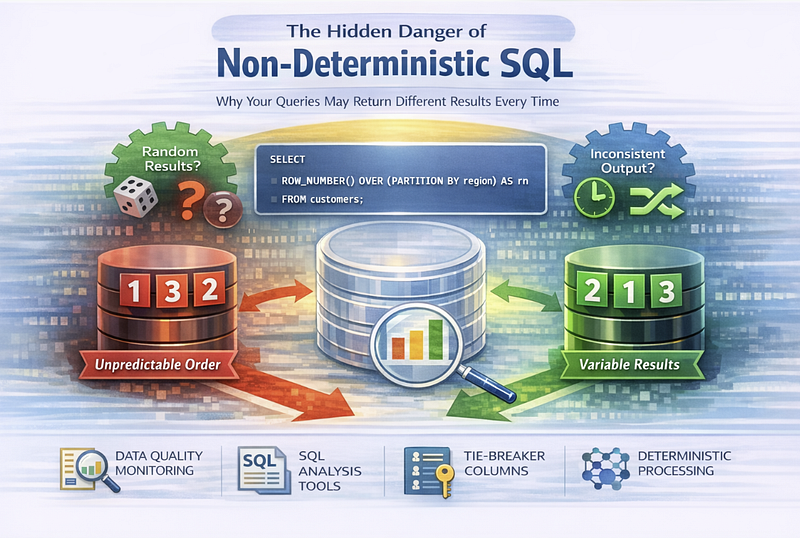
What Makes SQL Non-Deterministic?
A query is non-deterministic when it can produce different results from the same input data.
Let’s look at the most common patterns.
1️⃣ Window Functions Without ORDER BY
-- Non-deterministic
SELECT
    ROW_NUMBER() OVER (PARTITION BY department) AS rn,
    employee_name
FROM employees
Which row gets rn = 1?
The database decides.
The same applies to:
FIRST_VALUELAST_VALUELAGLEADRANKDENSE_RANK
Without an ORDER BY, the engine is free to choose any physical order.
Different query plan = different result.
2️⃣ Window Functions With Non-Unique ORDER BY
Even with an ORDER BY, you may still be unsafe:
SELECT
    ROW_NUMBER() OVER (
        PARTITION BY department
        ORDER BY hire_date
    ) AS rn,
    employee_name
FROM employees
What if two employees share the same hire_date?
Who becomes rn = 1?
Again: arbitrary choice.
Determinism requires uniqueness within each partition.
3️⃣ LIMIT Without ORDER BY
SELECT * FROM orders LIMIT 10
Which 10 rows?
Whatever the engine finds first.
Correct version:
SELECT * FROM orders
ORDER BY order_id
LIMIT 10
4️⃣ Volatile Functions
SELECT
    customer_id,
    RANDOM() AS random_value,
    NOW() AS execution_time,
    UUID() AS unique_id
FROM customers
These are intentionally non-deterministic.
But if used in transformations or tests, they break reproducibility.
Why This Actually Matters
Non-determinism is not just a theoretical purity issue.
It breaks real systems.
1️⃣ Migration & Regression Testing
When migrating platforms:
Oracle Results → Compare ← Snowflake Results
If results differ:
- Is it a migration bug?
- Or non-deterministic SQL noise?
You cannot tell.
Teams waste days chasing phantom defects while real issues hide in the noise.
2️⃣ Reproducible Analytics
Imagine your quarterly report:
- Monday: $10.2M
- Tuesday (same data): $10.4M
- Wednesday: $10.1M
If ranking or deduplication logic is non-deterministic, your numbers drift randomly.
Explaining that to a CFO is not fun.
3️⃣ Incremental Pipelines & Deduplication
Very common pattern:
WITH deduplicated AS (
    SELECT *,
        ROW_NUMBER() OVER (
            PARTITION BY customer_id
            ORDER BY updated_at
        ) AS rn
    FROM raw_customers
)
SELECT * FROM deduplicated WHERE rn = 1
If updated_at is not unique, today’s winner might be tomorrow’s loser.
Silent data changes.
Downstream corruption.
No errors thrown.
The Fix: Deterministic Tie-Breakers
The solution is simple:
Make your**ORDER BY**unique within each partition.
❌ Before (Non-Deterministic)
ROW_NUMBER() OVER (
    PARTITION BY department
    ORDER BY hire_date
)
✅ After (Deterministic)
ROW_NUMBER() OVER (
    PARTITION BY department
    ORDER BY hire_date, employee_id
)
employee_id acts as a tie-breaker.
Now:
Same input → same output → every time.
Common Tie-Breaker Columns
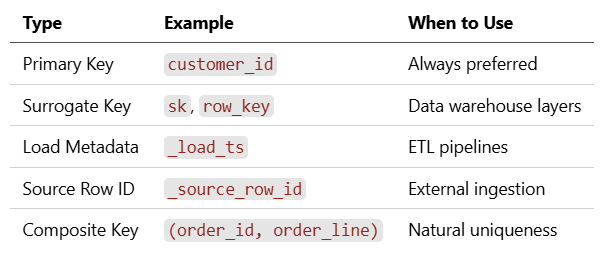
Beyond Fixing: Monitoring Determinism
Even after adding a tie-breaker, you may want to know:
- When would ties have existed?
- Are data patterns violating assumptions?
- Is dedup logic under stress?
You can add DQ monitoring columns.
SELECT
    customer_id,
    region,
    created_at,ROW_NUMBER() OVER (
        PARTITION BY region
        ORDER BY created_at, customer_id
    ) AS rn,
    COUNT(*) OVER (
        PARTITION BY region, created_at
    ) AS _dq_tie_count,
    CASE
        WHEN COUNT(*) OVER (PARTITION BY region, created_at) > 1
        THEN 'TIE_EXISTS'
        ELSE 'NO_TIE'
    END AS _dq_determinism_status
FROM customers
Now you can:
- Investigate tie scenarios
- Monitor them over time
- Detect data drift
- Prevent silent instability
This is where MDDE thinking starts to matter.
MDDE Perspective: Determinism Is Architecture
In Metadata-Driven Data Engineering (MDDE), SQL is not just code.
It is executable architecture.
Determinism must therefore be:
- Detectable (static analysis)
- Enforced (rules)
- Observable (DQ signals)
In MDDE Lite , we include a determinism checker:
from mdde_lite.determinism import check_determinism
issues = check_determinism(sql)
It detects:
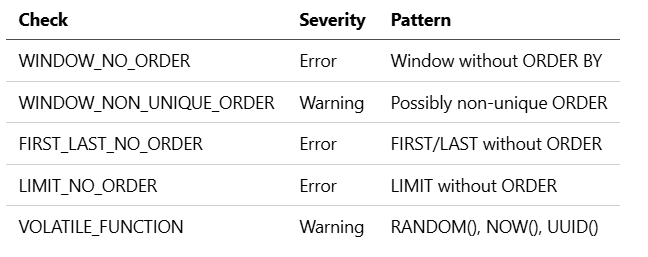
This shifts determinism from “developer discipline” to architectural guarantee.
Best Practices Summary
1️⃣ Always Include ORDER BY in Window Functions
ROW_NUMBER() OVER (PARTITION BY x ORDER BY y, z)
2️⃣ Ensure ORDER BY Is Unique
Add a primary or surrogate key as final element.
3️⃣ Never Use LIMIT Without ORDER BY
4️⃣ Parameterize Time-Dependent Filters
WHERE created_at > @report_date - INTERVAL '7 days'
Not:
WHERE created_at > NOW() - INTERVAL '7 days'
5️⃣ Monitor Tie Scenarios in Critical Logic
If it affects financial reporting, deduplication, or incremental loads — monitor it.
Final Thought
SQL should behave like a mathematical function:
Same input → Same output
If it doesn’t, it’s not just a query problem.
It’s an architectural flaw.
And architectural flaws scale.