Why Derived Queries Must Be Modeled — Not Rendered
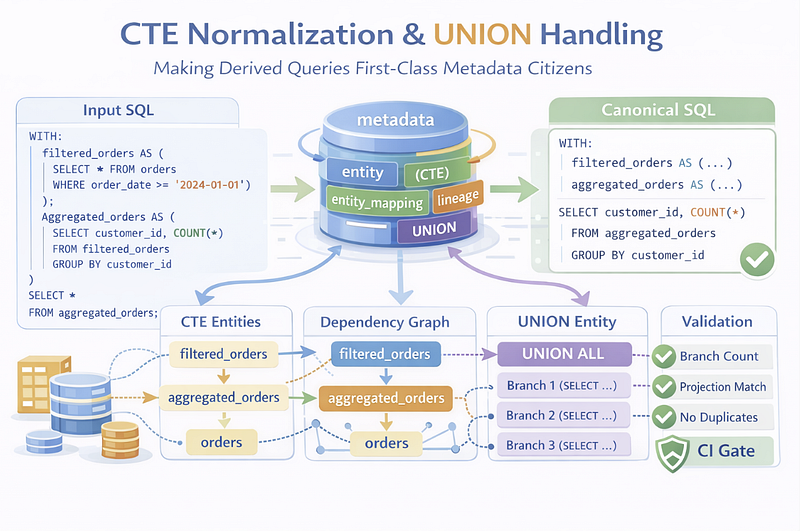
CTE Normalization & UNION Handling — Making Derived Queries First-Class Metadata Citizens
Why Derived Queries Must Be Modeled — Not Rendered
Most SQL complexity does not live in base tables.
It lives in:
- CTEs
- Subqueries
- UNION chains
- Nested derived queries
In many data platforms, these constructs are treated as textual blocks.
Parsed.
Rendered.
Forgotten.
MDDE treats them differently.
Derived queries are modeled as entities.
Not as strings.
The Problem With Textual CTE Handling
Consider:
WITH filtered_orders AS (
    SELECT *
    FROM orders
    WHERE order_date >= '2024-01-01'
),
aggregated_orders AS (
    SELECT customer_id, COUNT(*) AS order_count
    FROM filtered_orders
    GROUP BY customer_id
)
SELECT *
FROM aggregated_orders;
Traditional tooling:
- Keeps CTEs inline
- Preserves order of appearance
- Treats them as part of the final SQL blob
This causes problems:
- Lineage between CTEs is implicit
- Dependency resolution is fragile
- Duplicate CTE names become hard to detect
- UNION branches inside CTEs become ambiguous
- SQL regeneration becomes order-sensitive
MDDE normalizes CTEs into metadata entities.
CTE as Entity
When parsed, each CTE becomes:
metadata.entity
  entity_type = 'query'
  inheritance_kind = 'cte'
Lineage between CTEs is captured via:
metadata.entity_mapping
This is critical.
CTEs are not connected via parent_query_id for lineage.
parent_query_id represents structural containment.
Lineage is always represented explicitly in entity_mapping.
That architectural separation prevents subtle bugs.
Structural vs Lineage Modeling
There are two relationships at play:
- Structural containment
(Which query contains which subquery) - Data lineage
(Which entity reads from which entity)
Confusing these leads to generator instability.
MDDE enforces:
parent_query_id→ structure onlyentity_mapping.source_entity_id→ lineage only
That decision prevents generator ambiguity.
Dependency Graph Construction
Once CTEs are normalized into entities, MDDE builds a dependency graph:
Nodes:
- Query entities
- Base tables
Edges:
- entity_mapping rows
Then:
- Non-root CTE entities are pruned from standalone generation
- Topological sort determines correct WITH ordering
- Duplicate emission is prevented
This avoids:
- Re-rendering nested UNION entities
- Emitting inline subqueries twice
- Producing orphan CTEs
UNION Handling: A Structural Redesign
UNION queries are often mishandled in SQL generators.
Typical flawed model:
- Main query is parent
- UNION branches are children
- Generator tries to render all entities independently
This produces:
- Duplicate SELECT statements
- Broken nesting
- Incorrect branch ordering
MDDE redesigns UNION as a derived entity:
metadata.entity
  entity_type = 'query'
  combine_type = 'UNION' | 'UNION ALL'
Each branch becomes:
metadata.entity_mapping
  source_type = 'union_branch'
  ordinal_position = 1, 2, 3...
UNION branches are not independent queries.
They are ordered lineage components of one derived entity.
Why This Matters
Without explicit UNION modeling:
- Branch projection mismatch goes undetected
- Column alignment errors hide until runtime
- Canonical ordering becomes unstable
- Inline UNION inside CTE breaks rendering
With explicit modeling:
- Branch count can be validated
- Projection alignment can be enforced
- Canonical regeneration becomes deterministic
Guardrails in SQL Generation
Generator rules enforce:
- UNION entities must have ≥ 2 branches
- Projection schemas must align
- Non-root UNION entities cannot be rendered standalone
- WITH clauses emit each CTE exactly once
Example structural validation query:
SELECT entity_name
FROM metadata.entity
WHERE combine_type IS NOT NULL
AND entity_id NOT IN (
    SELECT DISTINCT target_entity_id
    FROM metadata.entity_mapping
);
Detects orphan UNION entities.
Inline Subqueries
Subqueries inside SELECT or WHERE clauses are modeled as:
inheritance_kind = 'subquery'
These entities:
- Have parent_query_id
- Participate in lineage
- Are never emitted as top-level SQL
This avoids accidental standalone rendering.
CTE Normalization in Migration Context
During migrations:
- Developers often inline CTEs differently
- UNION ordering changes
- Subqueries move between WITH and inline
Textual diff explodes.
Metadata normalization eliminates cosmetic drift.
Only structural changes remain visible.
That reduces migration risk dramatically.
🔧 Technical Deep Dive
Inspect CTE Lineage
SELECT
    parent.entity_name AS parent_cte,
    child.entity_name  AS child_source
FROM metadata.entity_mapping em
JOIN metadata.entity parent
  ON em.target_entity_id = parent.entity_id
JOIN metadata.entity child
  ON em.source_entity_id = child.entity_id
WHERE parent.inheritance_kind = 'cte';
Validate UNION Branch Count
SELECT entity_name
FROM metadata.entity e
LEFT JOIN metadata.entity_mapping em
  ON e.entity_id = em.target_entity_id
WHERE e.combine_type IS NOT NULL
GROUP BY entity_name
HAVING COUNT(*) < 2;
Topological Order for WITH Clause
Dependency ordering is derived from:
SELECT source_entity_id, target_entity_id
FROM metadata.entity_mapping;
Then resolved via topological sort in the generator.
The Principle
Derived queries are not formatting constructs.
They are structural entities.
Once CTEs and UNIONs are modeled explicitly:
- SQL generation becomes stable
- Dependency graphs become reliable
- Lineage becomes precise
- Migration becomes safer
- CI validation becomes enforceable
This is not about clever parsing.
It is about architectural modeling.
Next in the Advanced Series
Next we move into:
Compliance Scoring & CI Gates — Making Architecture Measurable
Where we’ll cover:
- Scoring models based on metadata
- Hard CI gates
- Structural invariants
- Enforcing deterministic design
- Optimizer diagnostics as measurable signals