The Architecture Absorption Problem
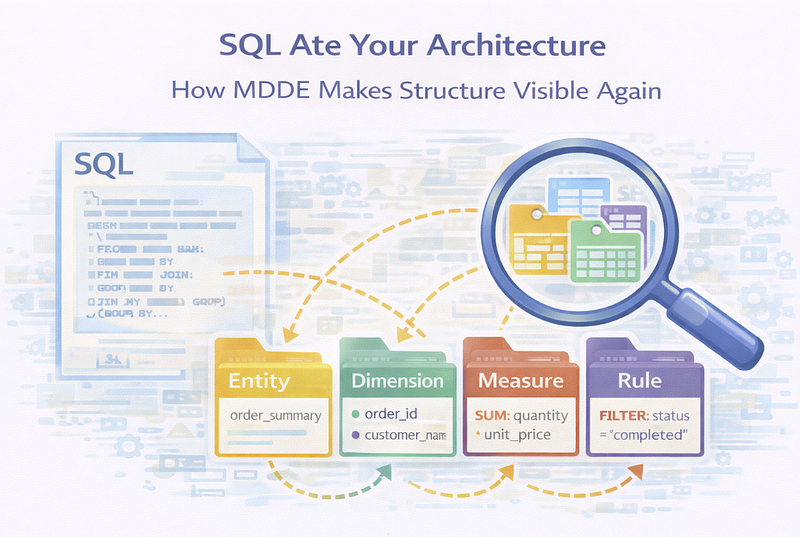
SQL Ate Your Architecture
How MDDE Makes Structure Visible Again
Your data platform works.
Queries run. Dashboards refresh. Pipelines complete.
But ask a simple question:
- What does this table represent conceptually?
- Why is this calculation defined this way?
- What breaks if I change this join?
And the answer is often:
“Read the SQL.”
That’s not architecture.
That’s archaeology.
The Architecture Absorption Problem
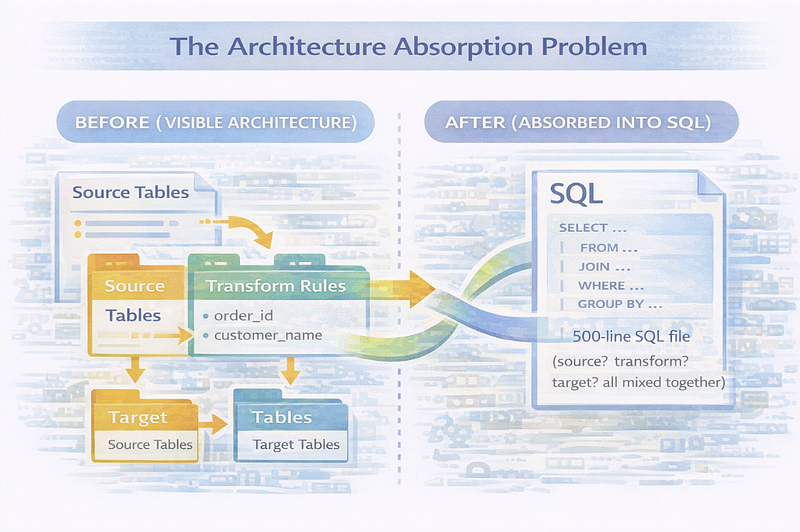
Early in a project, architecture is visible.
You have:
- Source systems
- Transformations
- Clear data flows
- Documented intent
It looks something like this:
Source → Transform → Target
Then scale happens.
More features.
More joins.
More edge cases.
More business rules.
More compliance requirements.
Gradually, structure collapses into a single layer:
SELECT ...
FROM ...
JOIN ...
WHERE ...
GROUP BY ...
A 500-line SQL file that contains:
- Business logic
- Structural modeling
- Temporal semantics
- Data quality rules
- Migration workarounds
- Performance optimizations
All mixed together.
Architecture didn’t disappear.
It was absorbed into SQL.
Why This Becomes Dangerous
SQL captures execution.
It does not capture intent.
Over time, this leads to:
- Invisible semantics
- Fear of refactoring
- Inconsistent patterns
- Duplicated logic
- Hard-to-explain lineage
Teams don’t avoid change because they lack skill.
They avoid change because they lack visibility.
After working on sustained migration programs — with regression testing, large-scale SQL analysis, and compliance-driven validation — one thing became obvious:
The real risk is not writing new SQL.
The real risk is not understanding the existing structure.
The MDDE Premise
MDDE (Metadata-Driven Data Engineering) does not replace SQL.
It treats SQL as a runtime artifact — and extracts its structural meaning.
The core idea:
- Parse SQL into structured metadata
- Surface implicit logical entities
- Make relationships and mappings explicit
- Enable observation and optimization
- Regenerate canonical SQL if desired
SQL remains central.
But architecture becomes visible again.
Take this transformation:
SELECT
    o.order_id,
    c.customer_name,
    SUM(oi.quantity * oi.unit_price) AS total_amount,
    MAX(oi.line_date) AS last_line_date
FROM orders o
JOIN customers c ON o.customer_id = c.customer_id
JOIN order_items oi ON o.order_id = oi.order_id
GROUP BY o.order_id, c.customer_name;
This query implicitly defines:
- A derived logical entity
- Attributes (both direct and computed)
- Relationships between source entities
- Aggregation semantics
- Column-level lineage
But none of that is explicit beyond the SQL text.
MDDE parses this into structured metadata.
Logical Entity
entity:
  name: order_summary
  entity_type: query
  source_entities:
    - orders
    - customers
    - order_items
Attributes
attributes:
  - name: order_id
    origin: orders.order_id
- name: customer_name
    origin: customers.customer_name
  - name: total_amount
    expression: SUM(quantity * unit_price)
  - name: last_line_date
    expression: MAX(line_date)
Relationships
relationships:
  - from: orders.customer_id
    to: customers.customer_id
    type: inner_join
- from: orders.order_id
    to: order_items.order_id
    type: inner_join
Mappings (Lineage)
mappings:
  - target: total_amount
    sources:
      - order_items.quantity
      - order_items.unit_price
- target: last_line_date
    sources:
      - order_items.line_date
Now:
- The entity boundary is explicit
- Attribute lineage is visible
- Relationships are defined
- Expressions can be extracted as reusable functions
Architecture was always there.
Now it is inspectable.
Classification Is Optional
Once logical structure is extracted, MDDE can optionally classify entities using stereotypes:
entity:
  name: order_summary
  stereotype: fact
Or:
entity:
  name: customer
  stereotype: dimension
But this is a second step.
MDDE does not assume dimensional modeling.
It extracts logical structure first — and lets modeling approaches layer on top.
In Practice (VSCode + Claude Code)
The MDDE framework is currently being built in VSCode, with Claude Code assisting in:
- Parser refinement
- Optimizer pass generation
- Metadata validation
- Canonical SQL generation
A typical workflow:
python -m mdde.importer.sql_importer path/to/sql --name sales_model
python -m mdde.scripts.analyze_model mdl_sales --verbose
python -m mdde.scripts.optimize_model mdl_sales --verbose
python -m mdde.scripts.export_model mdl_sales \
    --output workspace/applications/sql/sales_model \
    --html-documentation
The result is not abstract modeling.
It is structured visibility:
- Logical entities
- Attributes
- Relationships
- Functions
- Filters
- Source-to-target mappings
- Lineage
- Optimization proposals
SQL remains the execution surface.
Metadata becomes the architectural surface.
Visibility Without Obligation
MDDE separates:
- Observation from enforcement
- Detection from rewriting
- Insight from obligation
You can:
- Parse without generating
- Analyze without refactoring
- Detect patterns without enforcing them
Understanding comes first.
Change remains human-controlled.
This Is Not Model-Driven Perfection
MDDE does not assume:
- Systems can be perfectly modeled upfront
- Metadata replaces engineering judgment
- SQL disappears
It works the other way around:
Implementation → Extraction → Observation → Refinement
The model follows reality.
Not the other way around.
Why This Matters Now
Modern data platforms are:
- Multi-team
- Multi-dialect
- Compliance-sensitive
- Migration-heavy
- Increasingly AI-assisted
Hidden structure does not scale in this environment.
Explicit structure does.
What Comes Next
In the next article:
The MDDE Loop — Parse, Observe, Optimize, Generate
In the next article The MDDE Loop — Parse, Observe, Optimize, Generate we’ll walk through:
- The internal metadata schema
- How optimizer passes work
- How observations become proposals
- How canonical SQL is regenerated
- And how the loop remains deterministic and human-controlled
This article is part of the MDDE Framework Deep Dive (2026) series.
🔧 Technical Deep Dive — Inspecting Parsed Structure
Once SQL is imported, structure becomes queryable metadata.
Inspect Extracted Entities
SELECT
    entity_id,
    entity_name,
    entity_type,
    inheritance_kind
FROM metadata.entity
WHERE model_id = 'mdl_sales'
ORDER BY entity_name;
This shows:
- Physical tables
- Derived queries
- CTE entities
- Subqueries
Architecture is no longer hidden inside text.
Inspect Attribute Lineage
SELECT
    tgt.entity_name   AS target_entity,
    tgt_attr.attribute_name AS target_attribute,
    src.entity_name   AS source_entity,
    src_attr.attribute_name AS source_attribute
FROM metadata.attribute_mapping m
JOIN metadata.attribute tgt_attr
  ON m.target_attribute_id = tgt_attr.attribute_id
JOIN metadata.entity tgt
  ON tgt_attr.entity_id = tgt.entity_id
JOIN metadata.attribute src_attr
  ON m.source_attribute_id = src_attr.attribute_id
JOIN metadata.entity src
  ON src_attr.entity_id = src.entity_id
WHERE tgt.entity_name = 'order_summary';
This is column-level lineage, materialized.
Not inferred.
Not heuristic.