A continuous feedback cycle
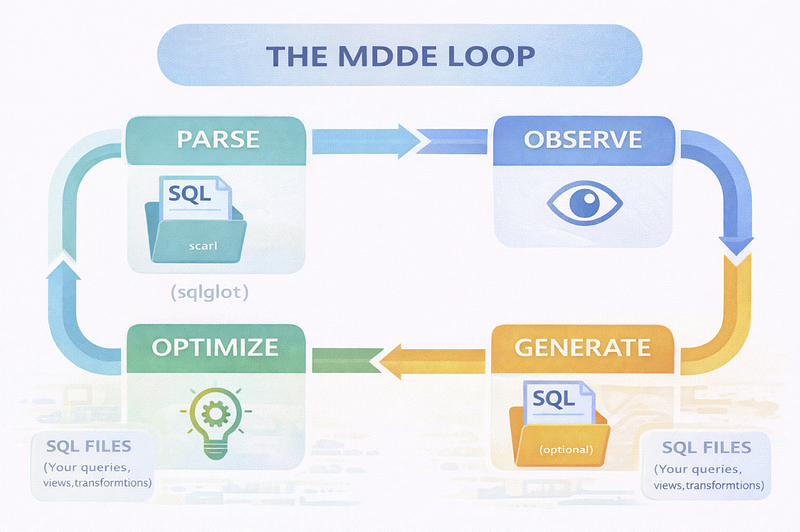
The MDDE Loop — Parse, Observe, Optimize, Generate
A Continuous Feedback Cycle
In the previous article, we looked at the architecture absorption problem:
As systems grow, structure disappears into SQL.
MDDE does not solve this by replacing SQL.
It solves it by creating a loop.Not a one-time migration step.
Not a modeling exercise.
A continuous feedback cycle.
This is the MDDE Loop:
Parse → Observe → Optimize → Generate
And then back again.
1. Parse — Extract Logical Structure From SQL
The loop always begins with existing SQL.
Not conceptual models.
Not hand-written YAML.
Not theoretical abstractions.
Real SQL.
SELECT
    o.order_id,
    c.customer_name,
    SUM(oi.quantity * oi.unit_price) AS total_amount,
    MAX(oi.line_date) AS last_line_date
FROM orders o
JOIN customers c ON o.customer_id = c.customer_id
JOIN order_items oi ON o.order_id = oi.order_id
GROUP BY o.order_id, c.customer_name;
MDDE parses this into a structured metadata model.
Under the hood, the parser extracts:
- Logical entities (tables, views, CTEs, derived entities)
- Attributes (columns with lineage)
- Relationships (joins, inferred foreign keys)
- Functions (reusable expressions)
- Filters (where conditions)
- Mappings (source-to-target attribute lineage)
In practice:
python -m mdde.importer.sql_importer path/to/sql --name sales_model
This does not rewrite your SQL.
It makes its structure explicit.
What Gets Extracted?
Logical Entity
entity:
  name: order_summary
  entity_type: query
  source_entities:
    - orders
    - customers
    - order_items
Attributes
attributes:
  - name: order_id
    origin: orders.order_id
- name: customer_name
    origin: customers.customer_name
  - name: total_amount
    expression: SUM(quantity * unit_price)
  - name: last_line_date
    expression: MAX(line_date)
Relationships
relationships:
  - from: orders.customer_id
    to: customers.customer_id
    type: inner_join
- from: orders.order_id
    to: order_items.order_id
    type: inner_join
Mapping (Lineage)
mappings:
  - target: total_amount
    sources:
      - order_items.quantity
      - order_items.unit_price
- target: last_line_date
    sources:
      - order_items.line_date
Classification Is a Secondary Step
At this stage, MDDE has not assumed:
- Fact table
- Dimension table
- Mart layer
- Integration layer
However, once logical structure is explicit, MDDE can classify entities using stereotypes.
For example:
entity:
  name: order_summary
  stereotype: fact
Or:
entity:
  name: customer
  stereotype: dimension
But classification is derived — not assumed.
The foundation is logical structure.
Why This Matters
By extracting logical entities and mappings first, MDDE avoids:
- Hardcoding dimensional assumptions
- Forcing star-schema thinking
- Overfitting to one modeling paradigm
Instead, it builds a neutral structural representation.
From there, you can:
- Apply dimensional modeling
- Apply Data Vault classification
- Apply SCD detection
- Apply compliance rules
- Apply optimizer passes
Structure first.
Semantics second.
2. Observe — Detect Patterns Without Forcing Change
Once structure is explicit, MDDE begins observing.
Observation is separate from action.
This is one of the most important design principles.
MDDE generates:
- Pattern detections
- Quality findings
- Optimization suggestions
- Compliance signals
Example observations:
- observation_id: obs_001
  category: pattern
  title: "Aggregation entity detected"
  message: "2 dimensions, 2 measures"
- observation_id: obs_002
  category: refactoring
  title: "Reusable expression detected"
  message: "quantity * unit_price appears multiple times"
- observation_id: obs_003
  category: compliance
  severity: warning
  title: "Naming convention mismatch"
Nothing is changed automatically.
Understanding comes first.
You cannot optimize what you cannot see.
3. Optimize — Structured, Reversible Improvements
Optimization in MDDE is not rewriting SQL blindly.
It is structured transformation passes applied to metadata.
Examples of optimizer passes:
- Extract reusable functions
- Normalize filters
- Detect deduplication patterns
- Classify entity stereotypes (fact, dimension, kernel, bridge)
- Identify SCD patterns
- Detect join reordering opportunities
Run optimizer:
python -m mdde.scripts.optimize_model mdl_sales --verbose
Each optimizer pass:
- Emits diagnostics
- Produces proposals
- Is reversible
- Leaves an audit trail
Optimization becomes explainable engineering — not manual rewriting.
4. Generate — Produce Canonical SQL (If You Want)
Generation is optional.
But powerful.
Once metadata is structured and optimized, MDDE can regenerate SQL:
python -m mdde.scripts.export_model mdl_sales \
    --output workspace/applications/sql/sales_model \
    --ddl --html-documentation
Generated SQL is:
- Deterministic
- Consistent
- Structured
- Documented
You can:
- Compare original vs canonical
- Adopt changes incrementally
- Keep original SQL if preferred
MDDE does not force replacement.
It enables standardization.
The Loop Is the Point
The real power is not in any single step.
It’s in the cycle:
SQL
  ↓
PARSE
  ↓
METADATA
  ↓
OBSERVE
  ↓
OPTIMIZE
  ↓
GENERATE
  ↓
SQL (again)
Each iteration:
- Reduces ambiguity
- Surfaces hidden structure
- Improves consistency
- Makes lineage clearer
- Lowers change risk
And then the loop can run again.
Human Control Remains Central
Important clarification:
MDDE does not automate architecture decisions.
It automates visibility.
Engineers decide:
- Which proposals to accept
- Which optimizations to apply
- Which rules to enforce
- When to regenerate SQL
The system reduces uncertainty.
It does not remove judgment.
Why This Loop Matters in Practice
In migration programs, this loop enables:
- Safe regression comparison
- Detection of semantic drift
- Refactoring with confidence
- Platform portability
In enterprise environments, it enables:
- Governance overlays
- Data quality enforcement
- Compliance scoring
- Multi-dialect deployment
In everyday engineering, it enables:
- Clearer reviews
- Faster onboarding
- Reduced duplication
- Observable change impact
Separation of Observation and Action
This deserves emphasis.
Many frameworks conflate detection and enforcement.
MDDE does not.
You can:
- Parse without optimizing
- Observe without generating
- Generate without enforcing
- Enforce selectively
This makes the loop safe in production environments.
Where VSCode and AI Fit
MDDE is being built in VSCode.
Claude Code is used to:
- Accelerate parser refinement
- Generate optimizer patterns
- Validate metadata structure
- Assist with deterministic generation
But the loop itself is deterministic.
AI assists development.
It does not replace the metadata engine.
Closing
MDDE is not a modeling tool.
It is not a SQL generator.
It is not a governance layer.
It is a loop that keeps architecture visible.
SQL remains execution.
Metadata becomes structure.
The loop keeps them aligned.
Next in the Series
In the next article: Workspace Anatomy — How MDDE Organizes Models, Entities, and Artifacts
We’ll go deep into:
- The folder structure
- Three-layer YAML separation
- Co-located artifacts
- Automation scripts
- Why “one entity, one folder” reduces chaos
The loop gives you structure.
The workspace makes it usable.
🔧 Technical Deep Dive — Optimizer Diagnostics in Practice
Each optimizer pass emits structured diagnostics.
Inspect Optimizer Results
SELECT
    pass_name,
    scanned_count,
    extracted_count,
    skipped_count,
    severity,
    message
FROM metadata.optimizer_diagnostics
WHERE model_id = 'mdl_sales'
ORDER BY created_at DESC;
Example result:
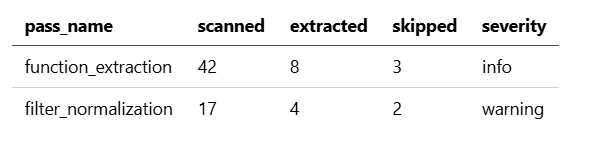
Optimization becomes measurable.
Example: Function Extraction Pass
Before:
SUM(order_items.quantity * order_items.unit_price)
After metadata extraction:
function_def:
  name: line_amount
  expression: quantity * unit_price
The aggregate now references:
SUM(line_amount)
Reusable.
Explicit.
Traceable.