💡 [[Legacy modeling tools]] are modernizing fast — but can they really compete with open, Git-native, AI-assisted metadata ecosystems?
1️⃣ From Debate to Dialogue
When I asked whether we still need traditional data modeling tools, I expected mostly practitioner reactions. What surprised me was how strongly tool vendors themselves joined the conversation.
Executives from [[SqlDBM]], [[Hackolade]], Ellie.ai, and even erwin Data Modeler (erwin DM) responded — each confirming that the industry is moving toward metadata-driven, Git-integrated, and AI-assisted modeling.
That’s a positive sign. It shows that the discussion is no longer about whether modeling is relevant, but how we modernize it.
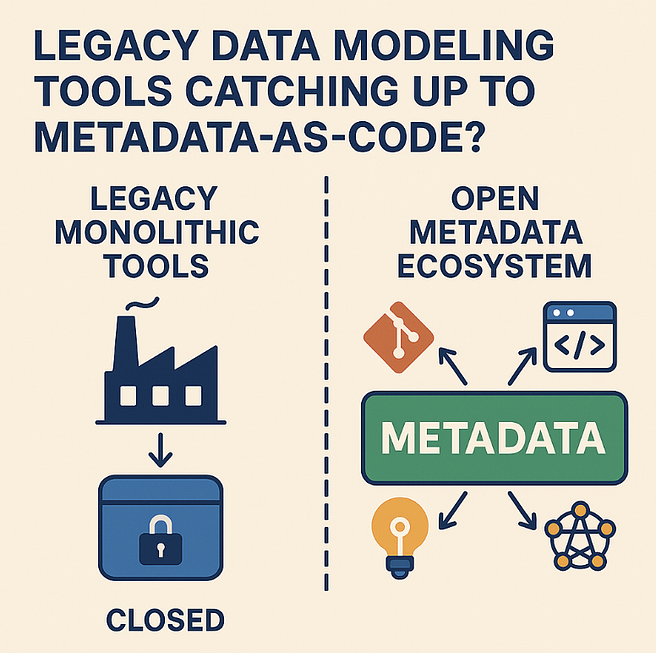
2️⃣ What the Legacy Vendors Are Saying
In their recent responses, vendors like erwin DM emphasized that their products now support modern data engineering patterns — Git integration, dbt/YAML export, CI/CD compatibility, and even initiatives around Data Mesh and autonomous data products.
These are promising developments. For years, traditional modeling tools were isolated: rich in features, but locked behind proprietary repositories and client software. If they’re truly embracing openness and DevOps principles, that’s an important step forward.
However, the key question remains:
Are these integrations native and open_, or simply_ add-ons to legacy architectures?
Based on documentation and community feedback, many teams still report challenges when trying to:
- Manage models as plain-text metadata in Git (YAML, JSON)
- Automate validation and CI/CD workflows
- Generate diagrams directly from metadata (not the other way around)
- Enable collaboration for both engineers and business users without license friction
So, while Git hooks and YAML exports exist, the paradigm shift to metadata-as-code is still in progress.
3️⃣ The New Benchmark for Modeling
The next generation of modeling environments — whether commercial or open — share five core traits:
- Open Metadata
Models stored as portable, human-readable metadata (YAML/JSON), not binary files. - Git & CI/CD Integration
Versioning, branching, and validation pipelines treat metadata like any other code asset. - Diagram Generation, Not Drawing
Visuals are created automatically from metadata, ensuring consistency and eliminating manual drift. - Business Collaboration
Browser-based or AI-assisted interfaces let business stakeholders contribute context and definitions without touching code. - AI Participation
Large language models help generate, document, and validate models turning static repositories into living knowledge systems.
Any tool — legacy or new — that meets these five criteria earns a place in the modern metadata ecosystem.
4️⃣ Why Openness Is the Deciding Factor
==The biggest differentiator isn’t the UI or the feature checklist — it’s== ==openness====.==
When metadata lives in open formats, it can flow across the entire stack:
From architecture diagrams → dbt models → data catalogs → observability → AI copilots.
Closed repositories, even if technically “Git-enabled,” still block this flow.
True modernization means removing barriers, not adding layers of integration between silos.
That’s why tools like Hackolade, SqlDBM, Ellie.ai, and CrossModel resonate so well with modern engineering teams: they were designed around interoperability first, not as an afterthought.
5️⃣ Where Legacy Tools Can Still Lead
That said, legacy vendors have one advantage that’s hard to replicate: maturity. Their frameworks for naming standards, domain rules, and validation are robust and enterprise-tested.
If they can open those strengths to modern ecosystems — via APIs, YAML interfaces, or AI-ready metadata exports — they could re-enter the race in a powerful way.
In other words:
They don’t need to reinvent themselves, only decentralize.
6️⃣ The Endgame — Modeling as a Living System
Regardless of tooling, the endgame is clear:
- Modeling as an open metadata fabric
- Connected to CI/CD and AI agents
- Expressed visually, logically, and semantically
- Governed by rules but powered by automation
That’s the world of Model-Driven Data Engineering (MDDE) —
where business, engineers, and AI all collaborate on the same living metadata layer.
Legacy tools can evolve to fit this world. But the change must go deeper than adding a Git plugin — it requires rethinking the paradigm from drawing diagrams to engineering meaning.
📚 Related Reads
📖 Beyond Tools: Metadata-Driven Modeling as a Shared Language Between Business, Engineers, and AI
💡 From debate to convergence — how the data community is redefining modeling for the metadata and AI era.
📖 Collaborative Data Modeling in VS Code — Bridging Modelers and Engineers through Metadata
A modern metadata-driven development workflow where data modelers define logic and semantics declaratively, while data engineers operationalize these definitions in SQL and Jinja macros. Powered by VS Code, JSON validation, and language-server intelligence, this approach unites modeling and engineering into a single semantic DevOps loop.
📖 Do We Still Need Traditional Data Modeling Tools?
Why VS Code, Python, AI, and Git-based metadata workflows might replace PowerDesigner, ERwin, and ER/Studio — and how we can scale this approach across conceptual, logical, and physical models.
📖 Beyond Legacy Modeling: Tools or VSCode + GenAI?
Are platforms like WhereScape, VaultSpeed, COALESCE, and SqlDBM still the right successors to PowerDesigner and erwin — or can we move to a VSCode-based, GenAI-powered modeling practice
📖 Beyond PowerDesigner: Migration Strategies and Modern Alternatives for Metadata-Driven Data Engineering
SAP PowerDesigner is reaching its End-of-Life in 2027. What should organizations do to safeguard their modelling assets, and what alternatives exist in today’s metadata-driven landscape?
📖 CrossModel Meets Model-Driven Data Engineering: A Modern Fit for Business-Friendly Mapping
How CrossModel can enhance metadata-as-data, historization, and business-friendly mapping by integrating with DuckDB, Python, and Notion.