How I use GenAI to transform the ECB’s BIRD initiative into metadata, ERDs, and dbt scaffolding
Summary
The ECB’s BIRD initiative defines a comprehensive reporting dictionary for banks, covering parties, groups, securities, positions, and ratings. I’ve applied GenAI to extract BIRD’s metadata, generate ERDs, and scaffold dbt models. BIRD demonstrates how a regulatory model can evolve into a universal reference LDM, complementing AnaCredit and RRE.

Key Takeaways
- BIRD scope: Party/Group structures, Instruments, Securities, Positions, Ratings.
- Challenge: breadth and normalization — covering multiple reporting needs in one model.
- GenAI role: parsing definitions, aligning with other models, generating YAML + dbt scaffolding.
- Outcome: reusable subject-area models for Parties, Groups, Securities, Positions.
- Lesson: BIRD shows how regulations can seed universal data models if treated as metadata.
The Context: What is BIRD?
The Banks’ Integrated Reporting Dictionary (BIRD) is an ECB initiative to standardize reporting requirements across Europe. It defines:
- Party / Group: organizations and their memberships.
- Instruments / Securities: financial products and identifiers (ISIN, types).
- Positions: holdings and balances at reporting dates.
- Ratings: credit quality assessments across systems.
This breadth makes BIRD more than a regulation — it’s a reporting meta-model. I see it as closely aligned to what I described in How Universal Data Models Support Business-Oriented Data Modeling: stable anchors that can serve multiple use cases.
The Challenge: Too Broad, Too Normalized
BIRD’s scope is impressive, but it’s also highly normalized. Without tooling, it feels overwhelming.
This reminds me of the gap I highlighted in From Coding to Modeling: The Rise of Model-Driven Data Engineering: complexity must be captured as metadata first, then re-expressed as executable, business-friendly models.
How I Apply GenAI to BIRD
Here’s how I approached it:
- Parse PDFs + GitHub repo → extract entities like Party, Group, Position, Rating System.
- Normalize names + definitions → align with AnaCredit’s Counterparty and RRE’s Property.
- Emit YAML → machine-readable specs for dbt scaffolding.
- Generate ERDs → clear subject-area diagrams.
- Build dbt models → sources, staging, marts for Parties, Groups, Securities, Positions.
This process directly reflects the metadata-first philosophy I also wrote about in Metadata as Data — Controlling and Governing Data Models.
Example YAML (BIRD Party/Group)
entities:
  party:
    keys: [party_id]
    attributes:
      - lei
      - name
      - country_code
  group:
    keys: [group_id]
    attributes:
      - group_name
  party_group_membership:
    keys: [party_id, group_id]
    attributes:
      - valid_from
      - valid_to
ERD
Press enter or click to view image in full size
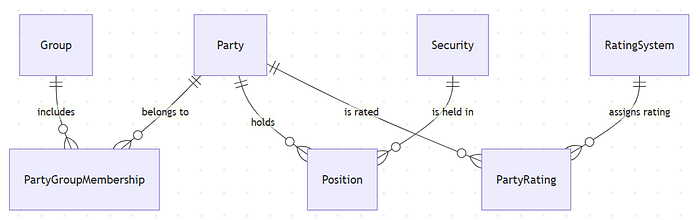
(Mermaid — convert via mermaid.live)
This ERD highlights roles and associations, a pattern I emphasized in Cooking with Data: How Business-Friendly Mapping Brings Clarity to ETL.
dbt Scaffold (Party Staging)
-- stg_bird__party.sql
select
  party_identifier as party_id,
  lei,
  party_name as name,
  country_code
from {{ source('bird','party') }};
This produces a clean, reusable view that aligns with AnaCredit’s ldm__counterparty.
Lessons from BIRD
- Breadth: covers most of the reporting landscape in one model.
- Normalization: great for governance, but needs abstraction for usability.
- Reusability: Party, Group, Security, Position entities are enterprise anchors.
- Mapping potential: aligns naturally with AnaCredit’s Counterparty and RRE’s Instrument/Property links.
Why It Matters
BIRD demonstrates that regulatory models can be more than compliance requirements — they can seed universal data models.
This resonates with what I shared in Bill Inmon’s Lasting Impact — normalized structures and universal anchors remain powerful, especially when combined with GenAI and dbt for execution.
What’s Next
Next, I’ll bring the strands together: AnaCredit, RRE, and BIRD. I’ll show how I use GenAI to propose cross-model mappings and construct a generic LDM that works as a financial services integration backbone.