How-Roelant-Vos-Data-Engine-Thinking-Supports-a-ModelDriven-Framework
Metadata patterns, mapping structures, and adaptive modeling from Roelant Vos converge to realize scalable, transparent, model-driven data engineering.
Summary
Roelant Vos’ evolving methodology — now formalized as Data Engine Thinking — brings structure, adaptability, and clarity to the core principles of model-driven data engineering.
His metadata patterns enhance business-friendly mapping and business-oriented modeling, making the triad of modeling, mapping, and automation not just complementary, but interdependent.
This article explores how Data Engine Thinking strengthens each pillar of this framework and helps build scalable, trustworthy data platforms.

The Promise of a Model-Driven Architecture
In my work, I emphasize the importance of three reinforcing principles:
- Business-Oriented Data Modeling — speak the language of the business
- Business-Friendly Mapping — make data transformations transparent and understandable
- Model-Driven Engineering — use metadata and models as the source of truth for automation
Each principle supports the others: a well-structured business model informs mapping; mapping drives code generation; code generation ensures consistency with the model.
Roelant Vos has now formalized many of the ideas supporting this approach into a comprehensive methodology: Data Engine Thinking.
What is Data Engine Thinking?
Roelant Vos recently introduced Data Engine Thinking as a new name for the design principles, metadata schemas, and automation patterns he has developed over the years. According to the official book website:
“Data Engine Thinking is a methodology to deliver a data solution that is designed to adapt to progressive understanding.”
It combines:
- Metadata-first design
- Explicit mapping structures
- Context-aware historization
- Dual timelines
- Guidelines for scalable, adaptive data solutions
With the publication of the Data Engine Thinking book, Roelant Vos offers a structured approach to building data platforms that can evolve as business understanding deepens.
1. Business-Oriented Modeling — Reinforced by Business Key Metadata
Roelant Vos emphasizes formalizing business keys using metadata constructs like Business Key Component Mappings. In practice, this means:
- Modeling business entities with clearly defined keys
- Structuring metadata to reflect how these keys are composed
- Ensuring traceability and consistency throughout the architecture
By treating business keys as first-class citizens in metadata, Data Engine Thinking makes business-oriented modeling more robust and adaptable.
2. Business-Friendly Mapping — Powered by Data Object Mapping
One of the core challenges in modern data engineering is maintaining transparency in source-to-target logic. Roelant Vos addresses this with the concept of Data Object Mapping:
- Define mappings at the metadata level
- Include business key logic and transformation rules
- Make mappings readable, versionable, and auditable
This aligns perfectly with the goal of business-friendly mapping — where transformations are not buried in code, but surfaced as structured, shareable artifacts.
3. Model-Driven Engineering — Automated from Metadata
Roelant Vos’ long-standing focus on automation has culminated in a metadata schema that supports:
- SQL code generation
- View and table creation
- Historization logic
- Data Vault structures
Data Engine Thinking makes it possible to implement a truly model-driven pipeline, where metadata is the engine behind consistent and scalable engineering.
4. Temporal Modeling & Dual Timelines
A defining feature of Roelant Vos’ methodology is the explicit separation of technical and business timelines. This allows:
- Accurate historization of data (e.g. Dual SCD2)
- Clear handling of backdated events
- Business-validity aware reporting
Incorporating this thinking helps create systems that are not just correct technically, but truthful in business terms.
5. Designed for Evolution — Progressive Understanding as a Principle
One of the most powerful aspects of Data Engine Thinking is its embrace of progressive understanding. Roelant Vos recognizes that business logic evolves, and therefore:
- Models must be versioned and adaptable
- Metadata must support change tracking
- Pipelines must be generated from source-of-truth metadata that can evolve
This approach directly strengthens the maintainability and resilience of model-driven systems.
Bringing It All Together
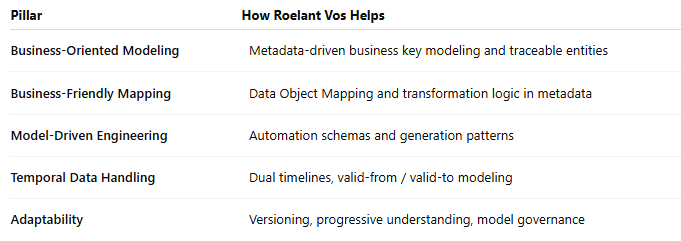
Data Engine Thinking serves as a blueprint to realize the promise of model-driven architecture in a practical, scalable, and evolving way.
Final Thoughts
Roelant Vos’ Data Engine Thinking doesn’t just support model-driven data engineering — it completes it. The methodology provides the patterns, language, and automation logic needed to build platforms where modeling, mapping, and metadata don’t just coexist, but reinforce one another.
If you’re building a business-aligned data platform, I strongly recommend exploring Data Engine Thinking.
📘 Learn more: Data Engine Thinking Book
🧠 Patterns and insights: Roelant Vos’ Blog