Data is the lifeblood of modern organizations. Yet managing it effectively remains one of the biggest challenges.
Centralized data platforms promise consistency and control, but they often become bottlenecks. Decentralized models empower teams, but can lead to fragmentation and chaos.
The Federated Common Data Platform (F-CDP) offers a middle ground — combining the reliability of central governance with the agility of domain ownership.
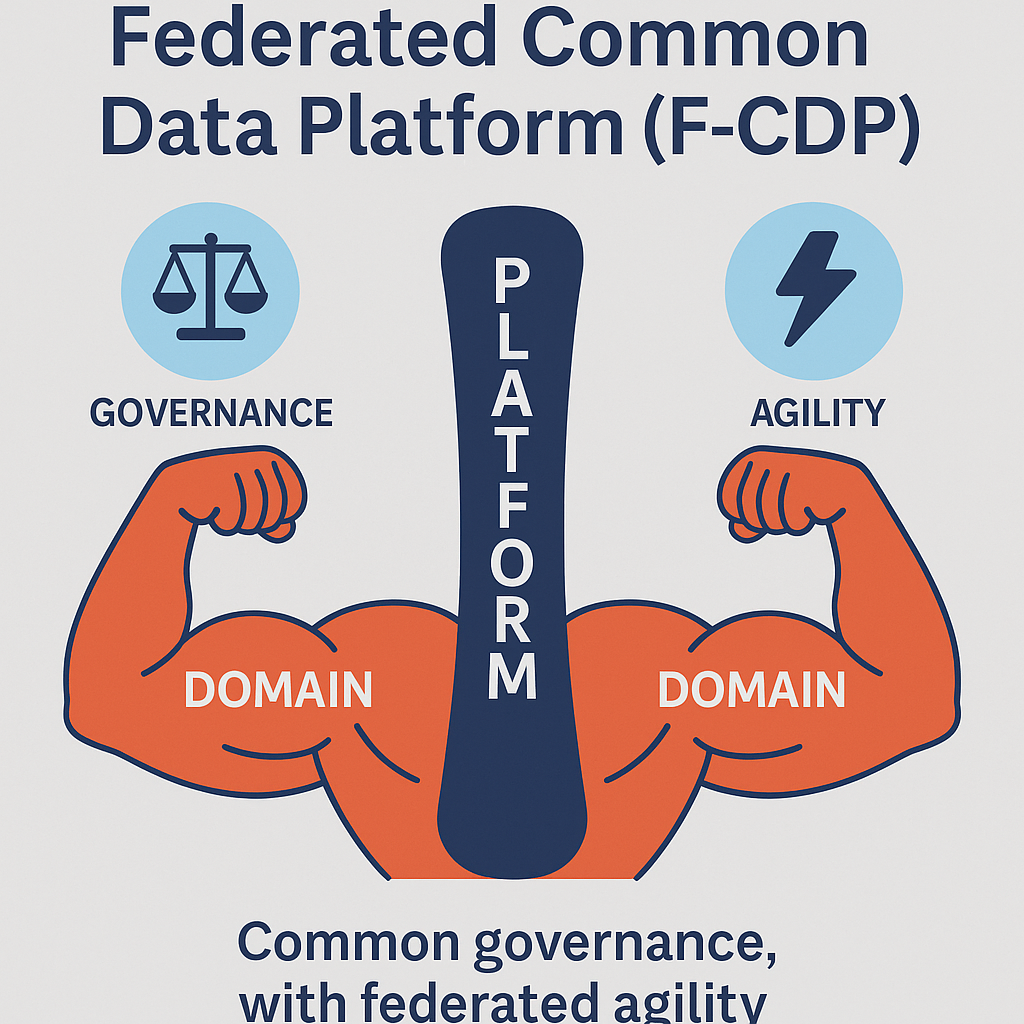
What Is a Federated Common Data Platform?
A Federated Common Data Platform is an evolution of the traditional Common Data Platform (CDP).
- A central platform team manages infrastructure, governance standards, and security.
- Domain teams own their data and publish it as data products — datasets with clear ownership, documentation, SLAs, and APIs for consumption.
- A federated governance model ensures interoperability and compliance across domains.
Think of it this way: the platform is the backbone, while the domains are the muscles that give it strength and agility.
Why It Matters
The federated approach solves a dilemma that many enterprises face:
- Agility → Domains move faster because they own their pipelines and products.
- Consistency → Central standards ensure interoperability and compliance.
- Trust → Data is closer to the business, improving quality and adoption.
- Scalability → Responsibility grows with the organization instead of overwhelming a single central team.
Key Principles of a Federated CDP
- Data as a Product
Every dataset has an owner, SLA, documentation, and is discoverable in a catalog. - Shared Infrastructure
The central platform provides tools — lakehouse, ETL, catalog, lineage, APIs — to keep things consistent. - Federated Governance
A council of central and domain representatives sets policies to balance compliance and innovation. - Progressive Ownership
Ownership expands step by step as domains build maturity.
The Path to Federation
Most organizations don’t adopt federation overnight. They evolve:
- Central CDP → A single team manages all data.
- CDP with Self-Service → Central team offers tools, domains start experimenting.
- Federated CDP → Shared responsibility between central and domains.
- (Optional) Full Data Mesh → Domains fully autonomous, platform only enables.
For many enterprises, the Federated CDP is the sweet spot: strong governance and compliance at the core, with the scalability of domain ownership.
Conclusion
The Federated Common Data Platform is more than a technology choice — it’s an organizational strategy.
By combining central governance with domain responsibility, it allows enterprises to:
- Scale without bottlenecks
- Unlock innovation at the edge
- Maintain compliance and trust at the core
In short: it’s federated by design, common at the core.