How Palantir’s Ontology compares to Kimball’s dimensional modeling—and why a model-driven, historization-first architecture offers a more sustainable middle path.
Summary
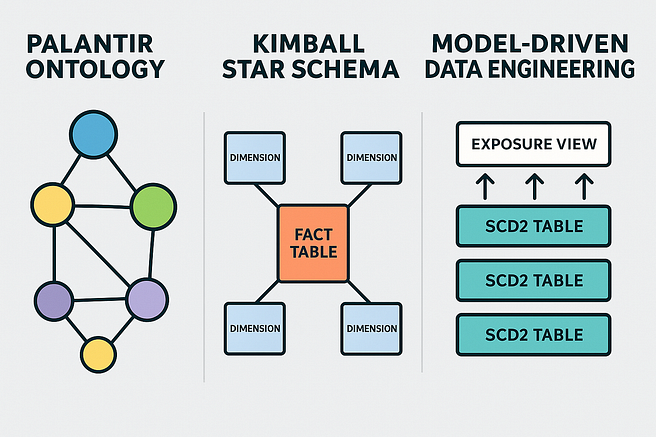
Palantir’s Ontology is a highly normalized, business-oriented abstraction layer that aligns data around business objects and relationships. It contrasts with Kimball’s star schema, which organizes data into denormalized facts and dimensions optimized for reporting.
Our model-driven data engineering approach — grounded in historization, bi-temporal SCD2, and metadata-driven views — combines the best of both worlds: business semantics and history preservation (ontology) with pragmatic usability and performance (dimensional modeling).
What Palantir’s Ontology Is
Palantir describes its Ontology as the central semantic layer for its Foundry platform:
- Data is modeled as business objects (Customer, Account, Contract, Product, Event).
- Relationships between objects are first-class citizens.
- Normalized, graph-like structure emphasizes consistency and semantics over query simplicity.
- Built for lineage, governance, and composability — every data asset can be traced back to its source.
In essence, Ontology is an object-oriented view of enterprise data, aiming to bridge technical storage with business meaning.
Kimball’s Star Schema in Contrast
Kimball’s dimensional modeling, the foundation of most BI data warehouses, emphasizes:
- Denormalization — facts (transactions, events) linked to dimensions (customer, product, time).
- Simplicity and speed — easy for business users to query with tools like Tableau or Power BI.
- Incremental delivery — each star schema can be built to deliver value quickly.
Strengths: pragmatic, user-friendly, performant for analytics.
Weaknesses: less semantic richness, poor at handling complex historization, and hard to evolve when business concepts change.
The Tension: Ontology vs. Star Schema
- Ontology (Palantir): Strong semantics, normalized, but heavy upfront investment and more complex queries.
- Star Schema (Kimball): Easy usability, but limited semantics and fragile with historical complexity.
This tension reflects a long-standing debate: do we optimize for business meaning or for business usability?
Where Model-Driven Data Engineering Fits
Our model-driven architecture offers a middle ground:
Historization as Foundation
- Unlike star schemas, we treat history as a first-class citizen.
- Dual SCD2 (Dual SCD2: The Foundation for True History) ensures both system and business time are preserved.
Views as Abstractions
- Like Palantir’s Ontology, we use metadata-driven exposure views (Designing Exposure Views) to present data in a business-oriented way.
- But these are built on reproducible patterns, not proprietary tooling.
Separation of Concerns
- Raw historized data is stored in staging / HSA / dual SCD2 layers.
- Business-friendly, dimensional-style marts can be built as needed — without losing the underlying semantics.
Model-Driven Flexibility
- Metadata and mappings drive the architecture (Metadata as Data).
- This enables agility while preserving governance — something Palantir Ontology promises but locks into its platform.
Comparative Summary
Press enter or click to view image in full size

Why This Matters
Understanding the differences helps clarify your positioning:
- Palantir Ontology shows the value of business semantics and relationships.
- Kimball shows the value of usability and performance.
- Our work brings the two together: a historization-first, metadata-driven approach where business semantics are preserved but exposed pragmatically.
In many ways, our dual SCD2 patterns, exposure views, and business-friendly mappings represent the “open-source ontology” that avoids Palantir’s lock-in while going beyond Kimball’s simplicity.
Conclusion
The debate between ontology vs. star schema is not new — it reflects two sides of the same coin: business semantics vs. business usability.
Our model-driven data engineering approach offers a third path:
- Build on historization and bi-temporal SCD2 as the foundation.
- Use metadata and mappings to define business meaning.
- Expose data through views and marts that balance semantics and usability.
In short: ontology without the lock-in, star schema without the fragility.
📝 Summary
- Palantir’s Ontology emphasizes business semantics and governance, while Kimball’s star schema emphasizes usability and speed.
- A model-driven, historization-first architecture combines the best of both, preserving history and semantics while staying pragmatic and open.