🧩 From Model-Driven to Contract-Driven: The Next Step in [[Semantic Data Engineering]]
How data models evolved from descriptive blueprints to enforceable agreements between producers and consumers
💡 Introduction: From Modeling Reality to Measuring Trust
For decades, data modeling meant describing reality — identifying entities, defining relationships, and creating diagrams that visualized structure. But in today’s metadata-driven world, the model’s purpose has changed.
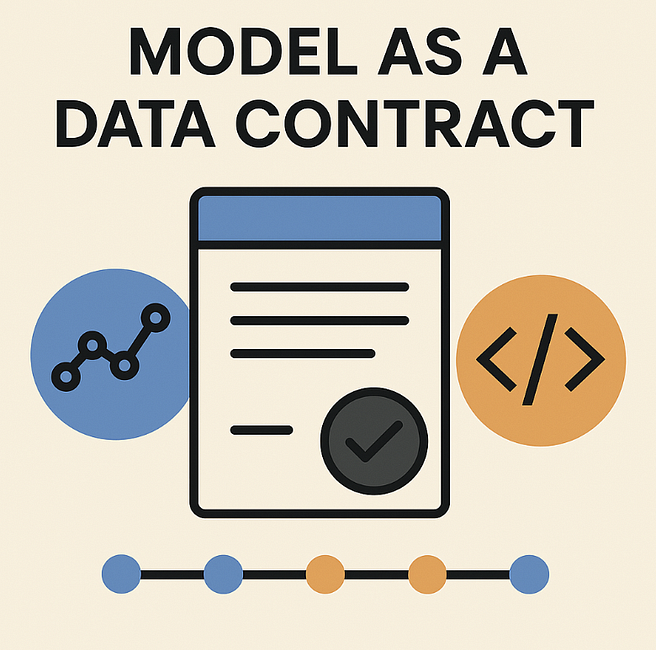
A modern model is no longer just a representation of data — it’s a contract that encodes expectations, semantics, and quality boundaries. It doesn’t only describe what data looks like; it defines what must be true for data to be trusted.
We’ve entered the era of [[contract-driven data engineering]], where models don’t just explain — they enforce.
🧭 1. From Descriptive to Measurable
==The word== ==model== ==originates from the Latin== ==modulus== ==— “a small measure.”
It once referred to a== ==standard of comparison====, not a drawing.==
This origin reveals something profound:
==A model is a measure of how well a system holds together.==
In this sense, a good model not only defines structure — it quantifies coherence. It tells us whether our data, relationships, and semantics remain consistent with our intent.
That’s why modern platforms like dbt and SQLMesh treat models as both logic and test. The model describes what data means and simultaneously measures its validity.
🧱 2. Boundaries of Meaning: The Semantic Contract
Every data product exists within a boundary of interpretation — a shared understanding of what things mean.
A model defines that boundary.
- It specifies which entities matter (customers, transactions, policies).
- It defines how they relate.
- And it encodes what rules govern them.
When that boundary is explicit and versioned — as a data contract — both producers and consumers can evolve independently yet remain aligned.
This is why a semantic layer is not just a technical feature — it’s a social agreement captured in code. It is the API of meaning.
🧪 3. Embedded Quality and Defensive Design
Traditional data quality came after the fact: validate data once it landed in a warehouse. Contract-driven systems invert this logic.
Quality expectations live inside the model.
- Constraints, assertions, and tests are declared next to schema definitions.
- Lineage and dependencies are generated automatically from metadata.
- Pipelines validate themselves before deployment.
This is defensive modeling — anticipating failure and preventing inconsistency by design. It’s not just automation — it’s governed automation.
⚙️ 4. Declarative by Design
Declarative modeling changes the relationship between humans and machines. Instead of telling the system how to build, we define what must be true.
The model becomes a policy, not a script. From there, tools can:
- Generate SQL or transformations automatically,
- Enforce lineage and versioning,
- Validate compatibility across domains.
Declarative metadata is the bridge between documentation and execution. It’s how AI and automation can reason about data without relying on brittle procedural code.
🌐 5. Contract-Driven Architecture: The Foundation of the Metadata Mesh
In a metadata mesh, each domain defines its own model-as-contract — a semantic boundary with its own rules and assurances. These contracts are published, discoverable, and interoperable.
Cross-domain collaboration then becomes contract negotiation — not ad-hoc integration.
- Domain A promises to deliver data conforming to its contract.
- Domain B consumes it, verifying the contract before use.
- Shared APIs ensure compatibility and enforce semantics.
This is how meaning, trust, and autonomy coexist at scale.
🚀 6. The Future: Executable Semantics
We are moving toward a future where:
- Models are versioned agreements stored in Git.
- Contracts are validated in CI/CD before data moves.
- Lineage is semantic, not just technical.
- AI agents can interpret and enforce these rules dynamically.
This is not only metadata-driven — it’s meaning-driven. The model has evolved into the ultimate interface between human intent and machine execution.
🧩 Real-World Validation: Airbnb’s Minerva
These ideas are no longer theoretical. Airbnb’s internal semantic platform, Minerva, shows how contract-driven thinking extends beyond models into metrics. By treating metrics as versioned code and enforcing governance through CI/CD, Minerva operationalizes the same principles of semantic alignment, versioning, and trust at enterprise scale.
It’s a clear signal that the model-as-contract philosophy is evolving into a broader discipline — one that unifies modeling, metrics, and governance under the same engineering principles.
🧩 Closing Thoughts
🔹Model-driven data engineering gave us structure.
🔹Contract-driven data engineering gives us trust.
As semantics, measurement, and automation converge, our models are no longer passive blueprints — they’re active guarantees. They define how data should behave, not just how it’s stored.
In the end, a data model is not just a reflection of reality — it’s the agreement that keeps reality consistent.
🧾 Summary
🔹Data models are evolving from descriptive blueprints into measurable, enforceable contracts.
🔹By treating the model as both a semantic definition and a quality boundary, organizations can align meaning, trust, and automation across teams.
🔹Contract-driven data engineering unites modeling, testing, and governance — turning metadata into a living agreement between data producers and consumers.
🔹The result is not only better data pipelines but also stronger semantics, defensive design, and governed automation across the enterprise.