Clarifying the relationship between reusable domain products and tailored data views
Summary
As data platforms evolve toward domain-oriented, product-driven architectures, the distinction between Data Products and Consumer Datasets becomes critical. This article explains their relationship, roles, and how metadata-driven management ensures consistency, traceability, and scalability across teams and domains.
The Context
Modern data platforms are no longer monolithic pipelines feeding endless dashboards.
They are ecosystems of reusable, governed Data Products — and fit-for-purpose Consumer Datasets built on top of them.
Yet, these two concepts are often blurred. Teams talk about “datasets,” “products,” and “views” interchangeably, leading to inconsistent ownership, duplication, and governance gaps.
Let’s make the distinction clear.
Data Products: The Trusted Building Blocks
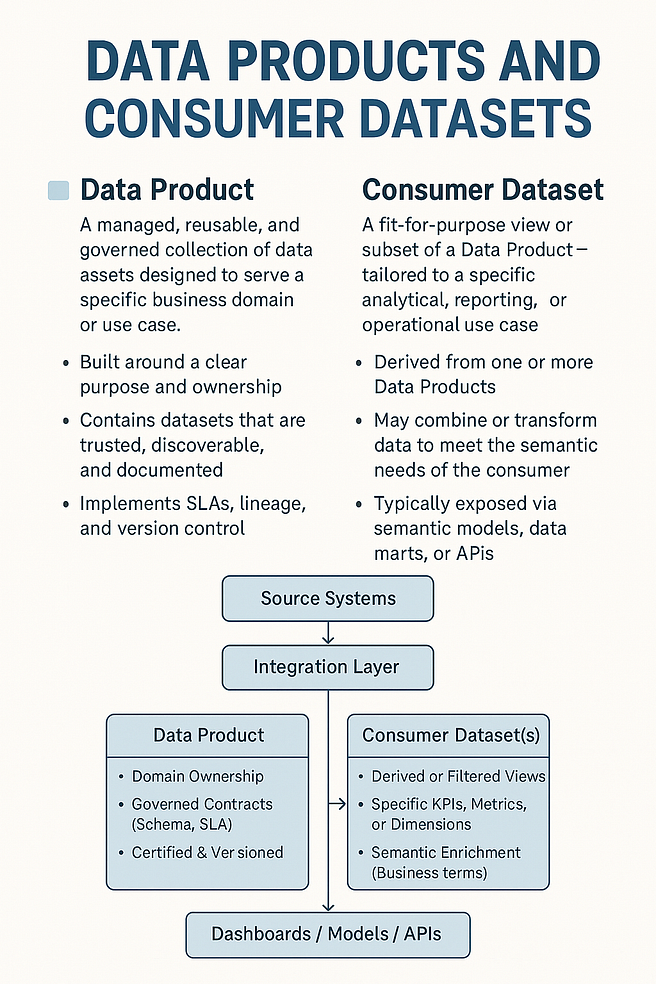
A Data Product is a managed, reusable, and governed collection of data assets designed to serve a specific business domain or use case.
Each Data Product:
- Is built around a clear purpose and ownership (typically a domain team).
- Implements SLAs, lineage, and version control.
- Contains certified datasets that are discoverable and documented.
- Aligns with a business domain or capability (e.g., Customer, Product, Transaction).
Think of a Data Product as a contract between data producers and consumers: a consistent interface to high-quality, versioned domain data.
Consumer Datasets: Tailored for Purpose
A Consumer Dataset is a fit-for-purpose view or subset of one or more Data Products — designed for a specific analytical, operational, or reporting need.
Each Consumer Dataset:
- Is derived from certified Data Products.
- Transforms or enriches data to meet the semantic needs of a consumer.
- Is typically exposed through semantic models, data marts, or APIs.
Consumer Datasets are contextual lenses that translate trusted data into business insights.
How They Relate
[ Source Systems ]
       │
       ▼
[ Integration Layer ]
       │
       ▼
[ Data Product ]
  ├── Domain Ownership
  ├── Governed Contracts (Schema, SLA)
  ├── Certified & Versioned
       │
       ▼
[ Consumer Dataset(s) ]
  ├── Derived or Filtered Views
  ├── Specific KPIs, Metrics, or Dimensions
  ├── Semantic Enrichment (Business terms)
       │
       ▼
[ Dashboards / Models / APIs ]
In this structure:
- Data Products form the stable, reusable core.
- Consumer Datasets deliver business-specific outputs.
- Both are connected through metadata and lineage, enabling transparency and governance.
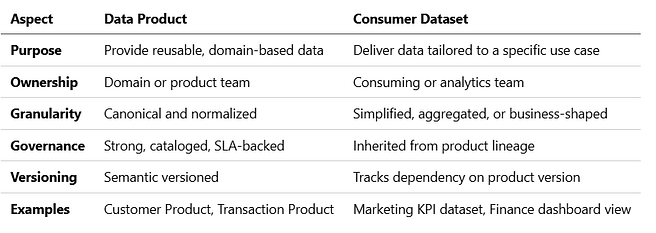
Comparing the Two
Press enter or click to view image in full size
Design Principles
- Separation of concerns:
Products manage quality and contracts; Consumer Datasets handle business logic. - Traceability:
Every dataset must link back to its originating Data Product(s). - Metadata-driven governance:
Relationships are maintained in the metadata repository for impact analysis and reuse. - Reusability through the Business LDM:
Common business entities (Customer, Product, Contract) form the foundation of reusable Data Products.
Example
A Customer Data Product standardizes attributes such as:
Customer_ID, Customer_Type, and Segment.
A Marketing Campaign Dataset uses these attributes, enriches them with campaign data, and exposes KPIs for dashboards — all while maintaining lineage back to the Customer Product.
Key Insights
- Data Products are sources of truth.
- Consumer Datasets are semantic bridges between raw data and business decisions.
- Metadata management makes the relationship between them governable and observable.
- Together, they enable controlled evolution of the data platform, supporting agility without chaos.