Stop hand-coding stars. Turn your governed, bi-temporal 3NF into fast, user-friendly facts & dimensions automatically.
Generating Dimensional Models Automatically from a Historized 3NF
Stop hand-coding stars. Turn your governed, bi-temporal 3NF into fast, user-friendly facts & dimensions automatically.
Series Overview
From Historized 3NF to Fast, Governed Analytics — A Metadata-Driven Journey (5 parts)
- Why Start from a Business-Shaped, Historized 3NF
- Generating Dimensional Models Automatically ← you’re here
- Automating with Metadata & dbt
- Solving Many-to-Many & Drill-Across with the Unified Star Schema
- Putting It All Together
⚡ Recap from Part 1
We built the case for a business-oriented, bi-temporal 3NF integration layer with:
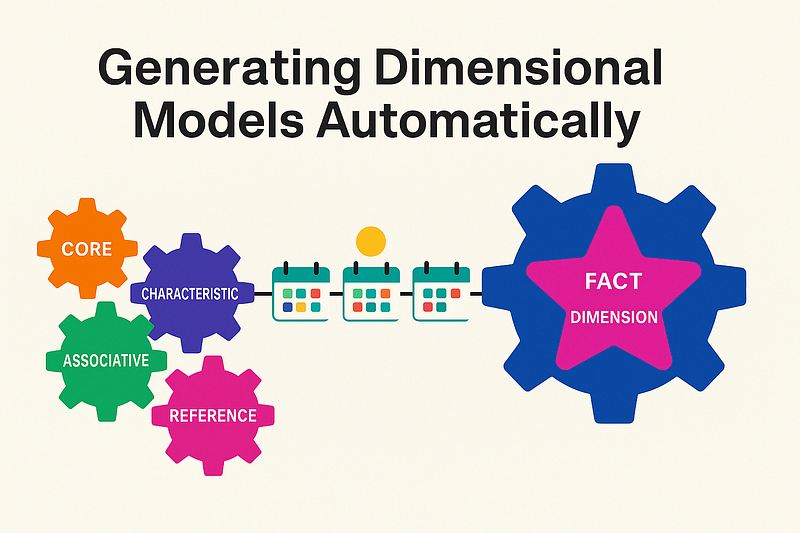
- Core / Characteristic / Associative / Reference entities
- SCD2 historization (valid & recorded timelines)
- Surrogate keys
- Point-In-Time (PIT) tables for fast “as-of” lookups
Now we’ll flatten this governed model into dimensional stars that BI tools love.
🗂️ Step 1—Identify Facts
Facts are usually events or relationships (Associative entities) or sometimes Characteristic events.
Examples:
ClaimParticipation, Shipment, Sale, PolicyPremium
They have measures (amounts, counts) and foreign keys to other entities.
🧭 Step 2 — Identify Dimensions
Dimensions describe the fact: who, what, when, where, how.
- Typically Core or Reference entities (Customer, Product, Policy, Time).
- Trace M:1 paths upward from the fact.
- Avoid 1:M or M:M to prevent row explosions.
Because your integration layer already integrates subtypes into supertypes , you’ll usually have one clean Customer dimension instead of many near-duplicates.
🧩 Step 3 — Turn SCD2 History into Snapshots
Create a snapshot view for each historized table:
-- Customer snapshot
CREATE OR REPLACE VIEW snap.d_customer AS
SELECT
    cp.snapshot_date,
    c.customer_sk,
    c.business_key,
    c.name,
    c.segment,
    c.valid_from,
    c.valid_to,
    c.recorded_from,
    c.recorded_to
FROM pit.customer_pit cp
JOIN integ.customer c
  ON cp.customer_sk = c.customer_sk;


-- Claim participation snapshot
CREATE OR REPLACE VIEW snap.f_claim_participation AS
SELECT
    cpp.snapshot_date,
    f.claim_participation_sk,
    f.claim_amount,
    f.reserve_amount,
    f.customer_sk,
    f.policy_sk,
    f.product_sk
FROM pit.claim_participation_pit cpp
JOIN integ.claim_participation f
  ON cpp.claim_participation_sk = f.claim_participation_sk;
Each PIT maps snapshot_date → surrogate key ; snapshot views resolve SCD2 timelines so queries don’t.
🔗 Step 4 — Build Stars with Simple Joins
CREATE OR REPLACE VIEW mart.f_claim_participation AS
SELECT
    f.snapshot_date,
    f.claim_participation_sk,
    f.claim_amount,
    f.reserve_amount,
    c.customer_sk,
    p.policy_sk,
    pr.product_sk,
    t.time_sk
FROM snap.f_claim_participation f
LEFT JOIN snap.d_customer  c  ON f.snapshot_date = c.snapshot_date AND f.customer_sk = c.customer_sk
LEFT JOIN snap.d_policy    p  ON f.snapshot_date = p.snapshot_date AND f.policy_sk    = p.policy_sk
LEFT JOIN snap.d_product   pr ON f.snapshot_date = pr.snapshot_date AND f.product_sk  = pr.product_sk
LEFT JOIN d_time           t  ON f.snapshot_date = t.calendar_date;
**BETWEEN valid_from AND valid_to**in queries.- Joins are snapshot_date + surrogate key → fast and deterministic.
- Facts & dimensions remain fully SCD2 and bi-temporal aware.
🌟 Benefits
- Performance: snapshot joins are light and predictable.
- Simplicity: analysts avoid temporal logic.
- Governance: PIT + surrogate keys give one version of the truth.
- Reusability: snapshots power any star or semantic layer.
🔮 Next: Automate It
Your entity types and relationships are already metadata-driven. Next we’ll show how to export that metadata and generate the SQL automatically using dbt macros and CI/CD in Part 3:Automating with Metadata & dbt
📜 Summary
Flattening a historized 3NF into snapshot views and stars turns a complex, bi-temporal model into a fast, analyst-friendly schema.
It keeps governance intact and sets the stage for metadata-driven automation.
✅ Key Takeaways
- Use PIT tables to pre-resolve SCD2 timelines.
- Build snapshot views — one per entity/fact — keyed by
snapshot_date. - Generate stars with simple joins (snapshot_date + surrogate key).
- This pattern keeps history, performance, and governance while simplifying BI.
👉 Next in the Series
Part 3 — Automating Dimensional Models with Metadata & dbt