Structural normalization and determinism
Join Reordering & Structural Optimization — When Metadata Becomes an Optimization Surface
Structural normalization and determinism
SQL optimizers inside databases already reorder joins.
So why would a metadata-driven framework care?
Because there are two very different concerns:
- Runtime execution optimization (handled by the database engine)
- Structural normalization and determinism (handled by MDDE)
These are not the same problem.
MDDE does not attempt to replace the database optimizer.
It ensures that the structural representation of joins is:
- Explicit
- Deterministic
- Canonical
- Traceable
Before SQL ever reaches execution.
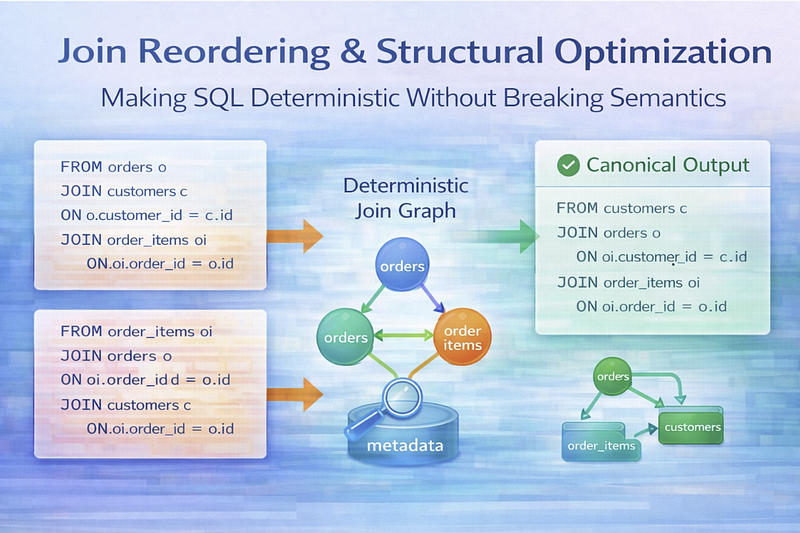
The Structural Problem
In real systems, equivalent queries are often written differently:
FROM orders o
JOIN customers c ON o.customer_id = c.id
JOIN order_items oi ON oi.order_id = o.id
vs
FROM order_items oi
JOIN orders o ON oi.order_id = o.id
JOIN customers c ON o.customer_id = c.id
These are logically equivalent.
But structurally different.
Which means:
- Lineage graphs differ
- Canonical SQL differs
- Diffs become noisy
- Optimizer diagnostics become unstable
MDDE aims for structural determinism.
Canonical Join Ordering
When SQL is parsed, joins are represented as relationship metadata:
metadata.relationship
metadata.entity_mapping
Each relationship has:
- Parent entity
- Child entity
- Join condition
- Join type
- Cardinality (when available)
Instead of preserving textual order, MDDE builds a join graph.
Then applies deterministic ordering rules.
Deterministic Ordering Strategy
A simple canonical rule might be:
- Root entity first
- Then breadth-first expansion
- Alphabetical fallback for ties
Example canonical output:
FROM customers c
JOIN orders o ON o.customer_id = c.id
JOIN order_items oi ON oi.order_id = o.id
This ensures:
- Stable regeneration
- Clean diffs
- Predictable lineage
- Deterministic SQL
The goal is not runtime optimization.
The goal is structural stability.
Join Graph Modeling
Join structure is represented internally as a graph:
Nodes:
- Entities
Edges:
- Relationships
Example query:
customers
   │
   └── orders
           │
           └── order_items
MDDE stores this as relational metadata.
Then generates join order based on graph traversal.
Cost-Based Hints (Optional Layer)
MDDE can optionally incorporate:
- Relationship cardinality
- Known primary/foreign keys
- Join selectivity metadata
- Historical row count statistics
Not to replace the database optimizer.
But to:
- Detect problematic patterns
- Flag cross joins
- Identify fan-out explosions
- Suggest safer join anchors
Example diagnostic:
SELECT *
FROM metadata.optimizer_diagnostics
WHERE pass_name = 'join_analysis';
Output:

Structural awareness improves architectural quality.
Avoiding Semantic Drift
Join reordering must be safe.
MDDE does not reorder joins when:
- Outer joins are involved in unsafe positions
- Window functions depend on join order
- Filter placement changes semantics
Semantic protection rules are embedded in optimizer passes.
Reordering is only applied when provably equivalent.
Why This Matters in Migration
In migration programs:
- Equivalent SQL is often rewritten
- Join order changes create noise
- Reviewers struggle with diff overload
- Structural drift hides logical drift
Canonical join ordering eliminates cosmetic differences.
It isolates real semantic changes.
That reduces migration risk.
🔧 Technical Deep Dive
Inspect Join Graph
SELECT
    parent.entity_name AS parent,
    child.entity_name  AS child,
    r.join_condition
FROM metadata.relationship r
JOIN metadata.entity parent
  ON r.parent_entity_id = parent.entity_id
JOIN metadata.entity child
  ON r.child_entity_id = child.entity_id
WHERE parent.model_id = 'mdl_sales';
Detect Potential Many-to-Many Joins
SELECT *
FROM metadata.relationship
WHERE cardinality = 'many-to-many';
Regenerate Canonical SQL
python -m mdde.scripts.export_model mdl_sales --canonical
Closing
Databases optimize execution.
MDDE optimizes structure.
When structure is deterministic:
- Diffs are clean
- Reviews are faster
- Lineage is stable
- Governance is reliable
Optimization begins before runtime.
It begins in metadata.