Treat quality rules as metadata
Data Quality as Metadata — Checks, Profiles, and Contracts Derived From Structure
Treat quality rules as metadata
Most data quality implementations begin with queries.
SELECT COUNT(*) FROM customer WHERE customer_id IS NULL;
Or:
SELECT customer_id, COUNT(*)
FROM customer
GROUP BY customer_id
HAVING COUNT(*) > 1;
Useful, but fragile.
Why?
Because quality logic is:
- Buried in SQL files
- Scattered across projects
- Not centrally visible
- Difficult to propagate
- Often forgotten during migration
MDDE approaches data quality differently.
It treats quality rules as metadata.
Not as ad-hoc SQL.
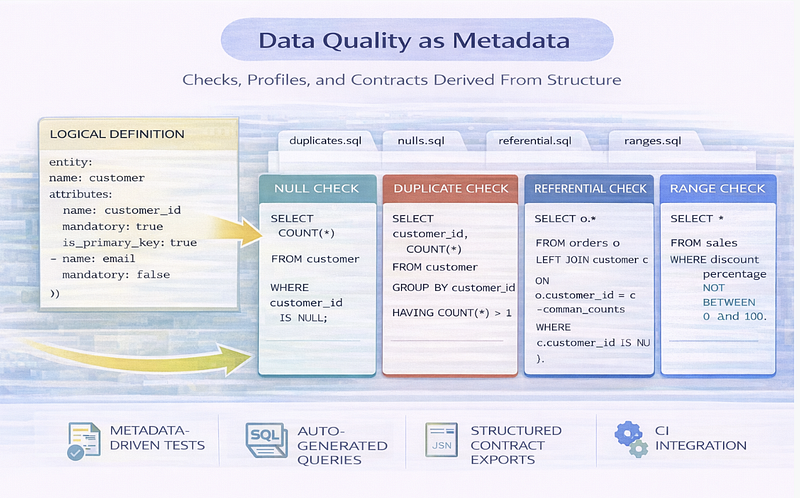
Quality Begins in Structure
When metadata defines:
- Primary keys
- Mandatory attributes
- Relationships
- Data types
- Stereotypes
Quality expectations are already implicit.
MDDE makes them explicit.
Example logical definition:
entity:
  name: customer
  attributes:
    - name: customer_id
      mandatory: true
      is_primary_key: true
    - name: email
      mandatory: false
From this, quality checks can be generated automatically.
Auto-Generated Null Checks
For mandatory attributes:
SELECT
    'customer_id' AS column_name,
    COUNT(*) AS null_count
FROM customer
WHERE customer_id IS NULL;
No manual rule definition required.
Change the metadata → regenerate checks.
Duplicate Detection
Primary keys imply uniqueness.
Generated check:
SELECT
    customer_id,
    COUNT(*) AS duplicate_count
FROM customer
GROUP BY customer_id
HAVING COUNT(*) > 1;
Again, derived from metadata.
Not handwritten.
Referential Integrity Checks
If relationships are defined:
relationship:
  parent: customer
  child: orders
  parent_key: customer_id
  child_key: customer_id
Generated check:
SELECT *
FROM orders o
LEFT JOIN customer c
    ON o.customer_id = c.customer_id
WHERE c.customer_id IS NULL;
Lineage and relationships drive validation.
Range and Domain Checks
If metadata defines:
attribute:
  name: discount_percentage
  min_value: 0
  max_value: 100
Generated rule:
SELECT *
FROM sales
WHERE discount_percentage < 0
   OR discount_percentage > 100;
Structure → quality.
Profiling Queries
Beyond binary validation, MDDE can generate profiling queries:
SELECT
    COUNT(*) AS row_count,
    COUNT(DISTINCT customer_id) AS distinct_ids,
    MIN(customer_id),
    MAX(customer_id)
FROM customer;
Profiling becomes standardized.
Not reinvented per project.
Quality as a First-Class Layer
In MDDE, quality rules live next to entities:
entities/customer/code/dq/
    duplicates.sql
    nulls.sql
    referential.sql
    ranges.sql
And are also reflected in metadata.
This means:
- Rules are regenerable
- Rules are versioned
- Rules are auditable
- Rules propagate with structure
Quality is not a separate discipline.
It is derived from modeling.
Data Contracts
Because metadata is structured, contracts can be exported.
For example:
- Required attributes
- Expected types
- Allowed value ranges
- Relationship constraints
These can be transformed into:
- Open Data Contract Standard (ODCS) exports
- JSON schema definitions
- API validation layers
The same metadata drives:
- DDL
- Documentation
- Lineage
- Quality
- Contracts
One structural core.
Multiple projections.
CI Integration
Quality checks can integrate into CI:
python -m mdde.scripts.validate_quality mdl_sales
Or through generated SQL executed in pipeline.
Fail thresholds can be:
- Blocking
- Warning-based
- Scored
Quality becomes:
- Measurable
- Repeatable
- Visible
Not tribal knowledge.
Migration Context
In migration programs, quality metadata is critical.
It enables:
- Before/after validation
- Drift detection
- Regression comparisons
- Semantic parity checks
Without re-writing validation logic.
Quality travels with the model.
Why This Matters
In many organizations:
- Modeling is separate
- Quality is separate
- Governance is separate
- Documentation is separate
MDDE unifies them.
Because they derive from the same structure.
What This Is Not
This is not a replacement for:
- Great Expectations
- dbt tests
- Enterprise DQ platforms
It complements them.
By generating consistent, structural baselines.
Closing
Quality should not depend on memory.
It should depend on structure.
When metadata defines intent, validation becomes mechanical.
When validation becomes mechanical, confidence increases.
And confident systems evolve faster.
Next in the Series
In the next article:
Automation Scripts — One-Click Pipelines for Model Management
We’ll explore:
- Generated reimport/analyze/optimize/export scripts
- Cross-platform execution
- Deterministic pipelines
- Reducing operational friction
Structure modeled.
Structure validated.
Next: structure automated.
🔧 Technical Deep Dive — Generated DQ Execution
Generated checks are registered:
SELECT
    entity_id,
    check_type,
    generated_sql
FROM metadata.data_quality_check
WHERE model_id = 'mdl_sales';
CI integration example:
python -m mdde.scripts.run_quality_checks mdl_sales \
    --fail-on-error
Quality becomes executable metadata.