Metadata-First DDL Generation.
Write Once, Deploy Anywhere (Without Losing Semantics) — Multi-Dialect DDL Generation
Metadata-First DDL Generation.
Most data platforms are not single-dialect anymore.
In modern environments, you often see:
- Snowflake for analytics
- Databricks for processing
- BigQuery for BI
- DuckDB for local experimentation
- PostgreSQL for operational workloads
And sometimes all of them in the same organization.
The question becomes:
How do you keep structural consistency across platforms without rewriting everything?
MDDE approaches this through metadata-first DDL generation.
The Problem With Platform-Specific SQL
Consider a simple table:
CREATE TABLE customer (
    customer_id VARCHAR(50) NOT NULL,
    customer_name VARCHAR(255),
    PRIMARY KEY (customer_id)
);
That works in ANSI SQL.
Now deploy it to:
- Snowflake
- Databricks
- BigQuery
- DuckDB
You quickly encounter:
- Quoting differences
- Type differences (VARCHAR vs STRING vs TEXT)
- Constraint support variations
- Comment syntax differences
- Schema naming patterns
- Storage clauses
Teams usually solve this by:
- Maintaining separate DDL scripts
- Introducing conditional templating
- Accepting slight divergence
- Or standardizing on the lowest common denominator
None of these scale well.
The Metadata-First Alternative
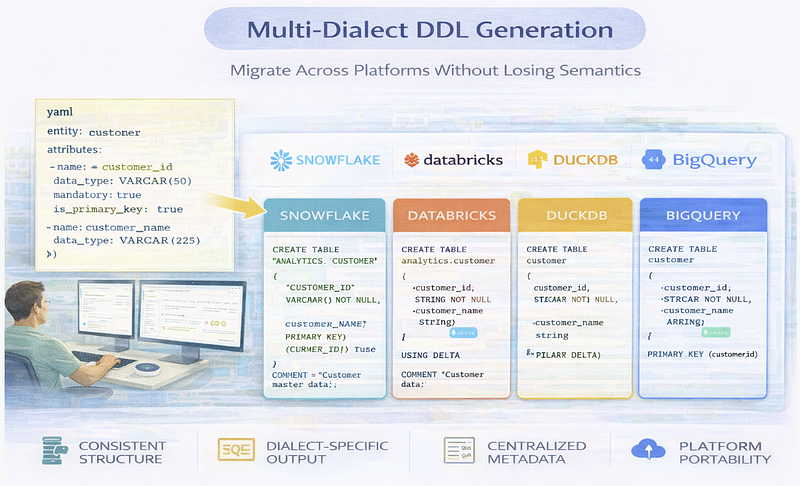
In MDDE, DDL is not the source of truth. Metadata is.
The logical layer defines:
entity:
  name: customer
  attributes:
    - name: customer_id
      data_type: VARCHAR(50)
      mandatory: true
      is_primary_key: true
    - name: customer_name
      data_type: VARCHAR(255)
From this, MDDE generates dialect-aware SQL.
ANSI Baseline
CREATE TABLE customer (
    customer_id VARCHAR(50) NOT NULL,
    customer_name VARCHAR(255),
    PRIMARY KEY (customer_id)
);
Snowflake Output
CREATE TABLE "ANALYTICS"."CUSTOMER" (
    "CUSTOMER_ID" VARCHAR(50) NOT NULL,
    "CUSTOMER_NAME" VARCHAR(255),
    PRIMARY KEY ("CUSTOMER_ID")
)
COMMENT = 'Customer master data';
Databricks Output
CREATE TABLE analytics.customer (
    customer_id STRING NOT NULL,
    customer_name STRING
)
USING DELTA
COMMENT 'Customer master data';
DuckDB Output
CREATE TABLE customer (
    customer_id VARCHAR(50) NOT NULL,
    customer_name VARCHAR(255),
    PRIMARY KEY (customer_id)
);
Same metadata.
Different dialects.
No duplication of structural definition.
Type Mapping Strategy
One of the hardest problems is type mapping.
Example:
- VARCHAR(50) → STRING (Databricks)
- DECIMAL(18,2) → NUMBER(18,2) (Snowflake)
- BOOLEAN → BOOL (some engines)
MDDE uses:
- Logical type definitions
- Dialect mapping tables
- Configurable overrides
This allows:
- Enterprise-wide type standards
- Platform-specific adjustments
- Centralized evolution of mappings
When a new dialect is added, you don’t rewrite models.
You extend mappings.
Dependency Ordering
DDL generation also handles:
- Relationship dependencies
- Foreign key ordering
- Schema grouping
Entities are created in dependency order.
No manual reordering required.
Why This Matters in Migration
In migration programs, platform shifts are common:
- SQL Server → Snowflake
- On-prem → Databricks
- Snowflake → BigQuery
- Legacy DW → Modern Lakehouse
Without metadata centralization, migration becomes:
- Manual rewriting
- Risk-prone diffing
- Inconsistent constraints
- Partial enforcement
With metadata-first DDL:
- Logical structure remains stable
- Dialect differences are mechanical
- Structural consistency is preserved
- Testing focuses on semantics, not syntax
Beyond Tables
DDL generation also includes:
- Views
- Materialized views
- Index definitions (where supported)
- Constraints
- Comments
- Documentation annotations
All derived from metadata.
Not duplicated in scripts.
Platform Portability as Architectural Discipline
Portability is not about running the same SQL everywhere.
It’s about:
- Preserving structural intent
- Abstracting syntax differences
- Enforcing consistent modeling standards
Metadata becomes: The portability layer.
Practical Example
Generate Snowflake DDL:
python -m mdde.scripts.export_model mdl_sales \
    --output workspace/my_model \
    --ddl \
    --dialect snowflake
Switch dialect:
python -m mdde.scripts.export_model mdl_sales \
    --output workspace/my_model \
    --ddl \
    --dialect databricks
No model rewrite.
No duplicated definitions.
Why This Is Not Just a Code Generator
Code generators usually:
- Operate from templates
- Lack deep lineage context
- Ignore governance rules
MDDE generates DDL from:
- Structured logical entities
- Explicit relationships
- Stereotype classifications
- Quality metadata
- Compliance constraints
DDL is a projection of architectural structure.
Not a handcrafted script.
VSCode Workflow
Inside VSCode:
- Modify metadata
- Run export
- Review generated DDL
- Commit changes
Platform shifts become diffs.
Not rewrites.
Closing
Data platforms evolve.
Cloud vendors change.
Strategies shift.
Costs fluctuate.
If your architecture depends on dialect-specific SQL, portability becomes fragile.
If your architecture depends on metadata, dialects become implementation details.
Next in the Series
In the next article:
Data Quality as Metadata — Checks, Profiles, and Contracts
We’ll explore:
- Generated duplicate checks
- Null validations
- Referential integrity enforcement
- Profiling SQL generation
- Data contract export
Structure deployed.
Next: structure validated.
🔧 Technical Deep Dive — Type Mapping Resolution
Inspect dialect resolution:
SELECT
    logical_type,
    snowflake_type,
    databricks_type,
    duckdb_type
FROM metadata.type_mapping;
DDL generation engine:
resolved_type = type_mapping.resolve(
    logical_type="decimal(18,2)",
    dialect="snowflake"
)
Output:
NUMBER(18,2)
Dialect switching is mechanical.
Structure remains stable.