How metadata templates let us separate what we build from how it runs
💡 Summary
As data engineers, we’ve learned to split complex SQL into logical, testable steps — filters, joins, derivations, aggregations. But that logical modularity doesn’t mean we must physically execute each step as a separate query.
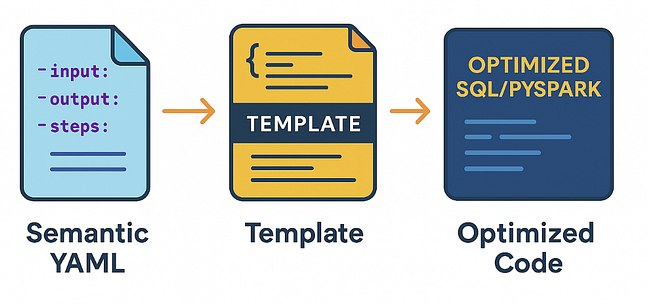
With metadata-driven design, we can describe transformations once — in YAML or another semantic format — and let platform-specific templates decide how to compile and optimize them.
That separation between what we mean and how it runs is the missing bridge between modeling, engineering, and automation.
🧭 1. Logical Clarity ≠ Physical Fragmentation
When teams first modularize SQL into smaller steps, a common concern appears:
“Won’t this make the pipeline slower?
We’re running five queries instead of one.”
In a purely physical sense, yes — each CTE or view could become a separate stage. But logically splitting transformations isn’t the same as executing them separately.
Think of it as design-time decomposition:
🔹we organize logic for readability, testing, and governance —
🔹not to dictate how the engine should run it.
At runtime, a metadata compiler can decide to combine, reorder, or materialize steps depending on the platform’s capabilities.
⚙️ 2. The Separation of What and How
At the design layer, we define transformations in a platform-agnostic YAML model describing:
- Inputs, outputs, and dependencies
- Rule types (filter, join, derive, dedup, etc.)
- Semantic intent — not syntax
At the execution layer, templates created by data engineers translate this logic into physical code: SQL, PySpark, or any execution language.
Those templates hold the platform intelligence — they decide how to implement the logical intent most efficiently.
Examples:
- Snowflake templates can replace multi-step dedup logic with a single
QUALIFY ROW_NUMBER()clause. - Databricks templates can collapse sequential CTEs into a single Spark DataFrame chain.
- Some engines even support native constructs like
NORMALIZEorFLATTENthat simplify nested data handling.
In other words:
🔹 The YAML captures what we want to do.
🔹The template decides how to do it optimally.
🧠 3. Templates as the Bridge
Templates are where metadata meets engineering craftsmanship. They understand both the semantic vocabulary of YAML rules and the performance nuances of the platform.
A template might:
- Merge multiple logical steps into one optimized SQL statement
- Choose between ephemeral CTEs, persistent views, or materialized tables
- Apply engine-specific hints or commands
- Automatically select join strategies or clustering keys
This allows data engineers to encode years of tuning experience once — so every generated transformation benefits from it.
The beauty of this approach: the logic doesn’t change.
🔹Only the expression of it does, depending on where it runs.
🚀 4. Why It Matters
This separation of concerns delivers three major advantages:
- Governance and Traceability
🔹Every transformation remains readable, testable, and explainable at the metadata level.
🔹Auditors, analysts, and AI models can reason about logic without parsing SQL dialects. - Performance and Optimization
🔹 The physical implementation is fully optimized for the target platform.
🔹The same YAML definition can generate radically different — but equally valid — execution plans. - Portability and Evolution
🔹Migrating from Snowflake to Databricks or from SQL to PySpark no longer means rewriting logic.
🔹You simply plug in a new set of templates.
This approach transforms metadata into an adaptive compiler — one that continuously evolves with your platform.
🧩 5. Materialization as a Late Decision
Materialization is another area where premature decisions often create rigidity. CTEs, views, and tables each have their purpose — but choosing too early couples design to infrastructure.
By treating materialization as a deployment-time choice, not a modeling decision, we stay flexible.
A few guiding principles:
- Keep logical CTEs ephemeral in development (DBT style).
- Materialize heavy or reused transformations selectively.
- Let the optimizer (or cost model) drive persistence strategy.
This late binding of physical strategy ensures the same YAML logic can be:
- a quick in-memory CTE during testing,
- a view in integration,
- or a fully materialized table in production.
The semantics stay constant — only the execution changes.
🧩 6. From Metadata to Compiler
Once rules, templates, and engines align, the metadata layer effectively becomes a compiler:
Functional Definition → Semantic Graph → Platform-Specific Code
Each new platform simply adds a translation layer.
Logic is written once, compiled many times.
Add AI to the loop, and this compiler can even recommend optimal strategies:
- “Combine these two filters; the optimizer will merge them anyway.”
- “This join pattern is more efficient using QUALIFY.”
- “Materialize this step — it’s reused downstream three times.”
At that point, metadata doesn’t just describe your system.
It runs it.
🧭 7. Why This Is a Turning Point
For years, data teams have been trapped between two worlds:
- Modeling (conceptual and logical clarity)
- Engineering (physical optimization and automation)
By encoding logic once — in metadata — and compiling it into platform-optimized code, we finally unify both worlds.
🔹Logical models remain human-friendly.
🔹Generated code remains machine-efficient.
This is how data modeling evolves from documentation into execution.
💬 Epilogue
Logical modularity and physical efficiency are not opposites — they’re layers of the same continuum.
Once we separate what we build from how it runs, our metadata becomes the bridge between design, engineering, and intelligence.
🧠 Related Reading
- The Power of YAML Rules: Deduplication, Unions, and Optimization Patterns
- The Python Rule Engine: Automating Transformation, Validation, and Documentation — next in the series (coming soon)