Bridging Metadata and Execution — How Declarative Pipelines Turn Data Design into Automated Delivery
When Databricks announced Declarative Data Pipelines — now even available on the Free Edition — it didn’t just simplify pipeline creation; it represented a convergence between how we design data transformations and how they’re executed.
For years, our data architecture has been moving toward metadata-driven automation — where functional logic is described declaratively, and code is generated automatically. Declarative pipelines now allow that philosophy to extend all the way into the execution layer.
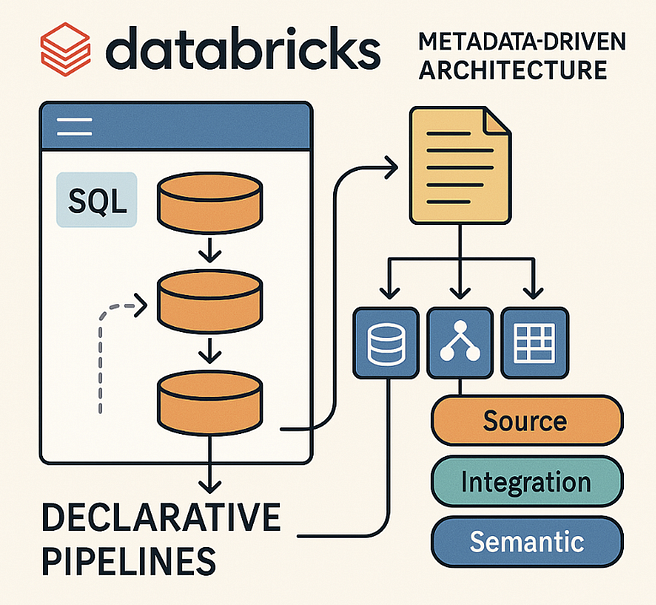
From Logical Design to Declarative Execution
In our metadata-driven approach, we describe transformations using logical blocks such as:
- Select — define which attributes are projected
- Derive — define calculated attributes or business rules
- Filter — define data constraints or SCD2 predicates
- Aggregate / Group — summarize data along business dimensions
- Union / Join / Pivot — define relationships between entities
Each block is expressed functionally in YAML or a mapping model, independent of SQL dialects.
This logical description becomes the single source of truth for all pipelines — batch, streaming, or hybrid.
With the arrival of Declarative Delta Pipelines (Lakeflow), Databricks offers a native way to interpret this same declarative logic natively on the platform.
Instead of managing orchestrations, dependencies, or retries, we can let Databricks handle the imperative details.
The platform becomes responsible for the how — we focus purely on the what.
A Natural Fit in Our Data Solution Architecture
Let’s see where this fits in our layered data solution:
Press enter or click to view image in full size
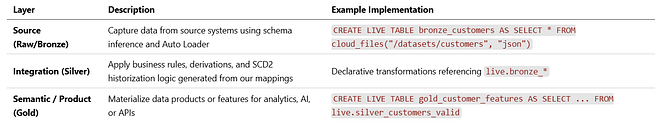
Each layer aligns with our Common Integration Layer (CIL) architecture.
The business logic remains declarative and tool-agnostic, while the execution happens through Databricks declarative pipelines.
In other words, metadata defines intent, and Databricks executes it declaratively.
Why It Matters
Declarative pipelines don’t just simplify the syntax; they fundamentally change the operating model:
- Simplified governance — lineage, quality constraints (
EXPECTclauses), and schema evolution are handled automatically. - Reduced boilerplate — we no longer maintain complex orchestration DAGs; dependencies are inferred.
- Unified execution — same logic can run in batch or streaming mode without code change.
- Faster prototyping — developers can test end-to-end pipelines in Databricks Free Edition using Development Mode.
This aligns perfectly with our Continuous Metadata Integration philosophy: diagrams and mappings describe what the system should do, while automation layers (e.g., Databricks DLT, dbt, Airflow) translate and execute that logic consistently.
Example: From Mapping Metadata to Declarative SQL
In our modeling tools, a simple YAML definition like this:
entity: customers_cleaned
steps:
– select: [id, name, email, registration_date]
– derive:
– customer_name: “initcap(name)”
– registered_on: “to_date(registration_date, ‘yyyy-MM-dd’)”
– filter: “name IS NOT NULL”
– expectations:
– valid_email: “email LIKE ‘%@%’”
Can be automatically converted into:
CREATE OR REFRESH LIVE TABLE silver_customers_cleaned
AS SELECT
id,
initcap(name) AS customer_name,
email,
to_date(registration_date, ‘yyyy-MM-dd’) AS registered_on
FROM live.bronze_customers
WHERE name IS NOT NULL;
CONSTRAINT valid_email EXPECT (email LIKE ‘%@%’);
This means our logical design and Databricks execution become two sides of the same coin — connected through metadata.
The Bridge to AI-Ready Data
Declarative pipelines are not just an engineering simplification; they form the foundation for AI enablement:
- Curated, deduplicated data for feature stores
- Reliable time-series inputs for forecasting
- Consistent metrics for LLM-powered analytics agents
They bring the repeatability and transparency that regulatory-grade architectures (like banks or insurers) require, while still supporting the experimentation and agility that AI demands.
Looking Ahead
As we continue to evolve our metadata-driven data platform, declarative pipelines represent the execution backbone of this architecture.
They align perfectly with our ongoing themes:
- Spec-Driven Development (SDD) — metadata defines intent
- Semantic DevOps — validation and deployment through metadata contracts
- Declarative Execution — Databricks handles operational complexity
Together, they close the loop between design, generation, and execution — the true hallmark of a model-driven data architecture.