Managing the evolution of a common data platform through models, mappings, and metadata
Introduction
As data platforms grow, so does the complexity of managing their evolution.
New sources are onboarded, data quality issues are resolved, use cases are delivered — yet underneath it all lies a more fundamental challenge:
how do we plan, track, and control the growth of a common data platform in a structured, measurable way?This is where Model-Driven Data Delivery comes in.
It’s a framework that treats the enterprise data platform not as a collection of pipelines, but as a model-driven system of building blocks — where progress can be measured attribute by attribute, entity by entity, across all layers of the platform.
From Coding to Modeling
Most organizations still approach data delivery as a sequence of technical tasks: ingest a source, transform the data, expose a dataset, deploy a dashboard.
But in a model-driven architecture, these activities are governed by metadata and data models. The business logical data model (LDM) becomes the foundation — the logical counterpart of the physical integration layer.
Each new data delivery, whether a dashboard, report, or analytical API, is tied to this model.
To deliver a specific use case, we can trace exactly which attributes in which entities need to exist — and whether they have been mapped, tested, and made available in the integration layer.
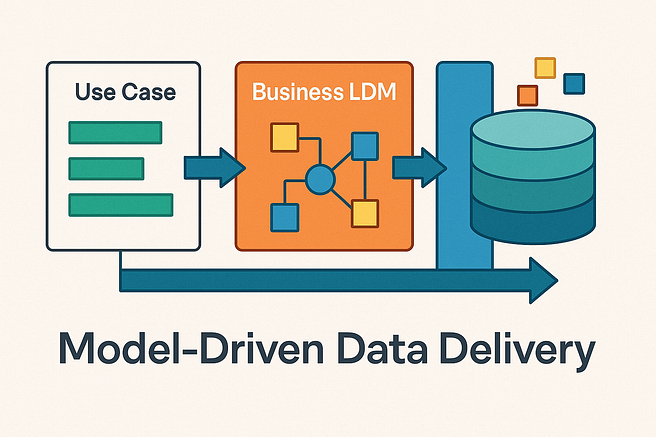
A Demand-Driven, Right-to-Left Approach
Traditional data delivery often moves left to right: from source to target.
We ingest data first, and only later figure out how it connects to business requirements.
Model-Driven Data Delivery reverses that logic.
It starts right to left: from business demand to technical realization.
- A use case defines the required attributes (e.g., “customer age”, “loan amount”, “risk score”).
- These attributes belong to entities in the business LDM (e.g., Customer, Loan, RiskAssessment).
- The integration layer implements these entities physically.
- Mappings define how each attribute is sourced, transformed, and validated.
This approach ensures that every data delivery is anchored in business meaning — and that every new source or pipeline adds measurable value to the common platform.
Managing Progress Through Metadata
Because every element — models, mappings, attributes, and entities — is captured as metadata, we can automate what was once impossible:
a real-time overview of the platform’s readiness and coverage.
Dashboards can now show:
- The percentage of attributes in the common LDM that are already delivered.
- Which entities are complete, in progress, or missing mappings.
- The status of data quality validation per use case.
- The lineage from business demand → integration layer → source system.
In other words: metadata becomes the management layer.
Progress is no longer estimated through Jira tickets or manual reporting — it’s visible directly through the models themselves.
The Platform as a Living System
This way of working transforms the data platform into a living, evolving system.
Every use case contributes to the maturity of the platform.
Every mapping and data quality fix enriches the shared foundation.
And every iteration strengthens the link between business logic and technical implementation.
It also builds a feedback loop: as we deliver new attributes and entities, the platform grows in capability and value — enabling faster, cleaner delivery of future use cases.
Why This Matters
Organizations are investing millions in cloud data platforms, but many struggle to demonstrate progress in measurable terms.
A model-driven approach changes that.
It gives transparency — not just in data lineage, but in delivery lineage:
how business requirements translate into technical readiness, step by step.
It aligns teams around a shared metadata framework, rather than individual projects.
And it enables continuous improvement — not through more tooling, but through better use of the models we already have.
The Series: Inside Model-Driven Data Delivery
This article is the starting point of a new publication dedicated to exploring how metadata, data models, and agile delivery come together.
Future articles will cover topics such as:
- How to manage platform roadmaps using model-based planning.
- Designing dashboards that visualize progress and readiness.
- Managing mappings as a measurable delivery backlog.
- Linking data lineage, data quality, and delivery status.
- How Business-Friendly Metadata and Business-Friendly Diagramming support this approach.
Together, these articles will form a practical framework for managing data platform delivery through models — not spreadsheets.
Key Takeaways
- The business logical data model should guide platform development and delivery.
- Right-to-left (demand-driven) planning connects business use cases directly to source mappings.
- Metadata is the foundation for transparency, automation, and progress measurement.
- Model-Driven Data Delivery turns a cloud data platform into a living, measurable system.
✍️ Summary
Model-Driven Data Delivery brings structure and visibility to the evolution of your enterprise data platform.
By uniting business models, mappings, and metadata, it transforms delivery from a series of isolated projects into a transparent, demand-driven process — where progress can be measured attribute by attribute, and the platform grows with every use case delivered.
This article is part of the publication Model-Driven Data Delivery, exploring how enterprises can plan, manage, and measure data platform development through models and metadata — where models meet delivery.