Designing layered, governed, and temporal data platforms — driven by models and meaning
From Models to Architecture
Modern data platforms are built from zones, layers, and transformations.
But behind every zone lies something more fundamental — a model of meaning and time.
Model-Driven Data Architecture explores how we can design data platforms that are not just pipelines, but systems of record, understanding, and trust.
It’s about connecting the logical and the physical: from conceptual business models to the data structures that store and expose them.
Here, metadata is the blueprint, and architecture is the living reflection of that metadata.
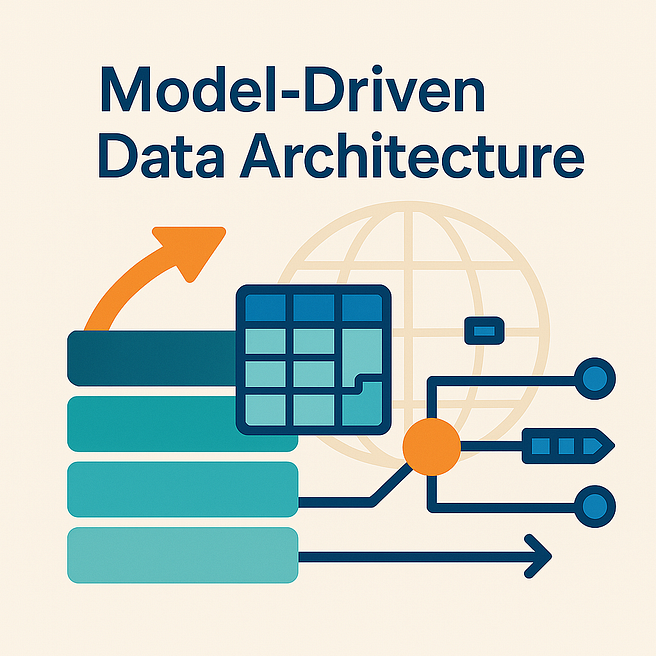
What You’ll Find Here
This publication focuses on how models drive architecture — shaping how data moves through zones, layers, and history.
Topics include:
- Layered and zoned architecture patterns (raw, harmonized, historized, exposed)
- Historization and temporal modeling (SCD2, snapshots, PIT tables)
- Bitemporal and dual SCD2 design for true historical tracking
- Exposure and consumption layers that translate complex history into clarity
- Surrogate keys, audit fields, and metadata structures for lineage and control
- How models connect governance, delivery, and performance
Each article balances architectural rigor with real-world usability — showing how model-driven principles make large data ecosystems manageable and explainable.
Historization & Temporal Modeling
Architectural design is inseparable from time.
Capturing how data changes — and exposing that history correctly — is one of the hardest challenges in enterprise architecture.
Recent articles explore how dual SCD2 + PIT structures form the backbone of scalable historization:
- From Historization to Exposure: Building a Usable Data Platform with Dual SCD2
- Dual SCD2: The Foundation for True History in Data Warehousing
- Snapshots vs PIT Tables: The Scalable Choice for Data Warehouses
- PIT Helper Tables: Making Dual SCD2 History Fast and Usable
- Adding Surrogate Keys to Dual SCD2 Tables to Enable PIT Tables
Each topic connects the conceptual model (what we want to know about change) with the physical model (how we store and query it efficiently).
Delivery & Consumption Layers
The goal of architecture isn’t just to capture data — it’s to deliver usable, trustworthy information.
This section focuses on exposure views and consumption schemas that transform historized data into something the business can actually use.
- Designing Exposure Views: Delivering Data from Dual SCD2 Layers to Consumers
- Universal Star Schema as the Foundation for the Delivery Layer
Here, architecture meets usability.
The delivery layer becomes a semantic interface between the governed core and business intelligence tools.
Why “Model-Driven”?
Because the best data architectures are designed, not improvised.
A model-driven approach ensures that each layer and table exists for a reason — defined by metadata, governed by lineage, and implemented consistently.
Model-driven architecture means:
- Each zone aligns to a clear purpose in the data lifecycle.
- Metadata defines transformation logic and relationships.
- Changes propagate predictably through automated generation.
- The system remains explainable and governed by design.
How It Fits in the Ecosystem
Model-Driven Data Architecture forms the structural backbone of my broader work on data design and communication.
- Model-Driven Data Engineering— implementing data platforms through metadata and automation
- Business-Friendly Data Modeling— making models understandable and valuable to business stakeholders
- Universal Data Models— reusable design patterns across domains
- Next-Gen Data Modeling — how AI reshapes design and documentation
Together, they show that great data platforms are both architected and explained — built on solid models, shared meaning, and temporal integrity.
Join the Journey
Follow this publication for deep dives into model-driven layering, historization, and data delivery design.
If you work in data architecture, modeling, or platform engineering, this is your home for structure, governance, and clarity.