How systematic comparison reshaped the way I think about data architecture.
Why Regression Testing Became an Architectural Tool
How systematic comparison reshaped the way I think about data architecture.
Introduction
Regression testing is usually discussed in operational terms.
It’s something teams do to reduce risk, verify outcomes, or gain confidence during change. Important, but typically downstream from architecture and design.
During recent migration work, that perspective shifted.
Regression testing stopped being a validation step and became something more fundamental: a way to make architectural intent explicit , comparable, and verifiable.
This article explains how that happened — and why I now consider regression testing a first-class architectural concern.
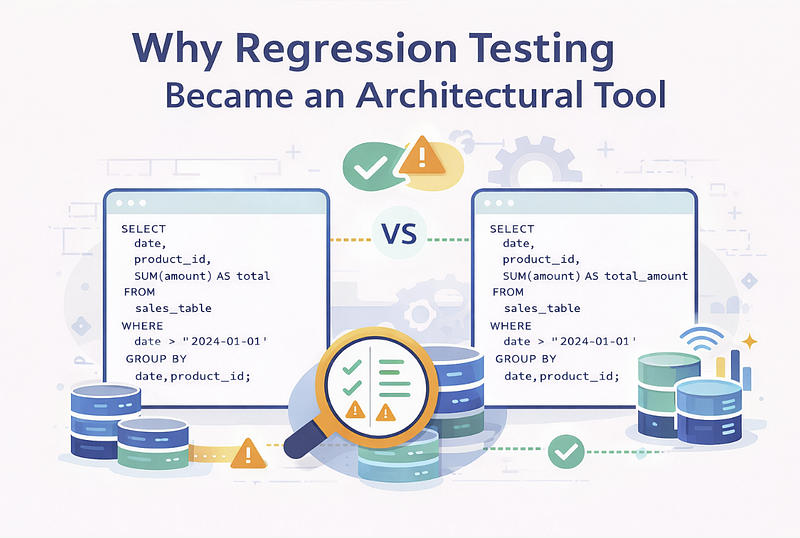
The limits of confidence-based validation
In many data migrations, validation relies on a familiar mix:
- Spot checks
- Aggregated reconciliations
- Sample comparisons
- Stakeholder sign-off
These techniques are often necessary — but they are not sufficient.
They provide confidence, not certainty.
They confirm outcomes, not intent.
What they rarely do is surface:
- Implicit assumptions
- Boundary behavior
- Semantic differences
- Historical conventions embedded in logic
Those elements only become visible when systems are compared systematically , not selectively.
Comparison changes the conversation
Regression testing introduces a different mode of thinking.
Instead of asking “does this look right?” , it asks:
- What exactly is the same?
- Where does behavior diverge?
- Is that difference intentional, acceptable, or undefined?
When applied consistently, regression testing shifts discussions from opinion to observation.
It replaces:
- “This should be equivalent”
with
- “This is equivalent under these conditions”
That distinction turns out to be architectural.
From validation to clarification
One of the most valuable outcomes of regression testing was not confirmation, but clarification.
By comparing systems across many queries and scenarios, patterns emerged:
- Assumptions that were shared but never documented
- Conventions that had evolved organically
- Interpretations that were consistent, but implicit
Regression testing made these patterns visible.
Not as problems to be fixed, but as behavior to be understood and, where necessary, specified.
In that sense, regression testing became a tool for semantic discovery.
Architecture that can be compared behaves differently
Architectures designed with comparison in mind tend to share certain characteristics:
- Deterministic behavior
- Explicit semantics
- Clear boundaries
- Observable outcomes
Architectures that rely on convention and trust are harder to compare, because their intent lives outside the system.
Regression testing exposes that difference quickly.
If two systems cannot be compared meaningfully, it usually indicates that intent was never made explicit in the first place.
Making regression testing architectural
Treating regression testing as an architectural concern changes how systems are designed.
It influences decisions such as:
- How SQL is structured and generated
- Whether logic is deterministic or context-dependent
- How assumptions are encoded
- What metadata is captured and exposed
In MDDE, this led to:
- Parsing and normalizing SQL rather than treating it as text
- Comparing structure and semantics, not just results
- Emitting diagnostics as first-class outputs
- Treating validation outcomes as architectural signals
Regression testing stopped being something applied to the architecture and became something enabled by it.
Precision enables safe change
A recurring theme throughout this work was the relationship between precision and adaptability.
At first glance, precision can feel restrictive.
In practice, it reduces uncertainty.
When behavior is explicit and comparable:
- Change becomes safer
- Differences become discussable
- Migration becomes incremental rather than risky
Regression testing provides the feedback loop that makes this possible.
It doesn’t prevent change — it makes change understandable.
Architecture beyond delivery
Perhaps the most important shift was this:
Regression testing didn’t just help us migrate.
It changed how we evaluated architecture itself.
Architectures that support systematic comparison age differently.
They accumulate knowledge rather than assumptions.
That insight has permanently influenced how I think about metadata, validation, and design discipline — and why regression testing is now embedded into MDDE as an architectural capability, not an optional safeguard.
What’s next
In the next articles, I’ll explore how this perspective connects to:
- SQL parsing and normalization
- Deterministic code generation
- Executable best practices
- Observability as an architectural output
- Architectural Decision Records shaped by validation
All with the same goal: making data architecture more explicit, testable, and resilient to change.