Using metadata, semantics, and AI to automate documentation and accelerate model design
Summary
At this stage in the series, your metadata-driven framework has evolved into a self-aware ecosystem:
- YAML models define conceptual, logical, and physical layers.
- DuckDB catalogs and lineage graphs expose structure and quality.
- The semantic layer adds meaning, rules, and policy context.
Now, the question is: how can we make this metadata work for us?
The answer: by applying AI to interpret, generate, and reason over metadata itself.
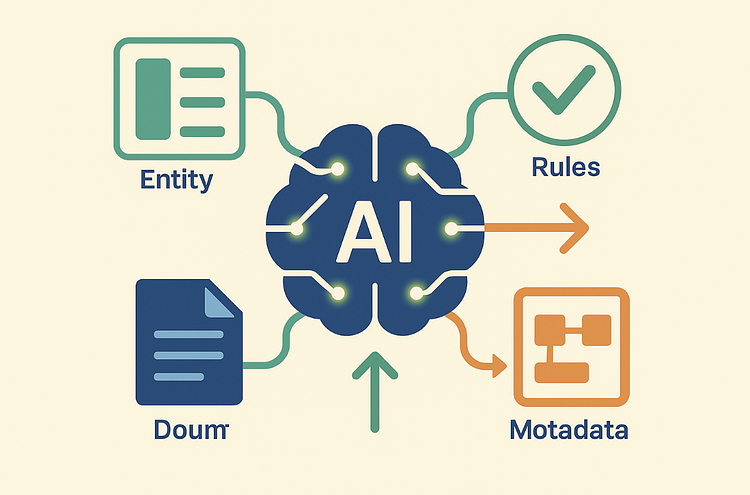
1. Metadata as the Foundation for AI Reasoning
AI systems — especially large language models — excel when given structured, contextual information.
A well-designed metadata mesh provides exactly that:
- Entities, attributes, and relationships (structure)
- Business rules and definitions (semantics)
- Lineage and dependencies (context)
Together, these form a metadata knowledge graph — an ideal substrate for reasoning, question-answering, and generation.
💡 The richer your metadata, the smarter your AI assistance becomes.
2. What Is a Metadata Knowledge Graph?
A metadata knowledge graph connects everything your organization knows about its data — not just where it is, but what it means and how it’s governed.
Example structure:
(Customer) ─ hasAttribute → (Email)
(Customer) ─ governedBy → (GDPR_Policy)
(Order) ─ derivedFrom → (Customer)
(Email) ─ validatedBy → (Rule: valid_email_format)
Each node and edge represents a piece of metadata.
The graph can be stored in relational form (DuckDB, PostgreSQL) or exported to a graph database (Neo4j, RDF triple store).
3. Why AI Loves Metadata Graphs
AI models can use metadata to:
🧠 Understand context — e.g., knowing “Customer.Email” is personal data.
✍️ Generate documentation — describe entities, lineage, and rules in natural language.
⚙️ Propose models — suggest new logical entities or attributes from business descriptions.
🧩 Validate consistency — detect missing lineage, undefined terms, or duplicate concepts.
By exposing metadata in structured form, you transform LLMs into metadata copilots.
4. Generating Documentation from Metadata
Here’s a simple example of how AI can use metadata to create structured documentation.
Prompt to an LLM:
“Generate a clear, business-friendly description of each entity using the metadata below.”
{
“entity”: “Customer”,
“definition”: “A person or organization that purchases goods or services.”,
“attributes”: [
{“name”: “CustomerID”, “datatype”: “integer”, “description”: “Unique surrogate identifier.”},
{“name”: “Email”, “datatype”: “string”, “rules”: [“valid_email_format”, “not_null”]}
],
“policies”: [“GDPR01”]
}
Output:
Customer
A customer represents any individual or company purchasing products.
Each record includes a unique ID and an email address, which must be valid and comply with GDPR personal data rules.
This can be automated for every entity in your catalog — creating continuously updated, AI-authored documentation.
5. Semantic Querying: Conversational Metadata Search
Because your metadata is structured and linked, you can enable semantic search:
- “Show me all entities containing personal data.”
- “Which tables derive from the Customer concept?”
- “List all business rules that apply to invoices.”
A lightweight retrieval layer (e.g., using DuckDB SQL + embedding search) lets AI respond accurately without hallucinating.
Example hybrid query:
SELECT entity, attribute
FROM metadata.attributes
WHERE tags LIKE ‘%pii%’ OR derived_from LIKE ‘%Customer%’;
AI wraps this logic into conversational responses.
6. AI-Assisted Model Generation
You can invert the process: feed AI your business descriptions, and let it propose YAML models.
Prompt:
“Define the conceptual model for an insurance domain where a Policy covers multiple Assets and has one Holder.”
AI output:
layer: conceptual
entities:
– name: Policy
attributes: [PolicyID, StartDate, EndDate]
relationships:
– name: covers
target: Asset
type: 1:M
– name: has_holder
target: Holder
type: 1:1
– name: Asset
attributes: [AssetID, Type, Value]
– name: Holder
attributes: [HolderID, Name, Contact]
This metadata can be directly validated, normalized, and extended into the logical layer — speeding up modeling workshops and onboarding.
7. Integrating AI in VSCode and CI/CD
With your YAML-based framework, AI assistance fits naturally into your existing workflow:
- VSCode extension: AI suggests attribute names, datatypes, and rules as you type YAML.
- Pre-commit hooks: validate metadata with AI before merging (e.g., check definition clarity).
- Continuous documentation: automatically refresh semantic glossaries and lineage descriptions.
Example CLI pattern:
python ai_generate_docs.py –source models/conceptual –target docs/descriptions
8. Enhancing Metadata Quality with AI
AI can also detect issues across the mesh:
- Duplicate entities (“Customer” vs. “Client”)
- Undefined attributes or ambiguous definitions
- Missing lineage or dangling rules
Example anomaly check:
“Find entities with overlapping definitions or mismatched derived_from links.”
Result:
- Customer and Client overlap 92% in attributes
- Customer.Contact missing derived_from → conceptual.Contact
This brings observability to the semantic level.
9. From Metadata to Machine Intelligence
Once the metadata mesh includes semantics, policies, and lineage, it effectively becomes an organizational knowledge base.
At that point, AI can:
- Summarize domain models
- Explain lineage chains
- Recommend governance actions
- Even generate SQL or documentation based on conceptual intent
You’ve created the foundation for a metadata-native AI assistant — grounded in real business meaning.
10. In Summary
By combining metadata, semantics, and AI, we achieve the next level of model-driven architecture:
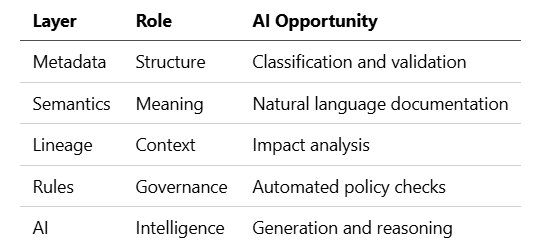
Your metadata ecosystem now thinks with you — turning architecture into an intelligent partner.
11. Next in the Series
“Metadata Copilot: Building an AI Assistant for Your Modeling Ecosystem.”
We’ll design the architecture for a conversational metadata assistant that integrates with VSCode, Notion, and DuckDB.