A practical view on how metadata-driven automation meets measurable business value.
💬 The Wake-Up Call: When a Single Record Breaks the Report
Financial data has a way of exposing every weakness in our data-quality setup. In many domains, imperfect data is tolerated — an empty description here, a wrong code there. But in finance, a single invalid record can flip a balance sheet, distort a P&L, or derail a budget review.
As Piotr Czarnas of DQOps observes:
“Business users can accept imperfect data — until it costs them money.”
When that happens, data quality stops being a technical nuisance and becomes a business necessity.
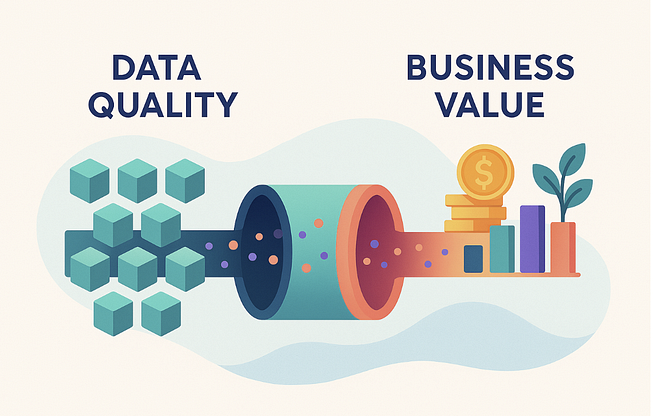
🧭 From Rules to ROI
Data-quality rules are often added reactively — a patchwork of filters added after a report fails. That approach scales with frustration, not with value.
Piotr’s insight reframes the conversation: financial-data quality can be expressed in monetary terms. Once you can estimate potential loss, you can prioritize improvement by return on investment.
In a metadata-driven architecture, this concept fits perfectly: rules, thresholds, and validation logic already live as metadata. All we need is to extend that metadata with business-impact metrics.
🧩 Adding ROI to Your Metadata
dataset: fact_financials
business_domain: finance
dq_criticality: high
dq_rules:
– rule_id: FIN_DATE_FORMAT
category: valid_formats
pattern: “YYYY-MM-DD”
potential_loss: 50000
– rule_id: FIN_NEGATIVE_AMOUNT
category: reasonable_ranges
range: [0, null]
potential_loss: 120000
observability:
metric: transaction_amount
alert_threshold: 3σ
roi_estimate: “Avoided 0.2% revenue discrepancy”
Each rule now carries context and consequence. Your metadata becomes a living ledger of value: “Which rules saved the company money this quarter?”
⚙️ Data Quality as Code — and as Business Control
Your metadata-driven platform already generates pipelines, transformations, and lineage. Why not let it generate and enforce data-quality rules the same way?
By defining validation templates in metadata, you can:
- Ensure consistent rule logic across sources
- Version-control everything (just like code)
- Attach observability hooks for anomaly detection
- Feed the results back into metadata for continuous learning
This makes data quality a closed feedback loop — failed checks lead to improved metadata, not manual cleanup.
🔍 Observability: Detecting the Unknown Unknowns
Manual rules catch known issues. But in finance, the largest risks often come from unexpected anomalies — sudden spikes, missing batches, or schema drifts.
This is where data observability shines. Instead of enumerating every possible rule, observability continuously monitors data metrics for unusual patterns.
Example:
“Alert if daily revenue deviates by more than 3 σ from the monthly moving average.”
🧠 What DQOps Brings to the Table
The DQOps platform provides a production-ready blueprint for this approach — fully metadata-driven, code-first, and ROI-aware.
Here’s how its capabilities align with metadata-driven architecture:
Press enter or click to view image in full size
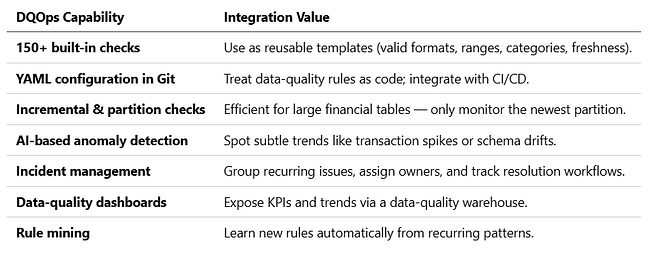
Together, these tools make it possible to automate detection, assign accountability, and calculate ROI in one flow.
Press enter or click to view image in full size
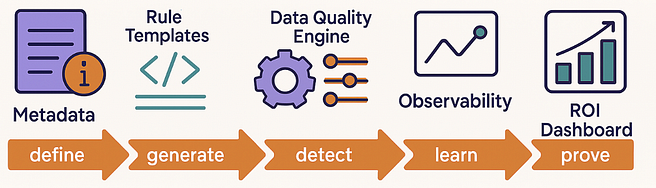
📈 Closing the Loop: From Detection to Prevention
Financial data quality isn’t about cleaning numbers — it’s about preserving trust and preventing loss.
By embedding ROI and thresholds into metadata, you create a self-prioritizing quality system:
- High-impact datasets get the strongest validation.
- Anomalies are detected and quantified in near real time.
- Dashboards show value preserved, not just records checked.
Over time, your business begins to see what Piotr calls “a return on improvement” — proof that investing in quality is cheaper than paying for its absence.
“If a single invalid record can distort your P&L, then every validation rule is an investment — not a constraint.”
💡 Takeaway
- Metadata-driven automation gives structure and scale.
- ROI-oriented thinking gives direction and purpose.
- Platforms like DQOps provide the observability and execution layer.
Together, they turn data quality into a measurable business capability —
one that quantifies trust, prevents loss, and continuously learns.