Part 2: Code patterns, Databricks integration, and production recipes
Multi-Tenant Airflow DAG Generation: Implementation Deep Dive
Part 2: Code patterns, Databricks integration, and production recipes
Quick Recap
In Part 1, we covered three strategies for multi-tenant DAG generation:
- Contract-Based Generation — Generate only relevant DAGs per entity
- Hierarchical Structure — Coordinator + entity-specific execution DAGs
- Dynamic Task Mapping — Single DAG with runtime-expanded tasks
This article provides implementation patterns for Databricks-based pipelines.
The Databricks Challenge
Your setup: Airflow orchestrates Python code that executes SQL in Databricks. The Python loader checks metadata conditions before running transformations.
The scaling problems are Databricks-specific:
- Cluster startup latency : 2–5 minutes per cluster start
- SQL Warehouse costs : Per-second billing adds up
- API rate limits : Too many concurrent calls fail
- Worker blocking : Python waits while Databricks processes
Let’s solve each one.
Pattern 1: Cluster-Aware Task Grouping
Problem
Each task starts its own cluster or connection, causing:
- 50 entities × 2 min startup = 100 minutes of startup time
- Cluster fragmentation (many small clusters vs. few large ones)
Solution: Group Tasks by Cluster
# src/orchestration/cluster_aware_generator.py
from dataclasses import dataclass
from typing import List, Dict
from collections import defaultdict

@dataclass
class ClusterConfig:
    cluster_id: str
    size: str  # small, medium, large
    max_concurrent_tasks: int = 8

def group_by_cluster(entities: List[str], contracts: Dict) -> Dict[str, List[str]]:
    """Group entities by optimal cluster assignment."""
    cluster_groups = defaultdict(list)

    for entity in entities:
        contract = contracts[entity]
        tier = contract.entity.tier
        # Assign cluster based on tier and workload
        if tier == "premium":
            cluster = "cluster_large_01"
        elif len(contract.delivery_contract.datasets) > 10:
            cluster = "cluster_medium_01"
        else:
            cluster = "cluster_small_01"
        cluster_groups[cluster].append(entity)

    return dict(cluster_groups)

def generate_cluster_aware_dag(cluster_id: str, entities: List[str]) -> DAG:
    """Generate DAG that processes multiple entities on same cluster."""

    with DAG(
        dag_id=f"load_{cluster_id}",
        schedule=None,
        tags=["execution", "cluster-aware"],
        max_active_tasks=8,  # Match cluster capacity
    ) as dag:

        # Single cluster startup task
        start_cluster = DatabricksStartClusterOperator(
            task_id="start_cluster",
            cluster_id=cluster_id,
            deferrable=True,
        )

        # Process entities sequentially to avoid cluster overload
        entity_tasks = []
        for entity in entities:
            entity_task = process_entity_task(
                entity_id=entity,
                cluster_id=cluster_id,
            )
            entity_tasks.append(entity_task)

        # Stop cluster when done
        stop_cluster = DatabricksStopClusterOperator(
            task_id="stop_cluster",
            cluster_id=cluster_id,
            trigger_rule="all_done",
        )
        # Wire: start -> all entities -> stop
        start_cluster >> entity_tasks >> stop_cluster
    return dag
Coordinator Integration
# dags/cluster_coordinator.py
with DAG(
    dag_id="cluster_coordinator",
    schedule="@daily",
    tags=["orchestration"],
) as dag:

    @task
    def plan_cluster_allocation():
        """Determine cluster assignments for today's workload."""
        ready_entities = get_ready_entities()
        contracts = {e: load_contract(e) for e in ready_entities}
        return group_by_cluster(ready_entities, contracts)
    @task
    def trigger_cluster_dags(cluster_plan: Dict[str, List[str]]):
        """Trigger one DAG per cluster with its entities."""
        for cluster_id, entities in cluster_plan.items():
            trigger_dag(
                dag_id=f"load_{cluster_id}",
                conf={"entities": entities},
            )
    plan = plan_cluster_allocation()
    trigger_cluster_dags(plan)
Pattern 2: SQL Warehouse Batching
Problem
Each SQL query opens a connection, executes, closes. Connection overhead dominates small queries.
Solution: Batch SQL Statements
# src/orchestration/sql_batcher.py
from typing import List, Tuple

def batch_sql_statements(
    transformations: List[Transformation],
    max_batch_size: int = 10,
    max_batch_duration_estimate: int = 300,  # seconds
) -> List[List[Transformation]]:

    """Batch transformations for efficient SQL Warehouse execution."""
    batches = []
    current_batch = []
    current_duration = 0

    for t in transformations:
        estimated_duration = estimate_query_duration(t)
        if (len(current_batch) >= max_batch_size or
            current_duration + estimated_duration > max_batch_duration_estimate):
            if current_batch:
                batches.append(current_batch)
            current_batch = [t]
            current_duration = estimated_duration
        else:
            current_batch.append(t)
            current_duration += estimated_duration

    if current_batch:
        batches.append(current_batch)
    return batches

def execute_batch(batch: List[Transformation], entity_id: str) -> dict:
    """Execute a batch of SQL statements in single connection."""

    with get_databricks_connection() as conn:
        results = []
        for t in batch:
            sql = generate_sql(entity_id, t)
            result = conn.execute(sql)
            results.append({
                "transformation": t.id,
                "rows_affected": result.rowcount,
                "duration": result.duration,
            })

    return {"batch_results": results}
Airflow Task Using Batching
@task
def execute_transformation_batch(
    entity_id: str,
    batch_index: int,
    batch: List[dict],
):
    """Execute batch of transformations for an entity."""
    transformations = [Transformation.from_dict(t) for t in batch]

    results = execute_batch(transformations, entity_id)

    # Log for observability
    for r in results["batch_results"]:
        log.info(f"{entity_id}/{r['transformation']}: {r['rows_affected']} rows in {r['duration']}s")
    return results
Pattern 3: Deferrable Databricks Operators
Problem
Standard operators block workers while Databricks processes queries (minutes to hours).
Solution: Custom Deferrable Operator
# src/operators/deferrable_databricks.py
from airflow.models import BaseOperator
from airflow.triggers.base import BaseTrigger, TriggerEvent
from airflow.utils.context import Context
import asyncio

class DatabricksQueryTrigger(BaseTrigger):
    """Trigger that polls Databricks query status without blocking."""

    def __init__(self, query_id: str, databricks_conn_id: str):
        super().__init__()
        self.query_id = query_id
        self.databricks_conn_id = databricks_conn_id

    def serialize(self):
        return (
            "src.operators.deferrable_databricks.DatabricksQueryTrigger",
            {"query_id": self.query_id, "databricks_conn_id": self.databricks_conn_id},
        )

    async def run(self):
        """Poll Databricks until query completes."""
        while True:
            status = await self._check_query_status()
            if status == "FINISHED":
                yield TriggerEvent({"status": "success", "query_id": self.query_id})
                return
            elif status in ("FAILED", "CANCELED"):
                yield TriggerEvent({"status": "failed", "query_id": self.query_id})
                return
            await asyncio.sleep(10)  # Poll every 10 seconds

    async def _check_query_status(self):
        # Async call to Databricks API
        async with aiohttp.ClientSession() as session:
            url = f"{self.databricks_host}/api/2.0/sql/statements/{self.query_id}"
            async with session.get(url, headers=self.headers) as resp:
                data = await resp.json()
                return data.get("status", {}).get("state")

class DeferrableDatabricksSqlOperator(BaseOperator):
    """Execute SQL on Databricks without blocking worker."""

    def __init__(
        self,
        sql: str,
        databricks_conn_id: str = "databricks_default",
        warehouse_id: str = None,
        **kwargs,
    ):
        super().__init__(**kwargs)
        self.sql = sql
        self.databricks_conn_id = databricks_conn_id
        self.warehouse_id = warehouse_id

    def execute(self, context: Context):
        """Submit query and defer to trigger."""
        # Submit query
        query_id = self._submit_query()
        # Defer to trigger for polling
        self.defer(
            trigger=DatabricksQueryTrigger(
                query_id=query_id,
                databricks_conn_id=self.databricks_conn_id,
            ),
            method_name="execute_complete",
        )

    def execute_complete(self, context: Context, event: dict):
        """Called when trigger fires."""
        if event["status"] == "success":
            return event["query_id"]
        else:
            raise AirflowException(f"Query {event['query_id']} failed")

    def _submit_query(self) -> str:
        """Submit SQL to Databricks SQL Warehouse."""
        hook = DatabricksSqlHook(databricks_conn_id=self.databricks_conn_id)
        response = hook.run_sql_statement(
            sql=self.sql,
            warehouse_id=self.warehouse_id,
            wait_timeout=0,  # Don't wait, return immediately
        )
        return response["statement_id"]
Using in DAG
with DAG(dag_id="entity_load_deferred", ...) as dag:

for transformation in sub_model.transformations:
        DeferrableDatabricksSqlOperator(
            task_id=f"load_{transformation.id}",
            sql=generate_sql(entity_id, transformation),
            databricks_conn_id="databricks_sql_warehouse",
            warehouse_id="{{ var.value.sql_warehouse_id }}",
        )
Pattern 4: Completeness-Driven Triggering
Problem
Coordinator triggers entities even when data isn’t ready, wasting resources on “nothing to do” runs.
Solution: Completeness API Integration
# src/completeness/api.py
from fastapi import FastAPI
from pydantic import BaseModel
from datetime import date

app = FastAPI()
class CompletenessRequest(BaseModel):
    entity_id: str
    period: date
    check_type: str = "base"  # "base" or "enriched"

class CompletenessResponse(BaseModel):
    entity_id: str
    period: date
    is_ready: bool
    missing_sources: list[str]
    available_sources: list[str]
    completeness_pct: float
    can_publish_base: bool
    can_publish_enriched: bool

@app.post("/completeness/check")
def check_completeness(request: CompletenessRequest) -> CompletenessResponse:
    """Check if entity is ready for processing."""

    contract = load_delivery_contract(request.entity_id)
    sub_model = derive_sub_model(contract)

    available = []
    missing = []

    for source in sub_model.required_sources:
        if source_has_data(source, request.entity_id, request.period):
            available.append(source)
        else:
            missing.append(source)

    completeness = len(available) / len(sub_model.required_sources) if sub_model.required_sources else 1.0

    return CompletenessResponse(
        entity_id=request.entity_id,
        period=request.period,
        is_ready=len(missing) == 0,
        missing_sources=missing,
        available_sources=available,
        completeness_pct=completeness,
        can_publish_base=check_inner_sources_ready(sub_model, available),
        can_publish_enriched=check_all_sources_ready(sub_model, available),
    )
Airflow Sensor Using API
# src/operators/completeness_sensor.py
from airflow.sensors.base import BaseSensorOperator
import requests

class CompletenessSensor(BaseSensorOperator):
    """Wait for entity data completeness before proceeding."""

    def __init__(
        self,
        entity_id: str,
        completeness_api_url: str,
        check_type: str = "base",
        **kwargs,
    ):
        super().__init__(**kwargs)
        self.entity_id = entity_id
        self.completeness_api_url = completeness_api_url
        self.check_type = check_type

    def poke(self, context) -> bool:
        """Check if entity is ready."""
        execution_date = context["execution_date"].date()

        response = requests.post(
            f"{self.completeness_api_url}/completeness/check",
            json={
                "entity_id": self.entity_id,
                "period": execution_date.isoformat(),
                "check_type": self.check_type,
            },
        )

        result = response.json()

        if result["is_ready"]:
            self.log.info(f"Entity {self.entity_id} is ready with {result['completeness_pct']:.0%} completeness")
            return True
        else:
            self.log.info(f"Entity {self.entity_id} waiting for: {result['missing_sources']}")
            return False
Coordinator with Smart Triggering
with DAG(dag_id="smart_coordinator", schedule="*/15 * * * *", ...) as dag:

@task
    def get_entities_to_check():
        """Get entities that might have new data."""
        # Only check entities expecting delivery today
        return [
            e for e in get_all_entities()
            if get_delivery_calendar(e).expects_delivery_today()
        ]

    @task
    def check_and_trigger(entity_id: str):
        """Check completeness and trigger if ready."""
        response = check_completeness_api(entity_id, today())

        if response["can_publish_base"]:
            # Check if already processed
            if not already_processed(entity_id, today(), "base"):
                trigger_dag(f"{entity_id}_load", conf={"mode": "base"})
                return {"entity": entity_id, "triggered": "base"}

        if response["can_publish_enriched"]:
            if not already_processed(entity_id, today(), "enriched"):
                trigger_dag(f"{entity_id}_load", conf={"mode": "enriched"})
                return {"entity": entity_id, "triggered": "enriched"}

        return {"entity": entity_id, "triggered": None}

    entities = get_entities_to_check()
    results = check_and_trigger.expand(entity_id=entities)
Pattern 5: Entity Resource Pools
Problem
A single large entity can starve other entities of workers.
Solution: Airflow Pools per Entity Tier
# Configuration: Create pools in Airflow UI or via CLI
# airflow pools set premium_entities 16 "Premium tier entity processing"
# airflow pools set standard_entities 8 "Standard tier entity processing"
# airflow pools set basic_entities 4 "Basic tier entity processing"

def get_pool_for_entity(entity_id: str) -> str:
    """Get appropriate pool based on entity tier."""
    contract = load_delivery_contract(entity_id)
    tier = contract.entity.tier

    return {
        "premium": "premium_entities",
        "standard": "standard_entities",
        "basic": "basic_entities",
    }.get(tier, "default_pool")

# In DAG generation
def create_entity_dag(entity_id: str) -> DAG:
    pool = get_pool_for_entity(entity_id)

    with DAG(dag_id=f"{entity_id}_load", ...) as dag:
        for transformation in sub_model.transformations:
            DeferrableDatabricksSqlOperator(
                task_id=f"load_{transformation.id}",
                sql=generate_sql(entity_id, transformation),
                pool=pool,  # Use entity-specific pool
                pool_slots=1,
            )

    return dag
Complete Example: Entity DAG Generator
Putting it all together:
# dags/generators/entity_dag_generator.py
from airflow import DAG
from airflow.utils.dates import days_ago
from datetime import timedelta

from src.contracts import load_delivery_contract, derive_sub_model
from src.operators.deferrable_databricks import DeferrableDatabricksSqlOperator
from src.operators.completeness_sensor import CompletenessSensor
from src.orchestration.sql_batcher import batch_sql_statements

def generate_entity_dag(entity_id: str) -> DAG:
    """Generate complete DAG for an entity."""

    # Load metadata
    contract = load_delivery_contract(entity_id)
    sub_model = derive_sub_model(contract)
    pool = get_pool_for_entity(entity_id)

    # Batch transformations for efficiency
    batches = batch_sql_statements(sub_model.transformations)
    with DAG(
        dag_id=f"{entity_id}_load",
        schedule=None,  # Triggered by coordinator
        start_date=days_ago(1),
        tags=["execution", entity_id, contract.entity.tier],
        default_args={
            "owner": contract.contacts.primary.email if contract.contacts else "data-team",
            "retries": 2,
            "retry_delay": timedelta(minutes=5),
            "pool": pool,
        },
        doc_md=f"""
        # {contract.entity.name} Data Load
        **Tier**: {contract.entity.tier}
        **Datasets**: {', '.join(d.id for d in contract.delivery_contract.datasets if d.status == 'active')}
        **SLA**: {contract.delivery_contract.datasets[0].sla if contract.delivery_contract.datasets else 'N/A'}
        ## Sub-Model
        - Tables: {len(sub_model.tables)}
        - Transformations: {len(sub_model.transformations)}
        - Batches: {len(batches)}
        """,
    ) as dag:

        # Wait for base data to be ready
        wait_for_data = CompletenessSensor(
            task_id="wait_for_completeness",
            entity_id=entity_id,
            completeness_api_url="{{ var.value.completeness_api_url }}",
            check_type="{{ dag_run.conf.get('mode', 'base') }}",
            mode="reschedule",
            poke_interval=300,
            timeout=3600 * 6,  # 6 hours max wait
        )

        # Execute transformation batches
        batch_tasks = []
        for i, batch in enumerate(batches):
            batch_sql = "\n;\n".join(
                generate_sql(entity_id, t) for t in batch
            )
            batch_task = DeferrableDatabricksSqlOperator(
                task_id=f"batch_{i:02d}",
                sql=batch_sql,
                databricks_conn_id="databricks_sql_warehouse",
            )
            batch_tasks.append(batch_task)

        # Publish completeness status
        @task
        def publish_status(entity_id: str, mode: str):
            update_completeness_dashboard(
                entity_id=entity_id,
                period=get_execution_date(),
                status="completed",
                mode=mode,
            )
        status = publish_status(
            entity_id=entity_id,
            mode="{{ dag_run.conf.get('mode', 'base') }}",
        )
        # Wire dependencies
        wait_for_data >> batch_tasks[0]
        for i in range(len(batch_tasks) - 1):
            batch_tasks[i] >> batch_tasks[i + 1]
        batch_tasks[-1] >> status

    return dag

# Generate DAGs for all entities with active contracts
for entity_id in get_entities_with_contracts():
    globals()[f"{entity_id}_load"] = generate_entity_dag(entity_id)
Monitoring & Observability
DAG Generation Metrics
# src/metrics/dag_metrics.py
from prometheus_client import Counter, Gauge, Histogram

# Track DAG generation
dags_generated = Counter(
    "mdde_dags_generated_total",
    "Total DAGs generated",
    ["entity", "tier"],
)

transformations_per_dag = Histogram(
    "mdde_transformations_per_dag",
    "Transformations per generated DAG",
    buckets=[1, 5, 10, 25, 50, 100],
)

# Track execution
entity_load_duration = Histogram(
    "mdde_entity_load_duration_seconds",
    "Time to load entity data",
    ["entity", "tier"],
    buckets=[60, 300, 600, 1800, 3600],
)

completeness_wait_time = Histogram(
    "mdde_completeness_wait_seconds",
    "Time waiting for source completeness",
    ["entity"],
    buckets=[0, 300, 600, 1800, 3600, 7200],
)
Completeness Dashboard Query
-- DuckDB query for completeness dashboard
SELECT
    e.entity_id,
    e.entity_name,
    c.period,
    c.check_type,
    c.completeness_pct,
    c.missing_sources,
    c.can_publish_base,
    c.can_publish_enriched,
    c.checked_at,
    CASE
        WHEN c.can_publish_enriched THEN 'enriched'
        WHEN c.can_publish_base THEN 'base'
        ELSE 'waiting'
    END as status
FROM entities e
LEFT JOIN completeness_checks c ON e.entity_id = c.entity_id
WHERE c.period = current_date()
ORDER BY e.tier DESC, c.completeness_pct ASC;
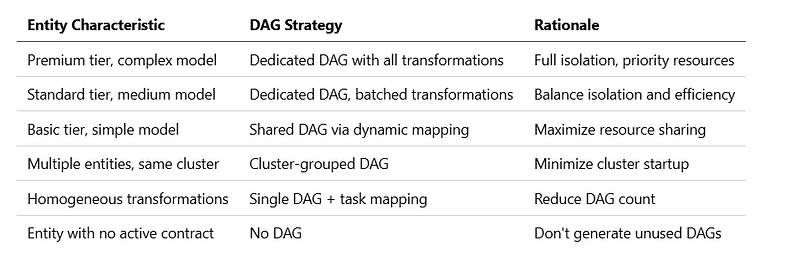
Summary: Which DAGs to Generate
Next Steps
- Audit your contracts — Map which datasets each entity actually uses
- Implement sub-model derivation — Build the filtering logic
- Start with hierarchical DAGs — Coordinator + entity execution
- Add deferrable operators — Free workers during Databricks execution
- Deploy completeness API — Enable smart triggering
- Measure and iterate — Track DAG count, scheduler time, resource usage
This is Part 2 of the Multi-Tenant Airflow series. See Part 1 for the conceptual framework.