💡 From debate to convergence — how the data community is redefining modeling for the metadata and AI era.
1️⃣ From Discussion to Convergence
When I asked whether we still need traditional data modeling tools, I expected opinions. What followed was something richer — a thoughtful, cross-disciplinary conversation between data modelers, architects, tool builders, and AI enthusiasts.
The responses revealed a shared realization:
Modeling is not dying — it’s evolving.
Traditional tools like [[PowerDesigner]], [[ERwin]], and [[ER/Studio]] gave us structure and governance, but the world they were built for no longer exists. The [[modern data stack]] runs on [[Git]], [[YAML]], [[dbt]], and [[AI]] — and modeling must live there too.
2️⃣ What the Community Said
Several themes emerged across the 100+ comments, messages, and reposts that followed.
- [[Werner Daehn]] reminded us that modeling direction matters — top-down vs bottom-up — and that metadata can now unify both.
- [[Robert Vane]] challenged the very paradigm of conceptual-logical-physical modeling, asking whether we’ve outgrown it.
- [[Anke Ruigrok]] emphasized accessibility — if we want business engagement, the tools must evolve, not disappear.
- Joerie Brugts voiced the frustration many engineers share: closed repositories and weak collaboration.
- Harmen Wessels from [[CrossModel]] highlighted the need for multiple perspectives on a single truth — one metadata foundation, many views.
- Guido de Vries reframed modeling as context definition, not visualization.
- Steve de Peijper connected the dots between open visualization formats, rule-based modeling, and AI participation.
- Thierry de Spirlet reminded us that enterprise suites like PowerDesigner and Enterprise Architect remain powerful — but the future lies in modular openness.
- Reeves Smith summed it up best:
“The issue isn’t that data modeling stopped being important… it’s that the old tools just couldn’t keep up.”
- And Serge Gershkovich from SqlDBM and Johannes Hovi from Ellie.ai both confirmed the trend from a vendor’s perspective:
“The need hasn’t disappeared — the paradigm has shifted.”
3️⃣ A New Definition of “Tool”
The consensus isn’t to abandon tools, but to redefine them.
Modern modeling environments are:
- Open — built on portable metadata, not proprietary repositories.
- Collaborative — Git-based, branching and merging like code.
- Visual — but visuals are generated from metadata, consistent and always current.
- Semantic — linked to business concepts, not just table names.
- AI-Assisted — capable of suggesting structures, validations, and documentation.
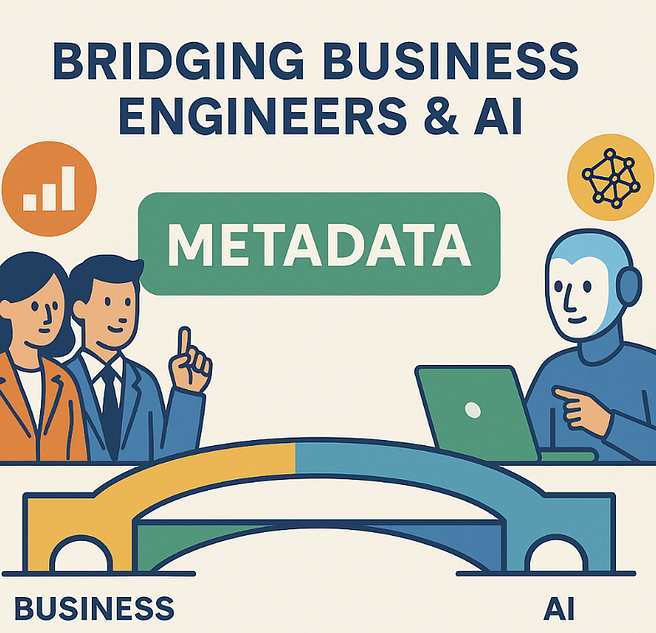
This is modeling as metadata engineering — a discipline where business, engineers, and AI share a common language.
4️⃣ From Static Models to Living Metadata
In this new landscape, the model is no longer an artifact — it’s a living system.
🔹Each conceptual definition connects to logical design and physical implementation through lineage and rules.
🔹Validation happens automatically.
🔹Visualizations update instantly.
🔹AI copilots translate natural language into structure and vice versa.
We’re moving from:
Static diagrams → executable metadata → self-documenting ecosystems.
5️⃣ The Road Ahead
The most encouraging outcome of this dialogue is that vendors and practitioners are finally aligned. Modern tools like SqlDBM, Ellie.ai, CrossModel, and open metadata frameworks are converging on the same goal:
To make modeling accessible, integrated, and intelligent — without losing its rigor.
The next decade of modeling won’t be about choosing between tools or code. It will be about creating a shared, versioned, AI-aware metadata layer that connects people, platforms, and purpose.
📚 Related Reads
📖 Are Legacy Data Modeling Tools Catching Up to Metadata-as-Code?
💡 Legacy modeling tools are modernizing fast — but can they really compete with open, Git-native, AI-assisted metadata ecosystems?
📖 Collaborative Data Modeling in VS Code — Bridging Modelers and Engineers through Metadata
A modern metadata-driven development workflow where data modelers define logic and semantics declaratively, while data engineers operationalize these definitions in SQL and Jinja macros. Powered by VS Code, JSON validation, and language-server intelligence, this approach unites modeling and engineering into a single semantic DevOps loop.
📖 Do We Still Need Traditional Data Modeling Tools?
Why VS Code, Python, AI, and Git-based metadata workflows might replace PowerDesigner, ERwin, and ER/Studio — and how we can scale this approach across conceptual, logical, and physical models.
📖 Beyond Legacy Modeling: Tools or VSCode + GenAI?
Are platforms like WhereScape, VaultSpeed, COALESCE, and SqlDBM still the right successors to PowerDesigner and erwin — or can we move to a VSCode-based, GenAI-powered modeling practice
📖 Beyond PowerDesigner: Migration Strategies and Modern Alternatives for Metadata-Driven Data Engineering
SAP PowerDesigner is reaching its End-of-Life in 2027. What should organizations do to safeguard their modelling assets, and what alternatives exist in today’s metadata-driven landscape?
📖 CrossModel Meets Model-Driven Data Engineering: A Modern Fit for Business-Friendly Mapping
How CrossModel can enhance metadata-as-data, historization, and business-friendly mapping by integrating with DuckDB, Python, and Notion.