Turning metadata and AI into an intelligent data quality framework for Databricks and Snowflake
Summary
Traditional data quality frameworks rely on static, manually defined rules.
In modern data platforms like Azure Databricks and Snowflake, that approach doesn’t scale.By combining metadata-driven rule templates with GenAI-assisted reasoning, we can automatically detect, explain, and even propose fixes for data quality and plausibility issues — across ingestion, transformation, and reporting layers.
This article explores how AI can extend your metadata foundation into a self-learning data quality system.

The problem: static rules in a dynamic world
Most data quality frameworks start well — a few simple checks like:
amount > 0order_date <= current_datecustomer_id IS NOT NULL
But after a few months, rule lists explode into the hundreds, hardcoded in YAML or SQL. Maintaining them across multiple systems becomes a full-time job. Worse, these rules rarely evolve with the data itself.
The question is:
Can we let the data — and its metadata — suggest the right quality checks automatically?
The evolution: from data rules to data intelligence
Metadata is already a powerful source of truth. It describes schemas, relationships, valid domains, and historical behavior. With GenAI layered on top, we can move from reactive to adaptive quality management:

The end goal: continuous plausibility checking that evolves with your data.
Architecture: metadata + GenAI + observability
The modern data quality pipeline for Databricks and Snowflake can be visualized as:
Metadata → Rule Templates → Data Quality Engine → Observability Layer → ROI Dashboard
↑ ↑ ↑ ↑
| | | |
GenAI Reasoning <—–> Historical Metrics <—–> Business Glossary
Each component plays a role:
- Metadata — schemas, lineage, and constraints stored in DuckDB or Unity Catalog.
- Rule Templates — declarative patterns (e.g., “no nulls,” “within domain,” “monotonic increase”).
- Data Quality Engine — runs SQL- or Spark-based validations.
- Observability Layer — stores metrics and detects drifts or anomalies.
- GenAI Layer — learns from historical results, proposes new rules, and explains anomalies in plain language.
Example: metadata-driven rule template
Here’s a simple YAML-style definition:
rules:
– id: R001
table: orders
column: amount
template: “value > 0”
severity: high
description: “Amount must be positive”
– id: R002
table: orders
column: order_date
template: “value <= current_date()”
severity: medium
description: “No future order dates”
GenAI can expand this template dynamically, based on data profiling and lineage.
For example:
- It might notice that
amountis always rounded to two decimals and add a precision rule. - Or that
order_dateclusters by weekday, suggesting a temporal plausibility check.
Example: AI-generated plausibility checks
Based on metadata and historical data samples, GenAI could generate:
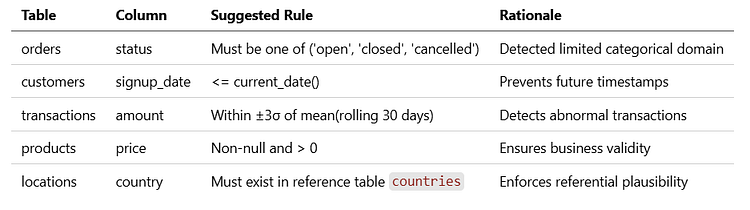
Each rule is explainable, traceable, and linked to the metadata graph.
Example: integrating with Databricks and Snowflake
The same framework can execute checks in both environments:
Databricks (Spark SQL)
SELECT COUNT(*) AS invalid_records
FROM orders
WHERE amount <= 0 OR order_date > current_date();
Snowflake
SELECT COUNT(*) AS invalid_records
FROM orders
WHERE IFNULL(amount,0) <= 0 OR order_date > CURRENT_DATE();
Results are published to a quality dashboard — showing metrics, trends, and ROI impact (e.g., “95% reduction in bad records since last quarter”).
GenAI’s role in continuous learning
Once the framework is running, GenAI can:
- Scan metadata for undocumented columns or inconsistent naming.
- Profile data distributions and suggest outlier thresholds.
- Interpret trends (“The increase in nulls started after version 3.2 of the ETL job”).
- Explain findings in business language.
- Propose remediations (“Add a constraint or validation rule in pipeline X”).
Over time, it learns which rules matter most — building an adaptive data quality knowledge base.
Example of an AI-generated insight
“Column
_order_date_in_orders_shows 12% future timestamps in the last 7 days.
This deviates from the historical pattern (<0.1%).
Possible causes: upstream timezone change, ingestion timestamp mismatch, or transformation order inversion.”
This type of natural language observability helps teams focus immediately on the root cause.
Closing the loop: observability → improvement
Every quality metric feeds back into the metadata model, creating a virtuous cycle:
- Detect — identify anomalies in real time.
- Diagnose — GenAI explains potential causes.
- Decide — teams approve or dismiss rules.
- Deploy — new rules are added automatically to the metadata catalog.
The result: a continuously improving, self-documenting data quality system.
Key Takeaways
✅ Metadata-driven templates turn rules into reusable assets.
✅ GenAI can propose, explain, and prioritize quality checks automatically.
✅ Observability transforms data quality from reactive to proactive.
✅ Cloud-native engines (Databricks, Snowflake) provide the ideal runtime foundation.
✅ The result is a self-learning, explainable data quality ecosystem.
Why this matters
Data quality is no longer about counting nulls. It’s about maintaining trust, transparency, and adaptability across modern data platforms.
By embedding GenAI into your metadata and observability stack, data quality becomes an intelligent, evolving capability — not a static checklist.
🧩 Related articles
- Metadata-Driven SQL Optimization and Migration
- Testing Query Migrations Using Synthetic Data
- Validating SQL Query Equivalence with Python & GenAI